

Chapter 5. SPATIALLY-COHERENT STRUCTURES
background mixed layer. The crests are spaced by ~40 min apart (when
interpolated to a fixed position of the ship).
The packet passage occurred several hours after the internal tide
elevation of the thermocline reached maximum around 0800 UTC. The
currents in the upper ocean (0–80 m) continued to be directed toward the
southwest for several hours following the first soliton, reversing to a
northwest flow only after passage of the third soliton.
According to Pinkel (2000), the intrinsic shear associated with solibores
is not sufficient to trigger Kelvin-Helmholtz instability in a quiescent
background. The minimum Richardson number remained relatively large
(above 15). Solibores, however, may trigger instability of the background
shear in an environment with gradient Richardson number not much larger
than ¼ and can result in the thermohaline fluxes through the bottom of the
mixed layer.
The rapid development of high-frequency internal waves on the
equatorial shear has also been observed in association with the nocturnal
convection in the eastern equatorial Pacific (Mack and Hebert, 1997).
Nocturnal convection can also trigger packets of strongly nonlinear internal
waves on the shear associated with the diurnal jet (see Section 5.5).
Mathematical modeling of the response of the mixed layer to the soliton
forcing is complicated by the difficulty in solving the resulting nonlinear
equations in the presence of vertical shear, which is ubiquitous in the upper
ocean environment. As a result, the induced dynamic instability in a nearly
critical background flow is still largely unexplored (Sandstrom and Oakey
1995).
5.3.4 Atmospheric buoyancy forcing
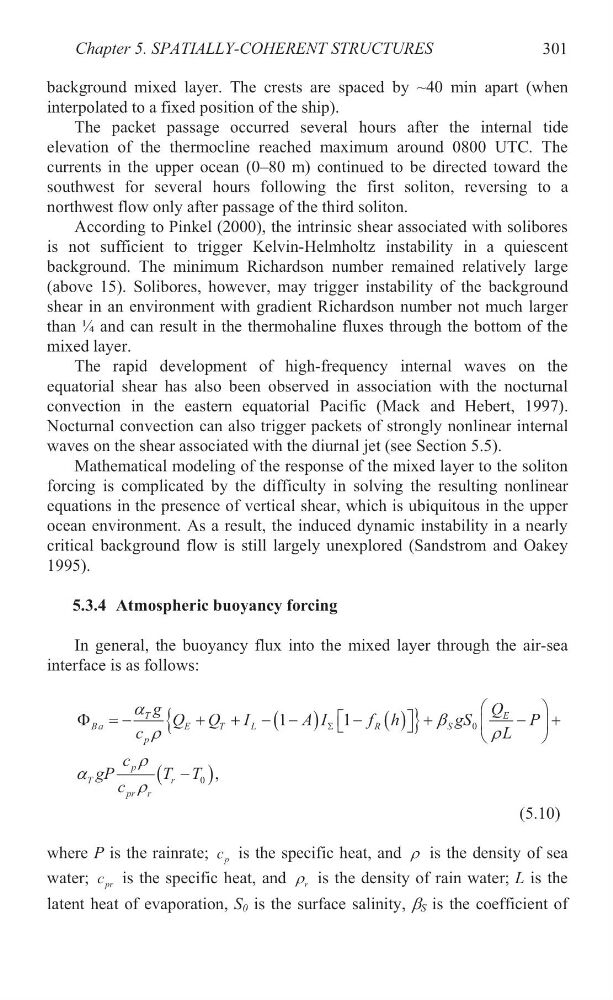
In general, the buoyancy flux into the mixed layer through the air-sea
interface is as follows:
^
`
0
0
1
1
,
T
E
Ba
E
T
L
R
S
p
p
T
r
pr r
g
Q
Q Q I
A I
f h
gS
P
c
L
c
gP
T T
c
D
E
U
U
U
D
U
6
§
·
ª
º
)
¨
¸
¬
¼
©
¹
(5.10)
where P is the rainrate; p
c is the specific heat, and U is the density of sea
water; pr
c is the specific heat, and r
U is the density of rain water; L is the
latent heat of evaporation, S 0 is the surface salinity, E S is the coefficient of
301
background mixed layer. The crests are spaced by ~40 min apart (when
interpolated to a fixed position of the ship).
The packet passage occurred several hours after the internal tide
elevation of the thermocline reached maximum around 0800 UTC. The
currents in the upper ocean (0–80 m) continued to be directed toward the
southwest for several hours following the first soliton, reversing to a
northwest flow only after passage of the third soliton.
According to Pinkel (2000), the intrinsic shear associated with solibores
is not sufficient to trigger Kelvin-Helmholtz instability in a quiescent
background. The minimum Richardson number remained relatively large
(above 15). Solibores, however, may trigger instability of the background
shear in an environment with gradient Richardson number not much larger
than ¼ and can result in the thermohaline fluxes through the bottom of the
mixed layer.
The rapid development of high-frequency internal waves on the
equatorial shear has also been observed in association with the nocturnal
convection in the eastern equatorial Pacific (Mack and Hebert, 1997).
Nocturnal convection can also trigger packets of strongly nonlinear internal
waves on the shear associated with the diurnal jet (see Section 5.5).
Mathematical modeling of the response of the mixed layer to the soliton
forcing is complicated by the difficulty in solving the resulting nonlinear
equations in the presence of vertical shear, which is ubiquitous in the upper
ocean environment. As a result, the induced dynamic instability in a nearly
critical background flow is still largely unexplored (Sandstrom and Oakey
1995).
5.3.4 Atmospheric buoyancy forcing
In general, the buoyancy flux into the mixed layer through the air-sea
interface is as follows:
^
`
0
0
1
1
,
T
E
Ba
E
T
L
R
S
p
p
T
r
pr r
g
Q
Q Q I
A I
f h
gS
P
c
L
c
gP
T T
c
D
E
U
U
U
D
U
6
§
·
ª
º
)
¨
¸
¬
¼
©
¹
(5.10)
where P is the rainrate; p
c is the specific heat, and U is the density of sea
water; pr
c is the specific heat, and r
U is the density of rain water; L is the
latent heat of evaporation, S 0 is the surface salinity, E S is the coefficient of
301