

Chapter 5. SPATIALLY-COHERENT STRUCTURES
For
4
10
4
!
k
m
-1 , which corresponds to wavelengths
16
O
km, the
experimental spectrum switches to a k
-3 dependence. In this subrange, the
experimental spectrum is not consistent with the theory of Batchelor (1969)
and Kraichnan (1975). An explanation is that for submesoscales density can
no longer be treated as a passive tracer.
The equatorial baroclinic Rossby radius for the density anomalies within
the mixed layer of the warm pool area, L E , is of the order of 10-20 km.
Rotation effects therefore are not expected to be of primary importance on
scales smaller than 10 km
5.3.2 Nonlinear advection-diffusion model
The process of puddle evolution is associated with vertical shearing,
which involves Taylor’s shear dispersion mechanism and nonlinear
dynamics. Ferrari and Young (1997; hereafter FY97) and Ferrari et al.
(2001) considered a non-rotating stratified fluid and developed a model for
nonlinear horizontal diffusion. They used the Boussinesq approximation and
a linear equation of state for seawater to derive the following system of
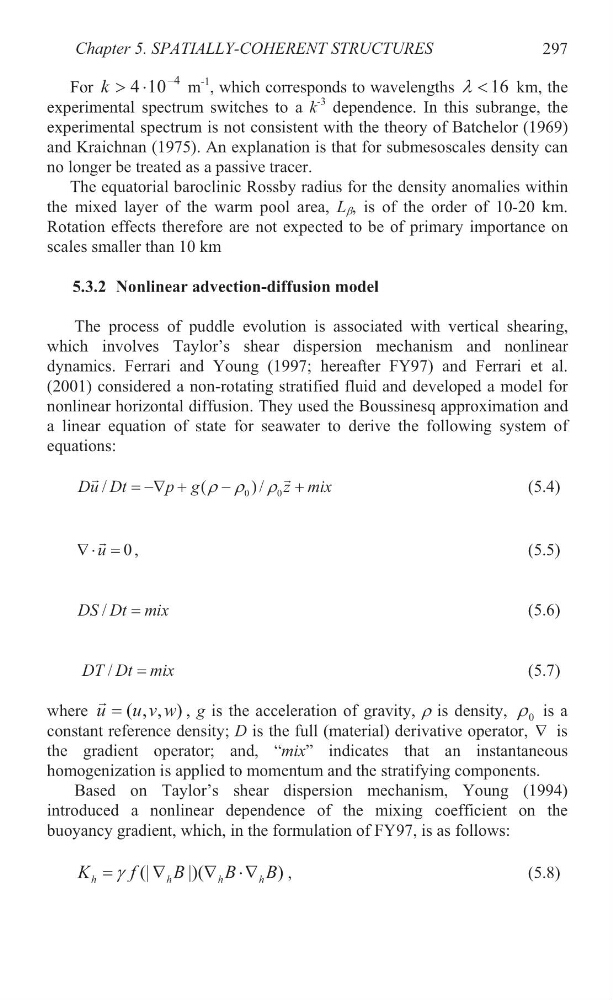
equations:
0
0
/
(
) /
Du Dt
p g
z mix
U U U
G
G
(5.4)
0
u
G
,
(5.5)
/
DS Dt mix
(5.6)
/
DT Dt mix
(5.7)
where
)
,
,
(
w
v
u
u
G
, g is the acceleration of gravity, U is density, 0
U is a
constant reference density; D is the full (material) derivative operator, is
the gradient operator; and, “mix” indicates that an instantaneous
homogenization is applied to momentum and the stratifying components.
Based on Taylor’s shear dispersion mechanism, Young (1994)
introduced a nonlinear dependence of the mixing coefficient on the
buoyancy gradient, which, in the formulation of FY97, is as follows:
(|
|)(
)
h
h
h
h
K
f
B
B
B
J
,
(5.8)
297
For
4
10
4
!
k
m
-1 , which corresponds to wavelengths
16
O
km, the
experimental spectrum switches to a k
-3 dependence. In this subrange, the
experimental spectrum is not consistent with the theory of Batchelor (1969)
and Kraichnan (1975). An explanation is that for submesoscales density can
no longer be treated as a passive tracer.
The equatorial baroclinic Rossby radius for the density anomalies within
the mixed layer of the warm pool area, L E , is of the order of 10-20 km.
Rotation effects therefore are not expected to be of primary importance on
scales smaller than 10 km
5.3.2 Nonlinear advection-diffusion model
The process of puddle evolution is associated with vertical shearing,
which involves Taylor’s shear dispersion mechanism and nonlinear
dynamics. Ferrari and Young (1997; hereafter FY97) and Ferrari et al.
(2001) considered a non-rotating stratified fluid and developed a model for
nonlinear horizontal diffusion. They used the Boussinesq approximation and
a linear equation of state for seawater to derive the following system of
equations:
0
0
/
(
) /
Du Dt
p g
z mix
U U U
G
G
(5.4)
0
u
G
,
(5.5)
/
DS Dt mix
(5.6)
/
DT Dt mix
(5.7)
where
)
,
,
(
w
v
u
u
G
, g is the acceleration of gravity, U is density, 0
U is a
constant reference density; D is the full (material) derivative operator, is
the gradient operator; and, “mix” indicates that an instantaneous
homogenization is applied to momentum and the stratifying components.
Based on Taylor’s shear dispersion mechanism, Young (1994)
introduced a nonlinear dependence of the mixing coefficient on the
buoyancy gradient, which, in the formulation of FY97, is as follows:
(|
|)(
)
h
h
h
h
K
f
B
B
B
J
,
(5.8)
297