

THE NEAR-SURFACE LAYER OF THE OCEAN
Figure 5-6. Cartoon of ocean spiral generation. An initial horizontal density gradient (cold to
the north) in a mixed upper layer is portrayed by the central isopycnal (blue) and the two
frontal isopycnals (red). With increasing time t, the isopycnals move together, tilt towards the
north, translate northward and eventually converge at the surface on the positive frontal
isopycnal. A developing eastward jet turns increasingly asymmetric, with strong cyclonic
shear (large positive Rossby numbers) to the north and weak anticyclonic shear to the south.
A downward tongue under the “north wall” and upwelling to the south modify the depth of
the mixed layer. The Rossby number along the north wall increases rapidly from +1 to +3
between the times t = 2.5 and 2.75, when critical vertical shear develops near the surface.
Horizontal shear instability develops along the north wall for Ro > 1, with an intensifying
cat’s-eye flow pattern characterized by nondimensional parameter a (see Stuart, 1967 for
details). Ambient surfactants are compressed and aligned along the north wall, and wound
into cyclonic spirals. (After Munk and Armi, 2001.)
294
Figure 5-5. Spirals on the ocean surface from the collection of NASA images (http://disc.gsfc.
nasa.gov/oceancolor/shuttle_oceanography_web/oss_160.shtml).
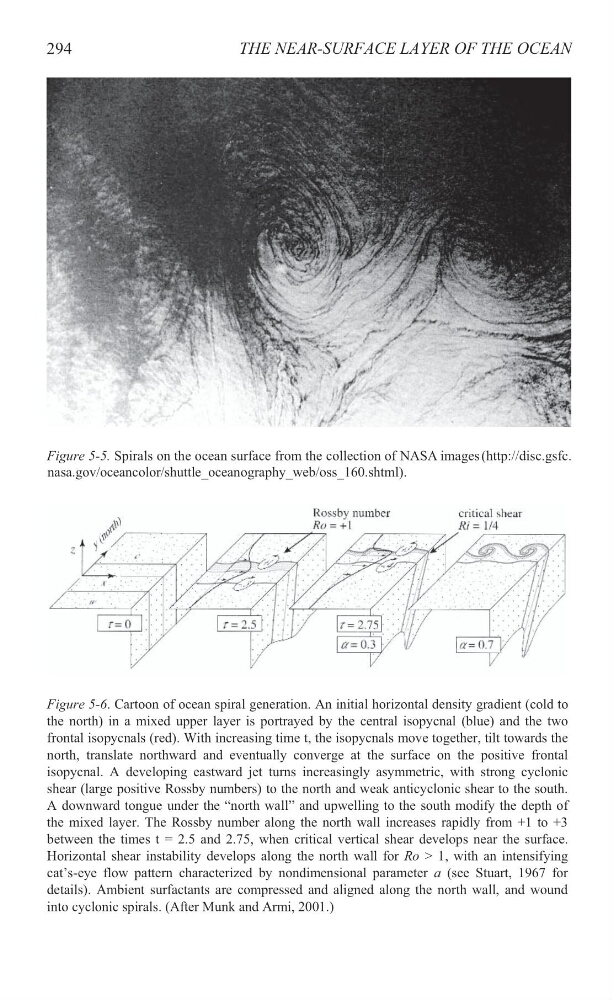
Figure 5-6. Cartoon of ocean spiral generation. An initial horizontal density gradient (cold to
the north) in a mixed upper layer is portrayed by the central isopycnal (blue) and the two
frontal isopycnals (red). With increasing time t, the isopycnals move together, tilt towards the
north, translate northward and eventually converge at the surface on the positive frontal
isopycnal. A developing eastward jet turns increasingly asymmetric, with strong cyclonic
shear (large positive Rossby numbers) to the north and weak anticyclonic shear to the south.
A downward tongue under the “north wall” and upwelling to the south modify the depth of
the mixed layer. The Rossby number along the north wall increases rapidly from +1 to +3
between the times t = 2.5 and 2.75, when critical vertical shear develops near the surface.
Horizontal shear instability develops along the north wall for Ro > 1, with an intensifying
cat’s-eye flow pattern characterized by nondimensional parameter a (see Stuart, 1967 for
details). Ambient surfactants are compressed and aligned along the north wall, and wound
into cyclonic spirals. (After Munk and Armi, 2001.)
294
Figure 5-5. Spirals on the ocean surface from the collection of NASA images (http://disc.gsfc.
nasa.gov/oceancolor/shuttle_oceanography_web/oss_160.shtml).