

Chapter 5. SPATIALLY-COHERENT STRUCTURES
2
;
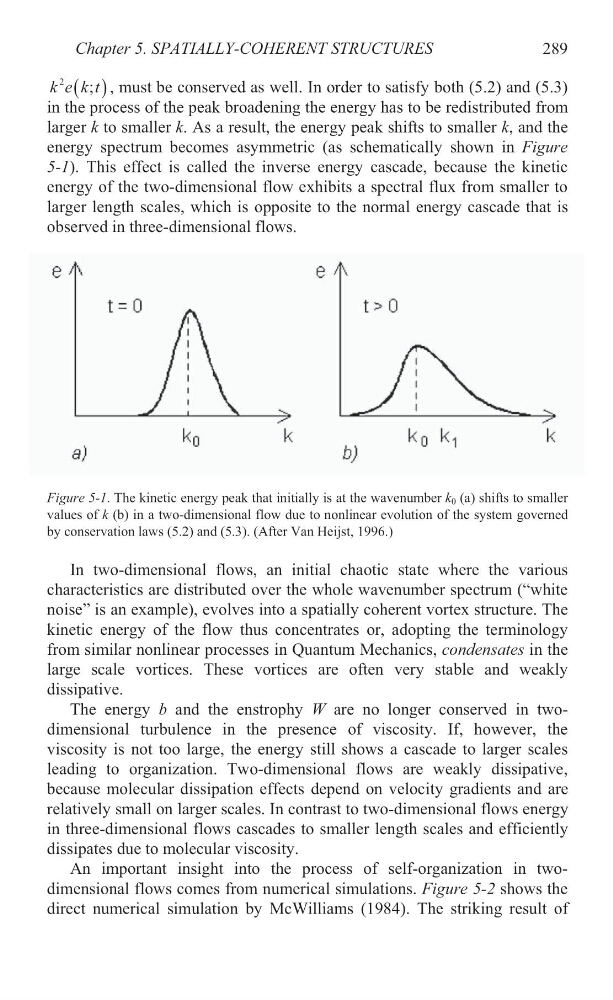
k e k t , must be conserved as well. In order to satisfy both (5.2) and (5.3)
in the process of the peak broadening the energy has to be redistributed from
larger k to smaller k. As a result, the energy peak shifts to smaller k, and the
energy spectrum becomes asymmetric (as schematically shown in Figure
5-1). This effect is called the inverse energy cascade, because the kinetic
energy of the two-dimensional flow exhibits a spectral flux from smaller to
larger length scales, which is opposite to the normal energy cascade that is
observed in three-dimensional flows.
Figure 5-1. The kinetic energy peak that initially is at the wavenumber k 0 (a) shifts to smaller
values of k (b) in a two-dimensional flow due to nonlinear evolution of the system governed
In two-dimensional flows, an initial chaotic state where the various
characteristics are distributed over the whole wavenumber spectrum (“white
noise” is an example), evolves into a spatially coherent vortex structure. The
kinetic energy of the flow thus concentrates or, adopting the terminology
from similar nonlinear processes in Quantum Mechanics, condensates in the
large scale vortices. These vortices are often very stable and weakly
dissipative.
The energy b and the enstrophy W are no longer conserved in twodimensional turbulence in the presence of viscosity. If, however, the
viscosity is not too large, the energy still shows a cascade to larger scales
leading to organization. Two-dimensional flows are weakly dissipative,
because molecular dissipation effects depend on velocity gradients and are
relatively small on larger scales. In contrast to two-dimensional flows energy
in three-dimensional flows cascades to smaller length scales and efficiently
dissipates due to molecular viscosity.
An important insight into the process of self-organization in twodimensional flows comes from numerical simulations. Figure 5-2 shows the
direct numerical simulation by McWilliams (1984). The striking result of
289
by conservation laws (5.2) and (5.3). (After Van Heijst, 1996.)
2
;
k e k t , must be conserved as well. In order to satisfy both (5.2) and (5.3)
in the process of the peak broadening the energy has to be redistributed from
larger k to smaller k. As a result, the energy peak shifts to smaller k, and the
energy spectrum becomes asymmetric (as schematically shown in Figure
5-1). This effect is called the inverse energy cascade, because the kinetic
energy of the two-dimensional flow exhibits a spectral flux from smaller to
larger length scales, which is opposite to the normal energy cascade that is
observed in three-dimensional flows.
Figure 5-1. The kinetic energy peak that initially is at the wavenumber k 0 (a) shifts to smaller
values of k (b) in a two-dimensional flow due to nonlinear evolution of the system governed
In two-dimensional flows, an initial chaotic state where the various
characteristics are distributed over the whole wavenumber spectrum (“white
noise” is an example), evolves into a spatially coherent vortex structure. The
kinetic energy of the flow thus concentrates or, adopting the terminology
from similar nonlinear processes in Quantum Mechanics, condensates in the
large scale vortices. These vortices are often very stable and weakly
dissipative.
The energy b and the enstrophy W are no longer conserved in twodimensional turbulence in the presence of viscosity. If, however, the
viscosity is not too large, the energy still shows a cascade to larger scales
leading to organization. Two-dimensional flows are weakly dissipative,
because molecular dissipation effects depend on velocity gradients and are
relatively small on larger scales. In contrast to two-dimensional flows energy
in three-dimensional flows cascades to smaller length scales and efficiently
dissipates due to molecular viscosity.
An important insight into the process of self-organization in twodimensional flows comes from numerical simulations. Figure 5-2 shows the
direct numerical simulation by McWilliams (1984). The striking result of
289
by conservation laws (5.2) and (5.3). (After Van Heijst, 1996.)