

Chapter 1: INTRODUCTION
Chapter 2 of this monograph in relation to the microlayer and in Chapter 4 in
relation to diurnal warming and precipitation effects.
Due to generation and subsequent evaporation of spray droplets, salt
crystals are transported into the atmosphere (see Chapter 6); however, no
significant mass of salt actually crosses the air-sea interface. Although this
amount of salt is unimportant from a salt balance point of view, the salt
crystals left behind by evaporating spray play a role in the radiation balance
and in cloud microphysics as condensation nuclei.
Fluxes of momentum, heat, and moisture at the air-sea interface can be
estimated from covariance and inertial-dissipation measurements in the
atmospheric boundary layer. However, such direct flux measurements are a
rather complicated experimental task, which is only performed during
specialized field campaigns. For many practical purposes, the fluxes at the
air-sea interface can be linked to the properties of the bulk of the atmosphere
and ocean and the properties of the interface.
The balance of forces that act upon the air-sea interface constitutes the
dynamic boundary condition in the potential theory of surface waves. This
boundary condition is discussed in Section 1.6.1.
1.3.2 Bulk-flux formulation
The turbulent flux of property x
is parameterized in bulk-flux
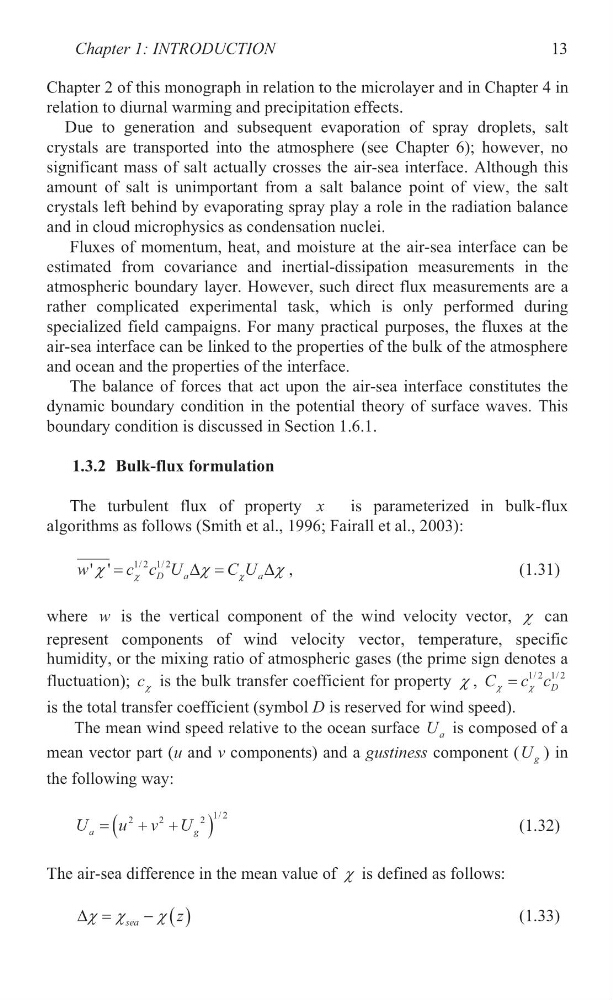
algorithms as follows (Smith et al., 1996; Fairall et al., 2003):
1/ 2 1/ 2
' '
D
a
a
w
c c U
C U
F
F
F
F
F
'
' ,
(1.31)
where w is the vertical component of the wind velocity vector, F can
represent components of wind velocity vector, temperature, specific
humidity, or the mixing ratio of atmospheric gases (the prime sign denotes a
fluctuation); c F is the bulk transfer coefficient for property F ,
1/ 2 1/ 2
D
C c c
F
F
is the total transfer coefficient (symbol D is reserved for wind speed).
The mean wind speed relative to the ocean surface a
U is composed of a
mean vector part (u and v components) and a gustiness component ( g
U ) in
the following way:
1/ 2
2
2
2
a
g
U
u v U
(1.32)
The air-sea difference in the mean value of F is defined as follows:
sea
z
F F
F
'
(1.33)
13
Chapter 2 of this monograph in relation to the microlayer and in Chapter 4 in
relation to diurnal warming and precipitation effects.
Due to generation and subsequent evaporation of spray droplets, salt
crystals are transported into the atmosphere (see Chapter 6); however, no
significant mass of salt actually crosses the air-sea interface. Although this
amount of salt is unimportant from a salt balance point of view, the salt
crystals left behind by evaporating spray play a role in the radiation balance
and in cloud microphysics as condensation nuclei.
Fluxes of momentum, heat, and moisture at the air-sea interface can be
estimated from covariance and inertial-dissipation measurements in the
atmospheric boundary layer. However, such direct flux measurements are a
rather complicated experimental task, which is only performed during
specialized field campaigns. For many practical purposes, the fluxes at the
air-sea interface can be linked to the properties of the bulk of the atmosphere
and ocean and the properties of the interface.
The balance of forces that act upon the air-sea interface constitutes the
dynamic boundary condition in the potential theory of surface waves. This
boundary condition is discussed in Section 1.6.1.
1.3.2 Bulk-flux formulation
The turbulent flux of property x
is parameterized in bulk-flux
algorithms as follows (Smith et al., 1996; Fairall et al., 2003):
1/ 2 1/ 2
' '
D
a
a
w
c c U
C U
F
F
F
F
F
'
' ,
(1.31)
where w is the vertical component of the wind velocity vector, F can
represent components of wind velocity vector, temperature, specific
humidity, or the mixing ratio of atmospheric gases (the prime sign denotes a
fluctuation); c F is the bulk transfer coefficient for property F ,
1/ 2 1/ 2
D
C c c
F
F
is the total transfer coefficient (symbol D is reserved for wind speed).
The mean wind speed relative to the ocean surface a
U is composed of a
mean vector part (u and v components) and a gustiness component ( g
U ) in
the following way:
1/ 2
2
2
2
a
g
U
u v U
(1.32)
The air-sea difference in the mean value of F is defined as follows:
sea
z
F F
F
'
(1.33)
13