

THE NEAR-SURFACE LAYER OF THE OCEAN
features in the diurnal thermocline. They are presumably associated with
overturning events, which are often observed in the diurnal thermocline
during the deepening stage.
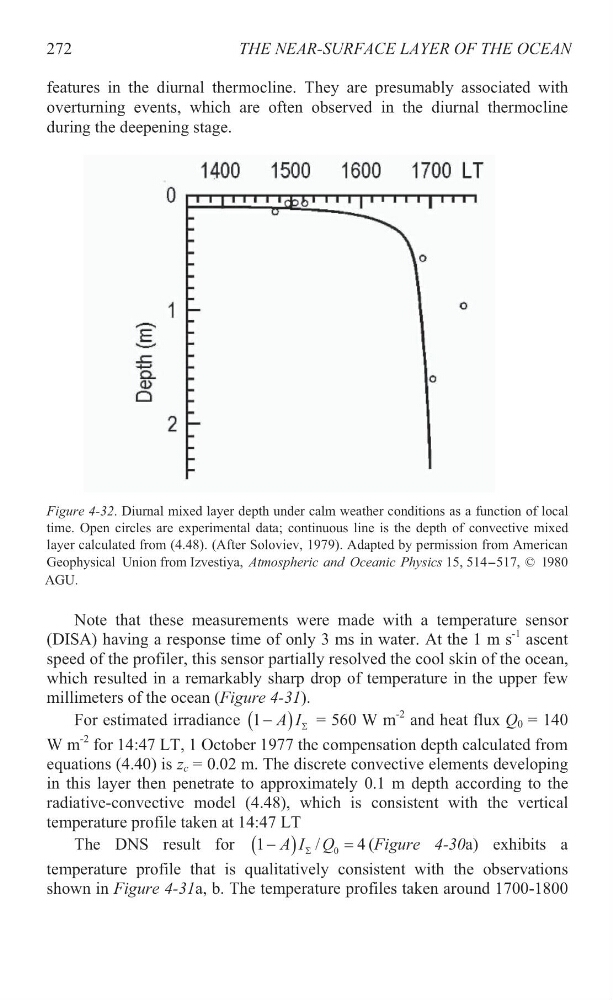
Figure 4-32. Diurnal mixed layer depth under calm weather conditions as a function of local
time. Open circles are experimental data; continuous line is the depth of convective mixed
X
X
Note that these measurements were made with a temperature sensor
(DISA) having a response time of only 3 ms in water. At the 1 m sP
-1
P
ascent
speed of the profiler, this sensor partially resolved the cool skin of the ocean,
which resulted in a remarkably sharp drop of temperature in the upper few
millimeters of the ocean (X Figure 4-31X ).
For estimated irradiance
1 A I 6
= 560 W mP
-2
P
and heat flux QB 0 B = 140
W mP
-2
P
for 14:47 LT, 1 October 1977 the compensation depth calculated from
equations X (4.40)X is zB c B = 0.02 m. The discrete convective elements developing
in this layer then penetrate to approximately 0.1 m depth according to the
radiative-convective model X (4.48)X , which is consistent with the vertical
temperature profile taken at 14:47 LT
The DNS result for
0
1
/
4
A I Q
6
(X Figure 4-30X a) exhibits a
temperature profile that is qualitatively consistent with the observations
shown in X Figure 4-31a, bX . The temperature profiles taken around 1700-1800
272
layer calculated from (4.48). (After Soloviev, 1979). Adapted by permission from American
©
Geophysical Union from Izvestiya, Atmospheric and Oceanic Physics 15, 514-517,
1980
AGU.
features in the diurnal thermocline. They are presumably associated with
overturning events, which are often observed in the diurnal thermocline
during the deepening stage.
Figure 4-32. Diurnal mixed layer depth under calm weather conditions as a function of local
time. Open circles are experimental data; continuous line is the depth of convective mixed
X
X
Note that these measurements were made with a temperature sensor
(DISA) having a response time of only 3 ms in water. At the 1 m sP
-1
P
ascent
speed of the profiler, this sensor partially resolved the cool skin of the ocean,
which resulted in a remarkably sharp drop of temperature in the upper few
millimeters of the ocean (X Figure 4-31X ).
For estimated irradiance
1 A I 6
= 560 W mP
-2
P
and heat flux QB 0 B = 140
W mP
-2
P
for 14:47 LT, 1 October 1977 the compensation depth calculated from
equations X (4.40)X is zB c B = 0.02 m. The discrete convective elements developing
in this layer then penetrate to approximately 0.1 m depth according to the
radiative-convective model X (4.48)X , which is consistent with the vertical
temperature profile taken at 14:47 LT
The DNS result for
0
1
/
4
A I Q
6
(X Figure 4-30X a) exhibits a
temperature profile that is qualitatively consistent with the observations
shown in X Figure 4-31a, bX . The temperature profiles taken around 1700-1800
272
layer calculated from (4.48). (After Soloviev, 1979). Adapted by permission from American
©
Geophysical Union from Izvestiya, Atmospheric and Oceanic Physics 15, 514-517,
1980
AGU.