

THE NEAR-SURFACE LAYER OF THE OCEAN
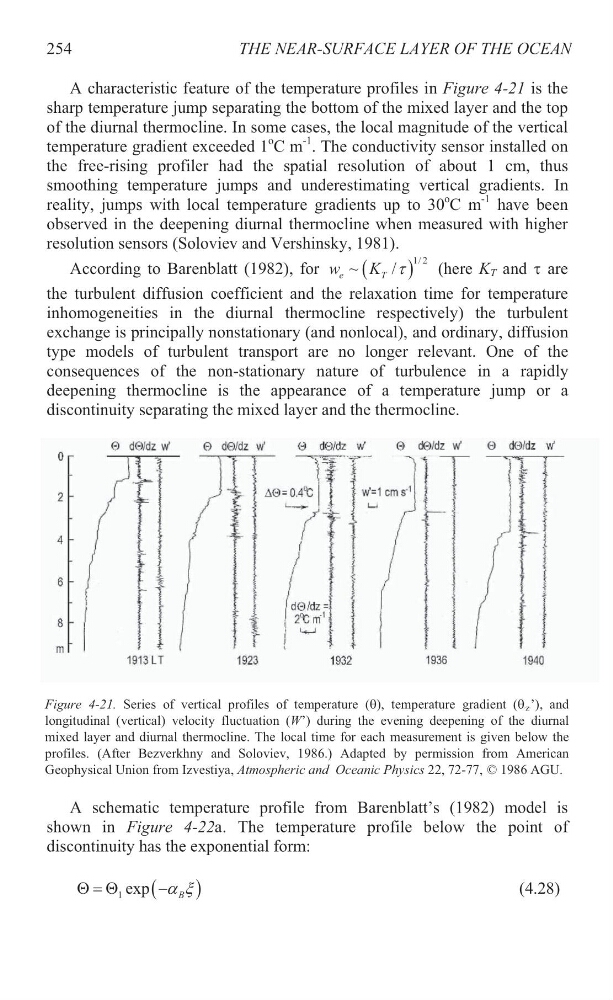
A characteristic feature of the temperature profiles in X Figure 4-21X is the
sharp temperature jump separating the bottom of the mixed layer and the top
of the diurnal thermocline. In some cases, the local magnitude of the vertical
temperature gradient exceeded 1P
o
PC
mP
-1
P.
The conductivity sensor installed on
the free-rising profiler had the spatial resolution of about 1 cm, thus
smoothing temperature jumps and underestimating vertical gradients. In
reality, jumps with local temperature gradients up to 30P
o
PC
mP
-1
P
have been
observed in the deepening diurnal thermocline when measured with higher
resolution sensors (Soloviev and Vershinsky, 1981).
According to Barenblatt (1982), for
1/ 2
~
/
e
T
w
K W
(here KB T B and W are
the turbulent diffusion coefficient and the relaxation time for temperature
inhomogeneities in the diurnal thermocline respectively) the turbulent
exchange is principally nonstationary (and nonlocal), and ordinary, diffusion
type models of turbulent transport are no longer relevant. One of the
consequences of the non-stationary nature of turbulence in a rapidly
deepening thermocline is the appearance of a temperature jump or a
discontinuity separating the mixed layer and the thermocline.
A schematic temperature profile from Barenblatt’s (1982) model is
shown in X Figure 4-22a. The temperature profile below the point of
discontinuity has the exponential form:
1 exp
B
D [
4 4
(4.28)
254
z B’), and
longitudinal (vertical) velocity fluctuation (W’) during the evening deepening of the diurnal
mixed layer and diurnal thermocline. The local time for each measurement is given below the
profiles. (After Bezverkhny and Soloviev, 1986.) Adapted by permission from American
Geophysical Union from Izvestiya, Atmospheric and Oceanic Physics 22, 72-77, © 1986 AGU.
Figure 4-21. Series of vertical profiles of temperature (T), temperature gradient (TB
A characteristic feature of the temperature profiles in X Figure 4-21X is the
sharp temperature jump separating the bottom of the mixed layer and the top
of the diurnal thermocline. In some cases, the local magnitude of the vertical
temperature gradient exceeded 1P
o
PC
mP
-1
P.
The conductivity sensor installed on
the free-rising profiler had the spatial resolution of about 1 cm, thus
smoothing temperature jumps and underestimating vertical gradients. In
reality, jumps with local temperature gradients up to 30P
o
PC
mP
-1
P
have been
observed in the deepening diurnal thermocline when measured with higher
resolution sensors (Soloviev and Vershinsky, 1981).
According to Barenblatt (1982), for
1/ 2
~
/
e
T
w
K W
(here KB T B and W are
the turbulent diffusion coefficient and the relaxation time for temperature
inhomogeneities in the diurnal thermocline respectively) the turbulent
exchange is principally nonstationary (and nonlocal), and ordinary, diffusion
type models of turbulent transport are no longer relevant. One of the
consequences of the non-stationary nature of turbulence in a rapidly
deepening thermocline is the appearance of a temperature jump or a
discontinuity separating the mixed layer and the thermocline.
A schematic temperature profile from Barenblatt’s (1982) model is
shown in X Figure 4-22a. The temperature profile below the point of
discontinuity has the exponential form:
1 exp
B
D [
4 4
(4.28)
254
z B’), and
longitudinal (vertical) velocity fluctuation (W’) during the evening deepening of the diurnal
mixed layer and diurnal thermocline. The local time for each measurement is given below the
profiles. (After Bezverkhny and Soloviev, 1986.) Adapted by permission from American
Geophysical Union from Izvestiya, Atmospheric and Oceanic Physics 22, 72-77, © 1986 AGU.
Figure 4-21. Series of vertical profiles of temperature (T), temperature gradient (TB