

THE NEAR-SURFACE LAYER OF THE OCEAN
H) instability and the resonant interaction between surface and internal
waves.
Billowing due to the K-H instability is probably the most frequent cause
of the observed step-like structures. As already mentioned at the beginning
of this section, the diurnal jet can slip over the underlying water mass with
little turbulent friction due to the stabilizing positive buoyancy flux from the
absorbed solar radiation. When the solar radiation decreases in the evening
(or due to clouds) the balance between turbulence and positive buoyancy
flux is disturbed. As a result, the shear stress at the bottom of the mixed layer
intensifies, which creates favorable conditions for the K-H instability
followed by the overturning events.
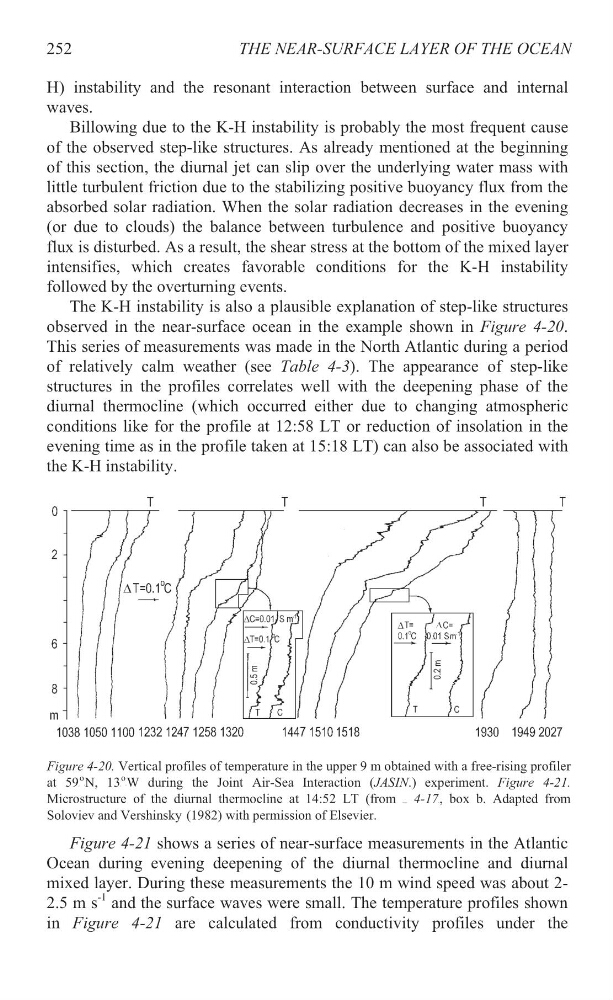
The K-H instability is also a plausible explanation of step-like structures
observed in the near-surface ocean in the example shown in X Figure 4-20X .
This series of measurements was made in the North Atlantic during a period
of relatively calm weather (see Table 4-3). The appearance of step-like
structures in the profiles correlates well with the deepening phase of the
diurnal thermocline (which occurred either due to changing atmospheric
conditions like for the profile at 12:58 LT or reduction of insolation in the
evening time as in the profile taken at 15:18 LT) can also be associated with
the K-H instability.
X Figure 4-21 shows a series of near-surface measurements in the Atlantic
Ocean during evening deepening of the diurnal thermocline and diurnal
mixed layer. During these measurements the 10 m wind speed was about 22.5 m sP
-1
P
and the surface waves were small. The temperature profiles shown
in X Figure 4-21 are calculated from conductivity profiles under the
252
Figure 4-20. Vertical profiles of temperature in the upper 9 m obtained with a free-rising profiler
at 59P
o
PN,
13P
o
PW
during the Joint Air-Sea Interaction (JASIN.) experiment. Figure 4-21.
Microstructure of the diurnal thermocline at 14:52 LT (from XFigure 4-17X , box b. Adapted from
Soloviev and Vershinsky (1982) with permission of Elsevier.
H) instability and the resonant interaction between surface and internal
waves.
Billowing due to the K-H instability is probably the most frequent cause
of the observed step-like structures. As already mentioned at the beginning
of this section, the diurnal jet can slip over the underlying water mass with
little turbulent friction due to the stabilizing positive buoyancy flux from the
absorbed solar radiation. When the solar radiation decreases in the evening
(or due to clouds) the balance between turbulence and positive buoyancy
flux is disturbed. As a result, the shear stress at the bottom of the mixed layer
intensifies, which creates favorable conditions for the K-H instability
followed by the overturning events.
The K-H instability is also a plausible explanation of step-like structures
observed in the near-surface ocean in the example shown in X Figure 4-20X .
This series of measurements was made in the North Atlantic during a period
of relatively calm weather (see Table 4-3). The appearance of step-like
structures in the profiles correlates well with the deepening phase of the
diurnal thermocline (which occurred either due to changing atmospheric
conditions like for the profile at 12:58 LT or reduction of insolation in the
evening time as in the profile taken at 15:18 LT) can also be associated with
the K-H instability.
X Figure 4-21 shows a series of near-surface measurements in the Atlantic
Ocean during evening deepening of the diurnal thermocline and diurnal
mixed layer. During these measurements the 10 m wind speed was about 22.5 m sP
-1
P
and the surface waves were small. The temperature profiles shown
in X Figure 4-21 are calculated from conductivity profiles under the
252
Figure 4-20. Vertical profiles of temperature in the upper 9 m obtained with a free-rising profiler
at 59P
o
PN,
13P
o
PW
during the Joint Air-Sea Interaction (JASIN.) experiment. Figure 4-21.
Microstructure of the diurnal thermocline at 14:52 LT (from XFigure 4-17X , box b. Adapted from
Soloviev and Vershinsky (1982) with permission of Elsevier.