

Chapter 4: FINE STRUCTURE AND MICROSTRUCTURE
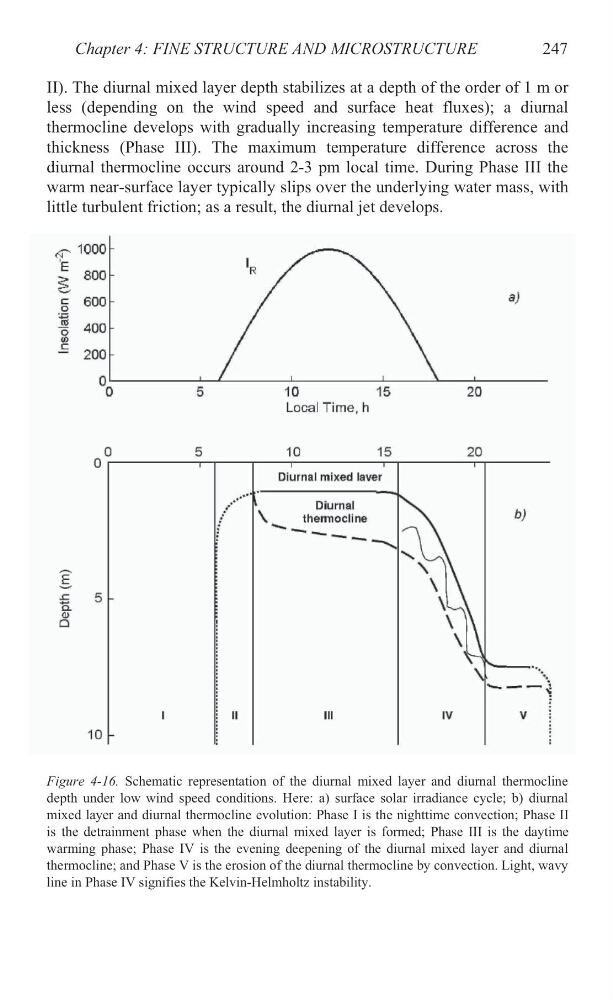
II). The diurnal mixed layer depth stabilizes at a depth of the order of 1 m or
less (depending on the wind speed and surface heat fluxes); a diurnal
thermocline develops with gradually increasing temperature difference and
thickness (Phase III). The maximum temperature difference across the
diurnal thermocline occurs around 2-3 pm local time. During Phase III the
warm near-surface layer typically slips over the underlying water mass, with
little turbulent friction; as a result, the diurnal jet develops.
Figure 4-16. Schematic representation of the diurnal mixed layer and diurnal thermocline
depth under low wind speed conditions. Here: a) surface solar irradiance cycle; b) diurnal
mixed layer and diurnal thermocline evolution: Phase I is the nighttime convection; Phase II
is the detrainment phase when the diurnal mixed layer is formed; Phase III is the daytime
warming phase; Phase IV is the evening deepening of the diurnal mixed layer and diurnal
thermocline; and Phase V is the erosion of the diurnal thermocline by convection. Light, wavy
line in Phase IV signifies the Kelvin-Helmholtz instability.
247
II). The diurnal mixed layer depth stabilizes at a depth of the order of 1 m or
less (depending on the wind speed and surface heat fluxes); a diurnal
thermocline develops with gradually increasing temperature difference and
thickness (Phase III). The maximum temperature difference across the
diurnal thermocline occurs around 2-3 pm local time. During Phase III the
warm near-surface layer typically slips over the underlying water mass, with
little turbulent friction; as a result, the diurnal jet develops.
Figure 4-16. Schematic representation of the diurnal mixed layer and diurnal thermocline
depth under low wind speed conditions. Here: a) surface solar irradiance cycle; b) diurnal
mixed layer and diurnal thermocline evolution: Phase I is the nighttime convection; Phase II
is the detrainment phase when the diurnal mixed layer is formed; Phase III is the daytime
warming phase; Phase IV is the evening deepening of the diurnal mixed layer and diurnal
thermocline; and Phase V is the erosion of the diurnal thermocline by convection. Light, wavy
line in Phase IV signifies the Kelvin-Helmholtz instability.
247