

THE NEAR-SURFACE LAYER OF THE OCEAN
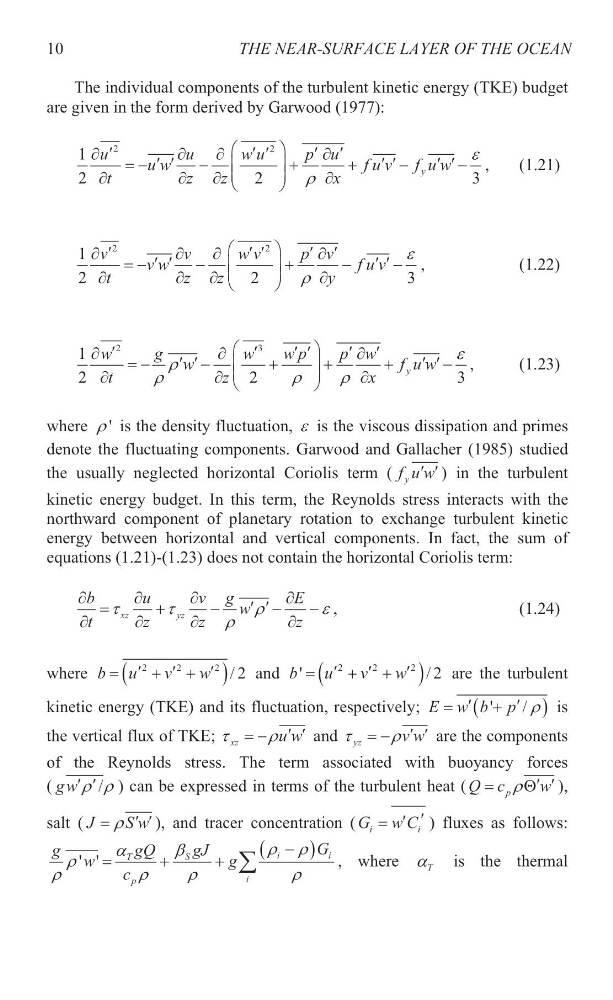
The individual components of the turbulent kinetic energy (TKE) budget
are given in the form derived by Garwood (1977):
2
2
1
2
2
3
y
u
u
wu
p u
u w
f u v f u w
t
z
z
x
H
U
§
·
c
cc
c c
w
w
w
w
c c
c c
c c
¨
¸
¨
¸
w
w
w
w
©
¹
,
(1.21)
2
2
1
2
2
3
v
v
wv
p v
v w
f u v
t
z
z
y
H
U
§
·
c
cc
c c
w
w
w
w
c c
c c
¨
¸
¨
¸
w
w
w
w
©
¹
,
(1.22)
2
3
1
2
2
3
y
w
g
w
wp
p w
w
f u w
t
z
x
H
U
U
U
U
§
·
c
c
cc
c c
w
w
w
c c
c c
¨
¸
¨
¸
w
w
w
©
¹
,
(1.23)
where '
U is the density fluctuation, H is the viscous dissipation and primes
denote the fluctuating components. Garwood and Gallacher (1985) studied
the usually neglected horizontal Coriolis term ( y
f u w
c c ) in the turbulent
kinetic energy budget. In this term, the Reynolds stress interacts with the
northward component of planetary rotation to exchange turbulent kinetic
energy between horizontal and vertical components. In fact, the sum of
equations (1.21)-(1.23) does not contain the horizontal Coriolis term:
xz
yz
b
u
v g
E
w
t
z
z
z
W
W
U
H
U
w
w
w
w
c c
w
w
w
w
,
(1.24)
where
2
2
2 / 2
b u
v
w
c
c
c
and
2
2
2
'
/ 2
b
u
v
w
c
c
c
are the turbulent
kinetic energy (TKE) and its fluctuation, respectively;
'
/
E w b p U
c
c
is
the vertical flux of TKE; xz
u w
W
U c c
and yz
v w
W
U c c
are the components
of the Reynolds stress. The term associated with buoyancy forces
(
/
g w U U
c c ) can be expressed in terms of the turbulent heat (
p
Q c
w
U c c
4 ),
salt ( J
S w
U c c ), and tracer concentration ( i
i
G w C c
c ) fluxes as follows:
' '
i
i
S
T
i
p
G
gJ
gQ
g w
g
c
U U
E
D
U
U
U
U
U
¦
, where
T
D
is the thermal
10
The individual components of the turbulent kinetic energy (TKE) budget
are given in the form derived by Garwood (1977):
2
2
1
2
2
3
y
u
u
wu
p u
u w
f u v f u w
t
z
z
x
H
U
§
·
c
cc
c c
w
w
w
w
c c
c c
c c
¨
¸
¨
¸
w
w
w
w
©
¹
,
(1.21)
2
2
1
2
2
3
v
v
wv
p v
v w
f u v
t
z
z
y
H
U
§
·
c
cc
c c
w
w
w
w
c c
c c
¨
¸
¨
¸
w
w
w
w
©
¹
,
(1.22)
2
3
1
2
2
3
y
w
g
w
wp
p w
w
f u w
t
z
x
H
U
U
U
U
§
·
c
c
cc
c c
w
w
w
c c
c c
¨
¸
¨
¸
w
w
w
©
¹
,
(1.23)
where '
U is the density fluctuation, H is the viscous dissipation and primes
denote the fluctuating components. Garwood and Gallacher (1985) studied
the usually neglected horizontal Coriolis term ( y
f u w
c c ) in the turbulent
kinetic energy budget. In this term, the Reynolds stress interacts with the
northward component of planetary rotation to exchange turbulent kinetic
energy between horizontal and vertical components. In fact, the sum of
equations (1.21)-(1.23) does not contain the horizontal Coriolis term:
xz
yz
b
u
v g
E
w
t
z
z
z
W
W
U
H
U
w
w
w
w
c c
w
w
w
w
,
(1.24)
where
2
2
2 / 2
b u
v
w
c
c
c
and
2
2
2
'
/ 2
b
u
v
w
c
c
c
are the turbulent
kinetic energy (TKE) and its fluctuation, respectively;
'
/
E w b p U
c
c
is
the vertical flux of TKE; xz
u w
W
U c c
and yz
v w
W
U c c
are the components
of the Reynolds stress. The term associated with buoyancy forces
(
/
g w U U
c c ) can be expressed in terms of the turbulent heat (
p
Q c
w
U c c
4 ),
salt ( J
S w
U c c ), and tracer concentration ( i
i
G w C c
c ) fluxes as follows:
' '
i
i
S
T
i
p
G
gJ
gQ
g w
g
c
U U
E
D
U
U
U
U
U
¦
, where
T
D
is the thermal
10