

THE NEAR-SURFACE LAYER OF THE OCEAN
data. Woods and Strass (1986) and Price et al. (1986) described the diurnal
jet developing as a result of diurnal warming. Their studies, however, did not
include conditions of low wind speed when the diurnal thermocline is
localized very near the surface.
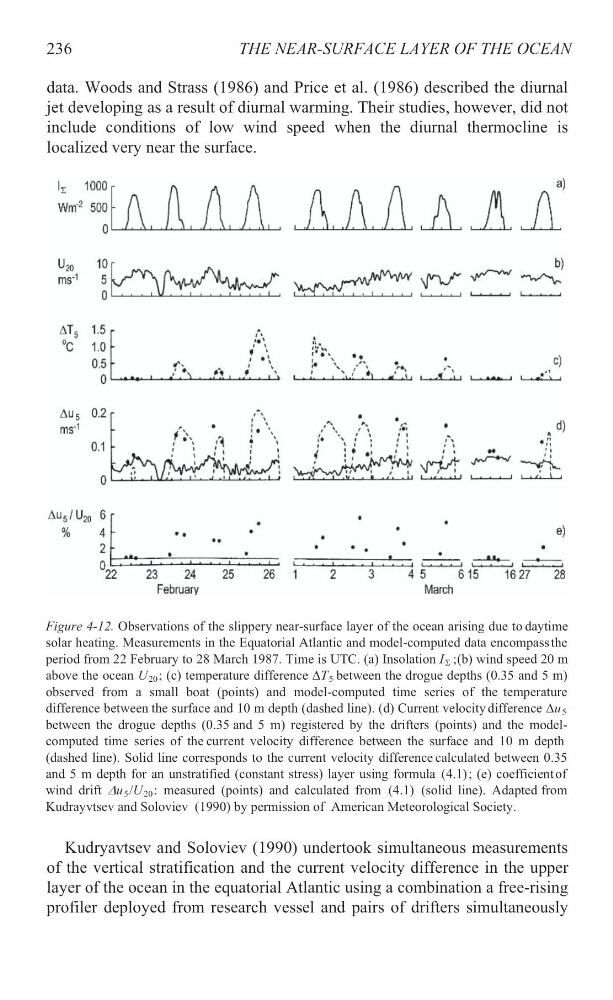
Kudryavtsev and Soloviev (1990) undertook simultaneous measurements
of the vertical stratification and the current velocity difference in the upper
layer of the ocean in the equatorial Atlantic using a combination a free-rising
profiler deployed from research vessel and pairs of drifters simultaneously
236
Figure 4-12. Observations of the slippery near-surface layer of the ocean arising due to daytime
solar heating. Measurements in the Equatorial Atlantic and model-computed data encompass the
period from 22 February to 28 March 1987. Time is UTC. (a) Insolation IB 6 B ; (b) wind speed 20 m
above the ocean UB 20 B; (c) temperature difference 'TB 5 B between the drogue depths (0.35 and 5 m)
observed from a small boat (points) and model-computed time series of the temperature
difference between the surface and 10 m depth (dashed line). (d) Current velocity difference 'uB 5 B
between the drogue depths (0.35 and 5 m) registered by the drifters (points) and the modelcomputed time series of the current velocity difference between the surface and 10 m depth
(dashed line). Solid line corresponds to the current velocity difference calculated between 0.35
and 5 m depth for an unstratified (constant stress) layer using formula X(4.1)X; (e) coefficient of
wind drift 'uB 5 B/UB 20 B: measured (points) and calculated from X(4.1)X (solid line). Adapted from
Kudrayvtsev and Soloviev (1990) by permission of American Meteorological Society.
data. Woods and Strass (1986) and Price et al. (1986) described the diurnal
jet developing as a result of diurnal warming. Their studies, however, did not
include conditions of low wind speed when the diurnal thermocline is
localized very near the surface.
Kudryavtsev and Soloviev (1990) undertook simultaneous measurements
of the vertical stratification and the current velocity difference in the upper
layer of the ocean in the equatorial Atlantic using a combination a free-rising
profiler deployed from research vessel and pairs of drifters simultaneously
236
Figure 4-12. Observations of the slippery near-surface layer of the ocean arising due to daytime
solar heating. Measurements in the Equatorial Atlantic and model-computed data encompass the
period from 22 February to 28 March 1987. Time is UTC. (a) Insolation IB 6 B ; (b) wind speed 20 m
above the ocean UB 20 B; (c) temperature difference 'TB 5 B between the drogue depths (0.35 and 5 m)
observed from a small boat (points) and model-computed time series of the temperature
difference between the surface and 10 m depth (dashed line). (d) Current velocity difference 'uB 5 B
between the drogue depths (0.35 and 5 m) registered by the drifters (points) and the modelcomputed time series of the current velocity difference between the surface and 10 m depth
(dashed line). Solid line corresponds to the current velocity difference calculated between 0.35
and 5 m depth for an unstratified (constant stress) layer using formula X(4.1)X; (e) coefficient of
wind drift 'uB 5 B/UB 20 B: measured (points) and calculated from X(4.1)X (solid line). Adapted from
Kudrayvtsev and Soloviev (1990) by permission of American Meteorological Society.