

THE NEAR-SURFACE LAYER OF THE OCEAN
surface layer of the ocean in the coastal areas with river run-off, in the
marginal ice zones, and in regions of strong mesoscale convection.
4.1 Near-Surface Thermohaline Structures
4.1.1 Diurnal mixed layer and diurnal thermocline
A fundamental mode of upper ocean variability is the diurnal cycle,
which is forced by the diurnal cycle of solar irradiance. As a result of this
forcing, a diurnal mixed layer and diurnal thermocline can develop near the
ocean surface. Following Fedorov and Ginzburg (1988), three main types of
vertical temperature structures are associated with this process as
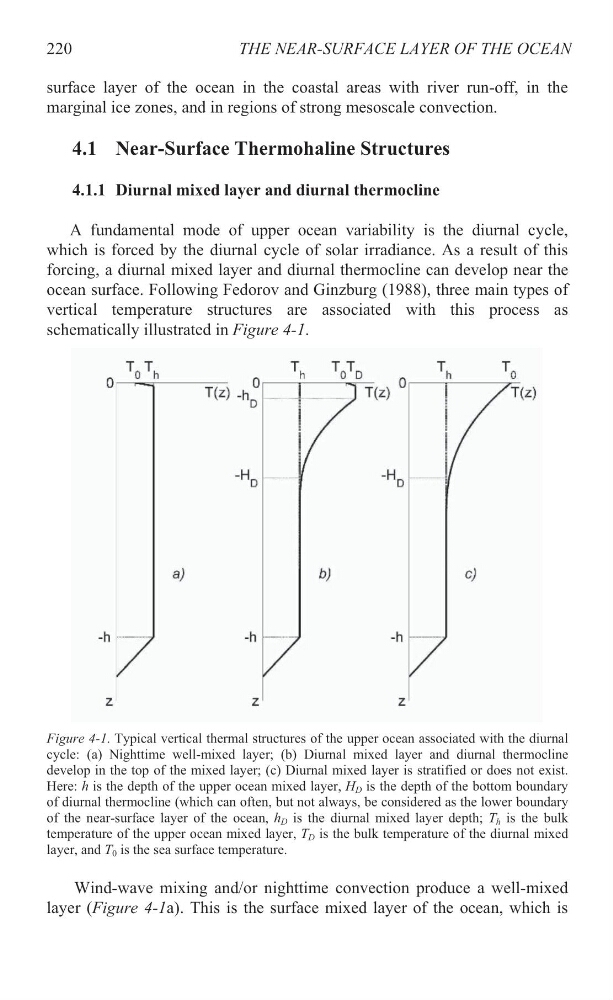
schematically illustrated in X Figure 4-1X .
Figure 4-1. Typical vertical thermal structures of the upper ocean associated with the diurnal
cycle: (a) Nighttime well-mixed layer; (b) Diurnal mixed layer and diurnal thermocline
develop in the top of the mixed layer; (c) Diurnal mixed layer is stratified or does not exist.
Here: h is the depth of the upper ocean mixed layer, HB D B is the depth of the bottom boundary
of diurnal thermocline (which can often, but not always, be considered as the lower boundary
of the near-surface layer of the ocean, hB D B is the diurnal mixed layer depth; TB h B is the bulk
temperature of the upper ocean mixed layer, TB D B is the bulk temperature of the diurnal mixed
layer, and TB 0 B is the sea surface temperature.
Wind-wave mixing and/or nighttime convection produce a well-mixed
layer (X Figure 4-1X a). This is the surface mixed layer of the ocean, which is
220
surface layer of the ocean in the coastal areas with river run-off, in the
marginal ice zones, and in regions of strong mesoscale convection.
4.1 Near-Surface Thermohaline Structures
4.1.1 Diurnal mixed layer and diurnal thermocline
A fundamental mode of upper ocean variability is the diurnal cycle,
which is forced by the diurnal cycle of solar irradiance. As a result of this
forcing, a diurnal mixed layer and diurnal thermocline can develop near the
ocean surface. Following Fedorov and Ginzburg (1988), three main types of
vertical temperature structures are associated with this process as
schematically illustrated in X Figure 4-1X .
Figure 4-1. Typical vertical thermal structures of the upper ocean associated with the diurnal
cycle: (a) Nighttime well-mixed layer; (b) Diurnal mixed layer and diurnal thermocline
develop in the top of the mixed layer; (c) Diurnal mixed layer is stratified or does not exist.
Here: h is the depth of the upper ocean mixed layer, HB D B is the depth of the bottom boundary
of diurnal thermocline (which can often, but not always, be considered as the lower boundary
of the near-surface layer of the ocean, hB D B is the diurnal mixed layer depth; TB h B is the bulk
temperature of the upper ocean mixed layer, TB D B is the bulk temperature of the diurnal mixed
layer, and TB 0 B is the sea surface temperature.
Wind-wave mixing and/or nighttime convection produce a well-mixed
layer (X Figure 4-1X a). This is the surface mixed layer of the ocean, which is
220