

THE NEAR-SURFACE LAYER OF THE OCEAN
3.4 Effects of Thermohaline Stratification
In this section we consider the effect of thermohaline stratification on the
near-surface turbulence. Air bubbles produced as a result of wave breaking
also create density stratification, which may affect near-surface turbulence.
The role of bubbles will be considered in Section 6.1.
Figure 3-20 shows the turbulence dissipation data obtained in stratified
conditions, below the layer of wave-enhanced turbulence. The dissipation
rate exhibits a three order of magnitude enhancement compared to the log
layer prediction. This is a much stronger relative increase of the dissipation
rate compared to what can be caused by surface wave breaking. This shows
that the effect of stratification on the dissipation of turbulent energy in the
near-surface layer of the ocean can be significant.
3.4.1 Formulation of the Monin-Oboukhov theory for the upper
ocean
The effect of thermohaline stratification on the turbulent boundary layer
can be characterized via the stability parameter,
/ O
z L
]
, where z is the
depth and L O is the Oboukhov length scale. The stability parameter is related
to the Monin-Oboukhov similarity theory, which has been found useful in
many studies of the atmospheric boundary layer (see Chapter 1).
Application of the Monin-Oboukhov theory to the upper ocean boundary
layer, however, is not straightforward. The main problem is that the velocity
scale in water is
/
30
a
U U |
times smaller than that in air. For the identical
length scale the kinematic mixing coefficient in water is about 30 times
smaller than in the air. It therefore takes much more time for heat and
momentum fluxes from the ocean surface to propagate to the same distance
in the oceanic boundary layer compared to the atmospheric boundary layer.
During this time interval surface heat fluxes may change significantly,
especially due to the diurnal cycle of solar radiation. This can make the
Oboukhov scale, which includes the surface fluxes, irrelevant.
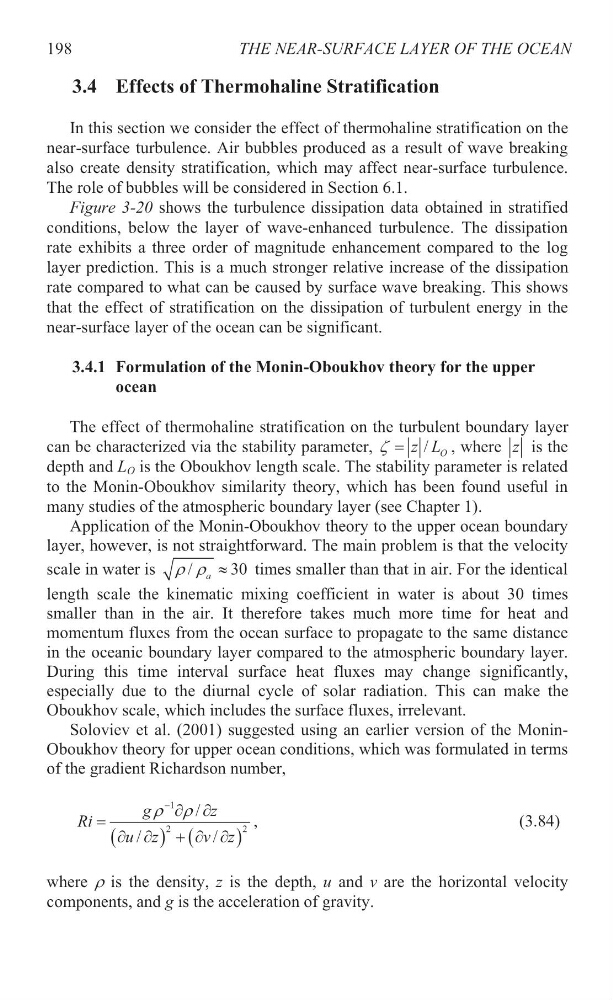
Soloviev et al. (2001) suggested using an earlier version of the MoninOboukhov theory for upper ocean conditions, which was formulated in terms
of the gradient Richardson number,
1
2
2
/
/
/
g
z
Ri
u z
v z
U U
w w
w w w w
,
(3.84)
where U is the density, z is the depth, u and v are the horizontal velocity
components, and g is the acceleration of gravity.
198
3.4 Effects of Thermohaline Stratification
In this section we consider the effect of thermohaline stratification on the
near-surface turbulence. Air bubbles produced as a result of wave breaking
also create density stratification, which may affect near-surface turbulence.
The role of bubbles will be considered in Section 6.1.
Figure 3-20 shows the turbulence dissipation data obtained in stratified
conditions, below the layer of wave-enhanced turbulence. The dissipation
rate exhibits a three order of magnitude enhancement compared to the log
layer prediction. This is a much stronger relative increase of the dissipation
rate compared to what can be caused by surface wave breaking. This shows
that the effect of stratification on the dissipation of turbulent energy in the
near-surface layer of the ocean can be significant.
3.4.1 Formulation of the Monin-Oboukhov theory for the upper
ocean
The effect of thermohaline stratification on the turbulent boundary layer
can be characterized via the stability parameter,
/ O
z L
]
, where z is the
depth and L O is the Oboukhov length scale. The stability parameter is related
to the Monin-Oboukhov similarity theory, which has been found useful in
many studies of the atmospheric boundary layer (see Chapter 1).
Application of the Monin-Oboukhov theory to the upper ocean boundary
layer, however, is not straightforward. The main problem is that the velocity
scale in water is
/
30
a
U U |
times smaller than that in air. For the identical
length scale the kinematic mixing coefficient in water is about 30 times
smaller than in the air. It therefore takes much more time for heat and
momentum fluxes from the ocean surface to propagate to the same distance
in the oceanic boundary layer compared to the atmospheric boundary layer.
During this time interval surface heat fluxes may change significantly,
especially due to the diurnal cycle of solar radiation. This can make the
Oboukhov scale, which includes the surface fluxes, irrelevant.
Soloviev et al. (2001) suggested using an earlier version of the MoninOboukhov theory for upper ocean conditions, which was formulated in terms
of the gradient Richardson number,
1
2
2
/
/
/
g
z
Ri
u z
v z
U U
w w
w w w w
,
(3.84)
where U is the density, z is the depth, u and v are the horizontal velocity
components, and g is the acceleration of gravity.
198