

THE NEAR-SURFACE LAYER OF THE OCEAN
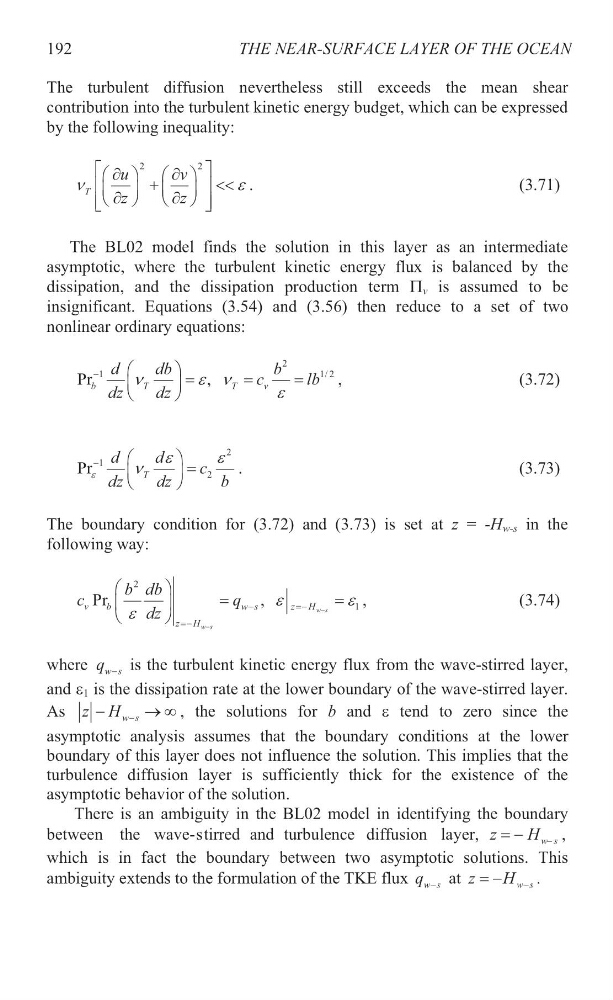
The turbulent diffusion nevertheless still exceeds the mean shear
contribution into the turbulent kinetic energy budget, which can be expressed
by the following inequality:
2
2
T
u
v
z
z
Q
H
ª
º
w
w
§ · § ·
«
»
¨ ¸ ¨ ¸
w
w
© ¹ © ¹
«
»
¬
¼
.
(3.71)
The BL02 model finds the solution in this layer as an intermediate
asymptotic, where the turbulent kinetic energy flux is balanced by the
dissipation, and the dissipation production term 3 v is assumed to be
insignificant. Equations (3.54) and (3.56) then reduce to a set of two
nonlinear ordinary equations:
2
1
1 / 2
Pr
,
b
T
T
v
d
db
b
c
lb
dz
dz
Q
H Q
H
§
·
¨
¸
©
¹
,
(3.72)
2
1
2
Pr
T
d
d
c
dz
dz
b
H
H
H
Q
§
·
¨
¸
©
¹
.
(3.73)
The boundary condition for (3.72) and (3.73) is set at z = -H w-s in the
following way:
2
1
Pr
,
w s
w s
v
b
w s
z H
z H
b db
c
q
dz
H
H
H
§
·
¨
¸
©
¹
,
(3.74)
where w s
q is the turbulent kinetic energy flux from the wave-stirred layer,
and H 1 is the dissipation rate at the lower boundary of the wave-stirred layer.
As
w s
z H
of, the solutions for b and H tend to zero since the
asymptotic analysis assumes that the boundary conditions at the lower
boundary of this layer does not influence the solution. This implies that the
turbulence diffusion layer is sufficiently thick for the existence of the
asymptotic behavior of the solution.
There is an ambiguity in the BL02 model in identifying the boundary
between the wave-stirred and turbulence diffusion layer,
w s
z
H
which is in fact the boundary between two asymptotic solutions. This
ambiguity extends to the formulation of the TKE flux w s
q at
w s
z
H
.
192
,
The turbulent diffusion nevertheless still exceeds the mean shear
contribution into the turbulent kinetic energy budget, which can be expressed
by the following inequality:
2
2
T
u
v
z
z
Q
H
ª
º
w
w
§ · § ·
«
»
¨ ¸ ¨ ¸
w
w
© ¹ © ¹
«
»
¬
¼
.
(3.71)
The BL02 model finds the solution in this layer as an intermediate
asymptotic, where the turbulent kinetic energy flux is balanced by the
dissipation, and the dissipation production term 3 v is assumed to be
insignificant. Equations (3.54) and (3.56) then reduce to a set of two
nonlinear ordinary equations:
2
1
1 / 2
Pr
,
b
T
T
v
d
db
b
c
lb
dz
dz
Q
H Q
H
§
·
¨
¸
©
¹
,
(3.72)
2
1
2
Pr
T
d
d
c
dz
dz
b
H
H
H
Q
§
·
¨
¸
©
¹
.
(3.73)
The boundary condition for (3.72) and (3.73) is set at z = -H w-s in the
following way:
2
1
Pr
,
w s
w s
v
b
w s
z H
z H
b db
c
q
dz
H
H
H
§
·
¨
¸
©
¹
,
(3.74)
where w s
q is the turbulent kinetic energy flux from the wave-stirred layer,
and H 1 is the dissipation rate at the lower boundary of the wave-stirred layer.
As
w s
z H
of, the solutions for b and H tend to zero since the
asymptotic analysis assumes that the boundary conditions at the lower
boundary of this layer does not influence the solution. This implies that the
turbulence diffusion layer is sufficiently thick for the existence of the
asymptotic behavior of the solution.
There is an ambiguity in the BL02 model in identifying the boundary
between the wave-stirred and turbulence diffusion layer,
w s
z
H
which is in fact the boundary between two asymptotic solutions. This
ambiguity extends to the formulation of the TKE flux w s
q at
w s
z
H
.
192
,