

THE NEAR-SURFACE LAYER OF THE OCEAN
3
0
1 0
1
3
pw
F
c
J E U
(3.60)
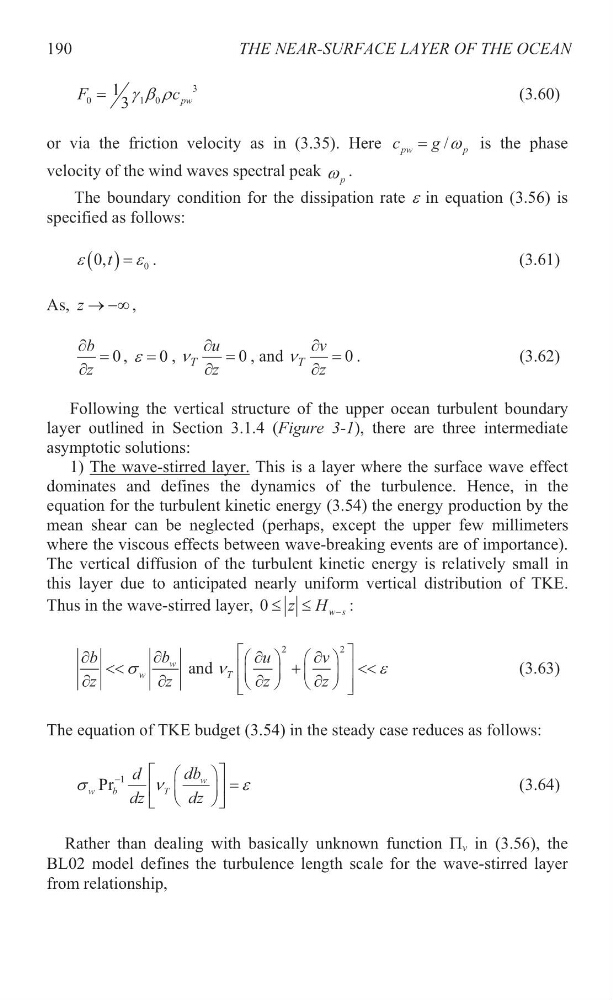
or via the friction velocity as in (3.35). Here
/
pw
p
c
g Z is the phase
velocity of the wind waves spectral peak p
Z .
The boundary condition for the dissipation rate H in equation (3.56) is
specified as follows:
0
0,t
H
H .
(3.61)
As, z o f ,
0
b
z
w
w
,
0
H
,
0
T
u
z
Q
w
w
, and
0
T
v
z
Q
w
w
.
(3.62)
Following the vertical structure of the upper ocean turbulent boundary
layer outlined in Section 3.1.4 (Figure 3-1), there are three intermediate
asymptotic solutions:
1) The wave-stirred layer. This is a layer where the surface wave effect
dominates and defines the dynamics of the turbulence. Hence, in the
equation for the turbulent kinetic energy (3.54) the energy production by the
mean shear can be neglected (perhaps, except the upper few millimeters
where the viscous effects between wave-breaking events are of importance).
The vertical diffusion of the turbulent kinetic energy is relatively small in
this layer due to anticipated nearly uniform vertical distribution of TKE.
Thus in the wave-stirred layer, 0
w s
z H
d d
:
2
2
and
w
w
T
b
b
u
v
z
z
z
z
V
Q
H
ª
º
w
w
w
w
§ · § ·
«
»
¨ ¸ ¨ ¸
w
w
w
w
© ¹ © ¹
«
»
¬
¼
(3.63)
The equation of TKE budget (3.54) in the steady case reduces as follows:
1
Pr
w
w
b
T
db
d
dz
dz
V
Q
H
ª
º
§
·
«
»
¨
¸
©
¹
¬
¼
(3.64)
Rather than dealing with basically unknown function 3 v in (3.56), the
BL02 model defines the turbulence length scale for the wave-stirred layer
from relationship,
190
3
0
1 0
1
3
pw
F
c
J E U
(3.60)
or via the friction velocity as in (3.35). Here
/
pw
p
c
g Z is the phase
velocity of the wind waves spectral peak p
Z .
The boundary condition for the dissipation rate H in equation (3.56) is
specified as follows:
0
0,t
H
H .
(3.61)
As, z o f ,
0
b
z
w
w
,
0
H
,
0
T
u
z
Q
w
w
, and
0
T
v
z
Q
w
w
.
(3.62)
Following the vertical structure of the upper ocean turbulent boundary
layer outlined in Section 3.1.4 (Figure 3-1), there are three intermediate
asymptotic solutions:
1) The wave-stirred layer. This is a layer where the surface wave effect
dominates and defines the dynamics of the turbulence. Hence, in the
equation for the turbulent kinetic energy (3.54) the energy production by the
mean shear can be neglected (perhaps, except the upper few millimeters
where the viscous effects between wave-breaking events are of importance).
The vertical diffusion of the turbulent kinetic energy is relatively small in
this layer due to anticipated nearly uniform vertical distribution of TKE.
Thus in the wave-stirred layer, 0
w s
z H
d d
:
2
2
and
w
w
T
b
b
u
v
z
z
z
z
V
Q
H
ª
º
w
w
w
w
§ · § ·
«
»
¨ ¸ ¨ ¸
w
w
w
w
© ¹ © ¹
«
»
¬
¼
(3.63)
The equation of TKE budget (3.54) in the steady case reduces as follows:
1
Pr
w
w
b
T
db
d
dz
dz
V
Q
H
ª
º
§
·
«
»
¨
¸
©
¹
¬
¼
(3.64)
Rather than dealing with basically unknown function 3 v in (3.56), the
BL02 model defines the turbulence length scale for the wave-stirred layer
from relationship,
190