

THE NEAR-SURFACE LAYER OF THE OCEAN
0
1
zy
v
fu
t
z
W
U
w
w
w
w
,
(3.29)
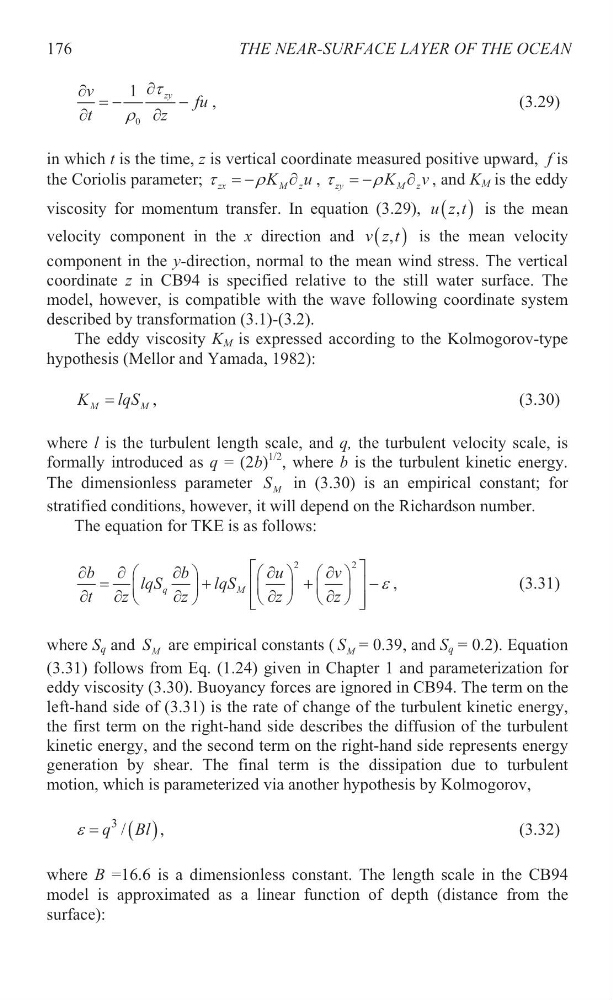
in which t is the time, z is vertical coordinate measured positive upward, f is
the Coriolis parameter; zx
M z
K
u
W
U
w , zy
M z
K
v
W
U
w , and K M is the eddy
viscosity for momentum transfer. In equation (3.29),
,
u z t is the mean
velocity component in the x direction and
,
v z t is the mean velocity
component in the y-direction, normal to the mean wind stress. The vertical
coordinate z in CB94 is specified relative to the still water surface. The
model, however, is compatible with the wave following coordinate system
described by transformation (3.1)-(3.2).
The eddy viscosity K M is expressed according to the Kolmogorov-type
hypothesis (Mellor and Yamada, 1982):
M
M
K
lqS ,
(3.30)
where l is the turbulent length scale, and q, the turbulent velocity scale, is
formally introduced as q = (2b)
1/2 , where b is the turbulent kinetic energy.
The dimensionless parameter M
S in (3.30) is an empirical constant; for
stratified conditions, however, it will depend on the Richardson number.
The equation for TKE is as follows:
2
2
q
M
b
b
u
v
lqS
lqS
t
z
z
z
z
H
ª
º
w
w
w
w
w
§
·
§ · § ·
«
»
¨
¸
¨ ¸ ¨ ¸
w
w
w
w
w
©
¹
© ¹ © ¹
«
»
¬
¼
,
(3.31)
where S q and M
S are empirical constants ( M
S = 0.39, and S q = 0.2). Equation
(3.31) follows from Eq. (1.24) given in Chapter 1 and parameterization for
eddy viscosity (3.30). Buoyancy forces are ignored in CB94. The term on the
left-hand side of (3.31) is the rate of change of the turbulent kinetic energy,
the first term on the right-hand side describes the diffusion of the turbulent
kinetic energy, and the second term on the right-hand side represents energy
generation by shear. The final term is the dissipation due to turbulent
motion, which is parameterized via another hypothesis by Kolmogorov,
3 /
q Bl
H
,
(3.32)
where B =16.6 is a dimensionless constant. The length scale in the CB94
model is approximated as a linear function of depth (distance from the
surface):
176
0
1
zy
v
fu
t
z
W
U
w
w
w
w
,
(3.29)
in which t is the time, z is vertical coordinate measured positive upward, f is
the Coriolis parameter; zx
M z
K
u
W
U
w , zy
M z
K
v
W
U
w , and K M is the eddy
viscosity for momentum transfer. In equation (3.29),
,
u z t is the mean
velocity component in the x direction and
,
v z t is the mean velocity
component in the y-direction, normal to the mean wind stress. The vertical
coordinate z in CB94 is specified relative to the still water surface. The
model, however, is compatible with the wave following coordinate system
described by transformation (3.1)-(3.2).
The eddy viscosity K M is expressed according to the Kolmogorov-type
hypothesis (Mellor and Yamada, 1982):
M
M
K
lqS ,
(3.30)
where l is the turbulent length scale, and q, the turbulent velocity scale, is
formally introduced as q = (2b)
1/2 , where b is the turbulent kinetic energy.
The dimensionless parameter M
S in (3.30) is an empirical constant; for
stratified conditions, however, it will depend on the Richardson number.
The equation for TKE is as follows:
2
2
q
M
b
b
u
v
lqS
lqS
t
z
z
z
z
H
ª
º
w
w
w
w
w
§
·
§ · § ·
«
»
¨
¸
¨ ¸ ¨ ¸
w
w
w
w
w
©
¹
© ¹ © ¹
«
»
¬
¼
,
(3.31)
where S q and M
S are empirical constants ( M
S = 0.39, and S q = 0.2). Equation
(3.31) follows from Eq. (1.24) given in Chapter 1 and parameterization for
eddy viscosity (3.30). Buoyancy forces are ignored in CB94. The term on the
left-hand side of (3.31) is the rate of change of the turbulent kinetic energy,
the first term on the right-hand side describes the diffusion of the turbulent
kinetic energy, and the second term on the right-hand side represents energy
generation by shear. The final term is the dissipation due to turbulent
motion, which is parameterized via another hypothesis by Kolmogorov,
3 /
q Bl
H
,
(3.32)
where B =16.6 is a dimensionless constant. The length scale in the CB94
model is approximated as a linear function of depth (distance from the
surface):
176