

Chapter 2: SEA SURFACE MICROLAYER
optimal drop impact and a surface uniformly covered with rain-induced
wavelets. Wave interactions, which have been neglected here, likely result in
greater wave heights.
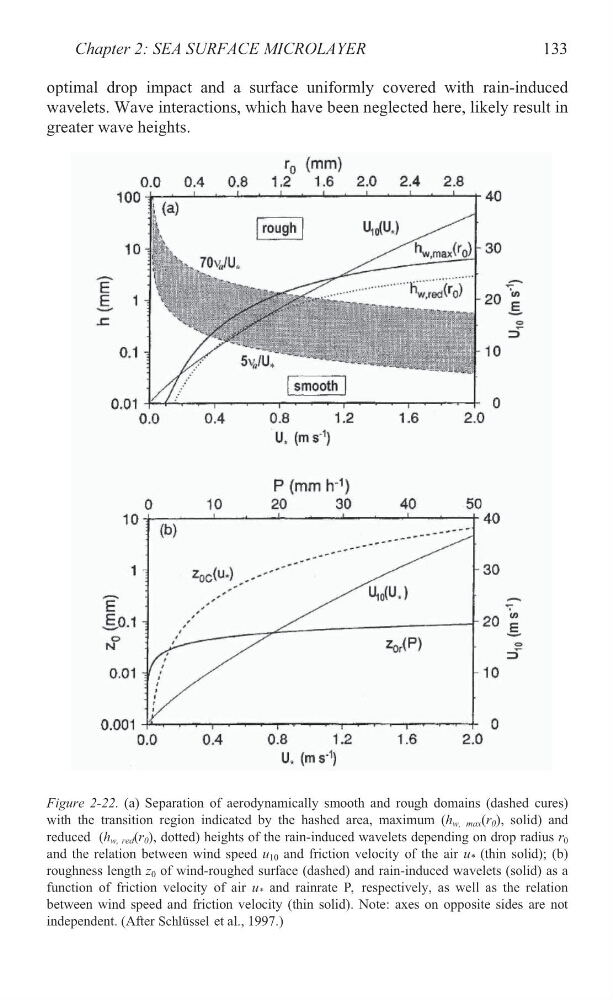
Figure 2-22. (a) Separation of aerodynamically smooth and rough domains (dashed cures)
with the transition region indicated by the hashed area, maximum (h w, max (r 0 ), solid) and
reduced (h w, red (r 0 ), dotted) heights of the rain-induced wavelets depending on drop radius r 0
and the relation between wind speed u 10 and friction velocity of the air u * (thin solid); (b)
roughness length z 0 of wind-roughed surface (dashed) and rain-induced wavelets (solid) as a
*
between wind speed and friction velocity (thin solid). Note: axes on opposite sides are not
independent. (After
et al., 1997.)
133
function of friction velocity of air u and rainrate P, respectively, as well as the relation
Schl ssel
ü
optimal drop impact and a surface uniformly covered with rain-induced
wavelets. Wave interactions, which have been neglected here, likely result in
greater wave heights.
Figure 2-22. (a) Separation of aerodynamically smooth and rough domains (dashed cures)
with the transition region indicated by the hashed area, maximum (h w, max (r 0 ), solid) and
reduced (h w, red (r 0 ), dotted) heights of the rain-induced wavelets depending on drop radius r 0
and the relation between wind speed u 10 and friction velocity of the air u * (thin solid); (b)
roughness length z 0 of wind-roughed surface (dashed) and rain-induced wavelets (solid) as a
*
between wind speed and friction velocity (thin solid). Note: axes on opposite sides are not
independent. (After
et al., 1997.)
133
function of friction velocity of air u and rainrate P, respectively, as well as the relation
Schl ssel
ü