

THE NEAR-SURFACE LAYER OF THE OCEAN
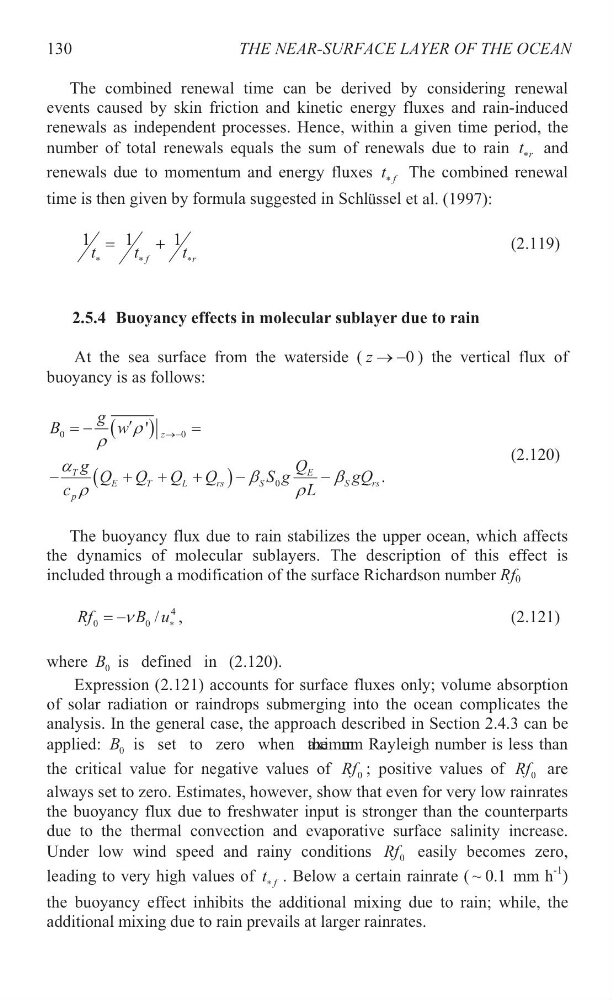
The combined renewal time can be derived by considering renewal
events caused by skin friction and kinetic energy fluxes and rain-induced
renewals as independent processes. Hence, within a given time period, the
number of total renewals equals the sum of renewals due to rain r
t and
renewals due to momentum and energy fluxes f
t The combined renewal
time is then given by formula suggested in
et al. (1997):
1
1
1
f
r
t
t
t
(2.119)
2.5.4 Buoyancy effects in molecular sublayer due to rain
At the sea surface from the waterside (
0
z o ) the vertical flux of
buoyancy is as follows:
0
0
0
'
.
z
T
E
E
T
L
r s
S
S
r s
p
g
B
w
g
Q
Q Q Q Q
S g
gQ
c
L
U
U
D
E
E
U
U
o
c
(2.120)
The buoyancy flux due to rain stabilizes the upper ocean, which affects
the dynamics of molecular sublayers. The description of this effect is
included through a modification of the surface Richardson number Rf 0
4
0
0 /
Rf
B u
Q
,
(2.121)
where 0
B is defined in (2.120).
Expression (2.121) accounts for surface fluxes only; volume absorption
of solar radiation or raindrops submerging into the ocean complicates the
analysis. In the general case, the approach described in Section 2.4.3 can be
applied: 0
B is set to zero when the m
aximum Rayleigh number is less than
the critical value for negative values of
0
Rf ; positive values of
0
Rf are
always set to zero. Estimates, however, show that even for very low rainrates
the buoyancy flux due to freshwater input is stronger than the counterparts
due to the thermal convection and evaporative surface salinity increase.
Under low wind speed and rainy conditions
0
Rf easily becomes zero,
leading to very high values of f
t . Below a certain rainrate ( ~ 0.1 mm h
-1 )
the buoyancy effect inhibits the additional mixing due to rain; while, the
additional mixing due to rain prevails at larger rainrates.
130
Schl ssel
ü
The combined renewal time can be derived by considering renewal
events caused by skin friction and kinetic energy fluxes and rain-induced
renewals as independent processes. Hence, within a given time period, the
number of total renewals equals the sum of renewals due to rain r
t and
renewals due to momentum and energy fluxes f
t The combined renewal
time is then given by formula suggested in
et al. (1997):
1
1
1
f
r
t
t
t
(2.119)
2.5.4 Buoyancy effects in molecular sublayer due to rain
At the sea surface from the waterside (
0
z o ) the vertical flux of
buoyancy is as follows:
0
0
0
'
.
z
T
E
E
T
L
r s
S
S
r s
p
g
B
w
g
Q
Q Q Q Q
S g
gQ
c
L
U
U
D
E
E
U
U
o
c
(2.120)
The buoyancy flux due to rain stabilizes the upper ocean, which affects
the dynamics of molecular sublayers. The description of this effect is
included through a modification of the surface Richardson number Rf 0
4
0
0 /
Rf
B u
Q
,
(2.121)
where 0
B is defined in (2.120).
Expression (2.121) accounts for surface fluxes only; volume absorption
of solar radiation or raindrops submerging into the ocean complicates the
analysis. In the general case, the approach described in Section 2.4.3 can be
applied: 0
B is set to zero when the m
aximum Rayleigh number is less than
the critical value for negative values of
0
Rf ; positive values of
0
Rf are
always set to zero. Estimates, however, show that even for very low rainrates
the buoyancy flux due to freshwater input is stronger than the counterparts
due to the thermal convection and evaporative surface salinity increase.
Under low wind speed and rainy conditions
0
Rf easily becomes zero,
leading to very high values of f
t . Below a certain rainrate ( ~ 0.1 mm h
-1 )
the buoyancy effect inhibits the additional mixing due to rain; while, the
additional mixing due to rain prevails at larger rainrates.
130
Schl ssel
ü