

THE NEAR-SURFACE LAYER OF THE OCEAN
2.5.2 Freshwater skin of the ocean
Besides the modification of the cool skin, rainfall creates a freshwater
skin on the top of the ocean where a salinity flux takes place via molecular
diffusion (
et al., 1997). Under no-rain conditions, evaporation at
the sea surface increases salinity, which tends to destabilize the near-surface
water enhancing the renewal process at the surface. However, when rain
starts, the part of the rain that does not submerge into the ocean can
compensate for the evaporation effect and create a stably stratified
freshwater skin. This is analogous to the conversion of the cool skin into its
antipode, the warm skin, which sometimes occurs under conditions of strong
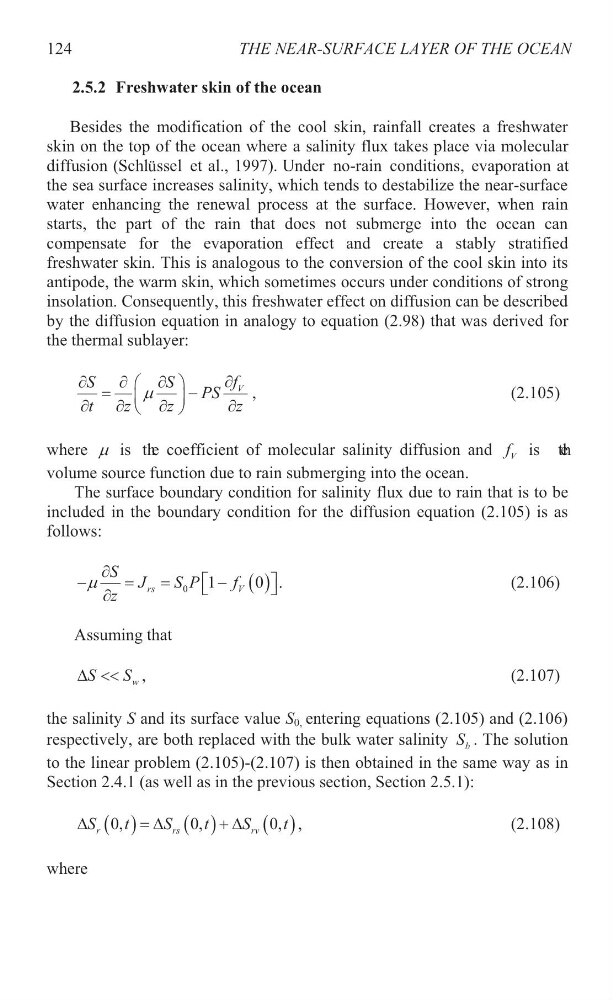
insolation. Consequently, this freshwater effect on diffusion can be described
by the diffusion equation in analogy to equation (2.98) that was derived for
the thermal sublayer:
V
f
S
S
PS
t
z
z
z
P
w
w
w
w
§
·
¨
¸
w
w
w
w
©
¹
,
(2.105)
where P is the coefficient of molecular salinity diffusion and V
f is th e
volume source function due to rain submerging into the ocean.
The surface boundary condition for salinity flux due to rain that is to be
included in the boundary condition for the diffusion equation (2.105) is as
follows:
0
1
0 .
rs
V
S J
S P
f
z
P
w
ª
º
¬
¼
w
(2.106)
Assuming that
w
S
S
' ,
(2.107)
the salinity S and its surface value S 0, entering equations (2.105) and (2.106)
respectively, are both replaced with the bulk water salinity b
S . The solution
to the linear problem (2.105)-(2.107) is then obtained in the same way as in
Section 2.4.1 (as well as in the previous section, Section 2.5.1):
0,
0,
0,
r
r s
r v
S
t
S
t
S
t
'
'
'
,
(2.108)
where
124
Schl ssel
ü
2.5.2 Freshwater skin of the ocean
Besides the modification of the cool skin, rainfall creates a freshwater
skin on the top of the ocean where a salinity flux takes place via molecular
diffusion (
et al., 1997). Under no-rain conditions, evaporation at
the sea surface increases salinity, which tends to destabilize the near-surface
water enhancing the renewal process at the surface. However, when rain
starts, the part of the rain that does not submerge into the ocean can
compensate for the evaporation effect and create a stably stratified
freshwater skin. This is analogous to the conversion of the cool skin into its
antipode, the warm skin, which sometimes occurs under conditions of strong
insolation. Consequently, this freshwater effect on diffusion can be described
by the diffusion equation in analogy to equation (2.98) that was derived for
the thermal sublayer:
V
f
S
S
PS
t
z
z
z
P
w
w
w
w
§
·
¨
¸
w
w
w
w
©
¹
,
(2.105)
where P is the coefficient of molecular salinity diffusion and V
f is th e
volume source function due to rain submerging into the ocean.
The surface boundary condition for salinity flux due to rain that is to be
included in the boundary condition for the diffusion equation (2.105) is as
follows:
0
1
0 .
rs
V
S J
S P
f
z
P
w
ª
º
¬
¼
w
(2.106)
Assuming that
w
S
S
' ,
(2.107)
the salinity S and its surface value S 0, entering equations (2.105) and (2.106)
respectively, are both replaced with the bulk water salinity b
S . The solution
to the linear problem (2.105)-(2.107) is then obtained in the same way as in
Section 2.4.1 (as well as in the previous section, Section 2.5.1):
0,
0,
0,
r
r s
r v
S
t
S
t
S
t
'
'
'
,
(2.108)
where
124
Schl ssel
ü