

THE NEAR-SURFACE LAYER OF THE OCEAN
0
V
T
r
f
T
T
P T T
t
z
z
z
N
w
w
w
w
§
·
¨
¸
w
w
w
w
©
¹
,
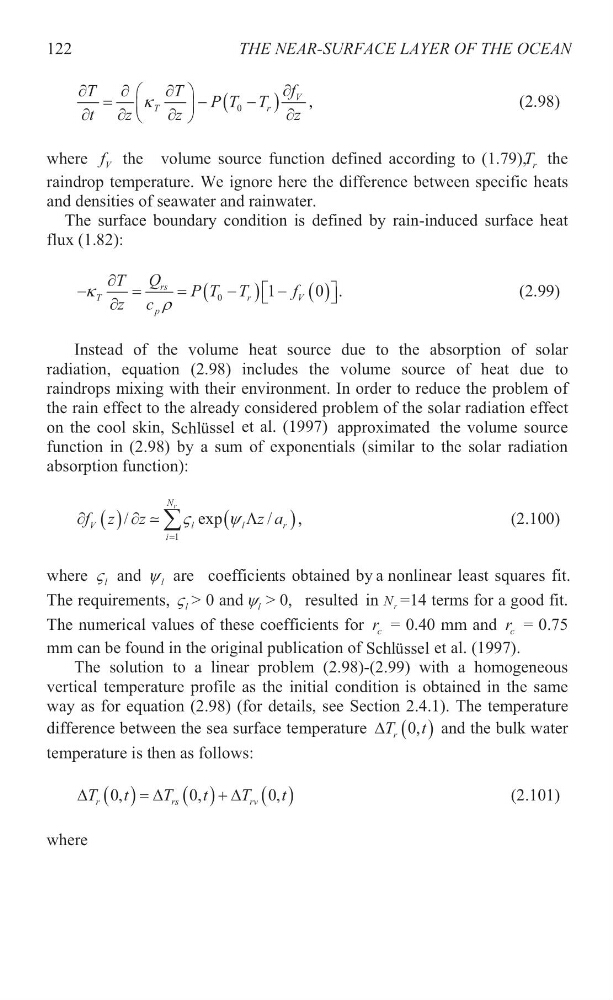
(2.98)
where V
f the volume source function defined according to (1.79), r
T the
raindrop temperature. We ignore here the difference between specific heats
and densities of seawater and rainwater.
The surface boundary condition is defined by rain-induced surface heat
flux (1.82):
0
1
0 .
rs
T
r
V
p
Q
T
P T T
f
z c
N
U
w
ª
º
¬
¼
w
(2.99)
Instead of the volume heat source due to the absorption of solar
radiation, equation (2.98) includes the volume source of heat due to
raindrops mixing with their environment. In order to reduce the problem of
the rain effect to the already considered problem of the solar radiation effect
on the cool skin,
et al. (1997) approximated the volume source
function in (2.98) by a sum of exponentials (similar to the solar radiation
absorption function):
1
/
e x p
/
r
N
V
l
l
r
i
f z z
z a
9
\
w
w
/
¦
,
(2.100)
where l
9 and l
\ are coefficients obtained by a nonlinear least squares fit.
The requirements, l
9 > 0 and l
\ > 0, resulted in r
N =14 terms for a good fit.
The numerical values of these coefficients for c
r = 0.40 mm and c
r = 0.75
mm can be found in the original publication of
et al. (1997).
The solution to a linear problem (2.98)-(2.99) with a homogeneous
vertical temperature profile as the initial condition is obtained in the same
way as for equation (2.98) (for details, see Section 2.4.1). The temperature
difference between the sea surface temperature
0,
r
T
t
'
and the bulk water
temperature is then as follows:
0,
0,
0,
r
r s
r v
T
t
T
t
T
t
'
'
'
(2.101)
where
122
Schl ssel
ü
Schl ssel
ü
0
V
T
r
f
T
T
P T T
t
z
z
z
N
w
w
w
w
§
·
¨
¸
w
w
w
w
©
¹
,
(2.98)
where V
f the volume source function defined according to (1.79), r
T the
raindrop temperature. We ignore here the difference between specific heats
and densities of seawater and rainwater.
The surface boundary condition is defined by rain-induced surface heat
flux (1.82):
0
1
0 .
rs
T
r
V
p
Q
T
P T T
f
z c
N
U
w
ª
º
¬
¼
w
(2.99)
Instead of the volume heat source due to the absorption of solar
radiation, equation (2.98) includes the volume source of heat due to
raindrops mixing with their environment. In order to reduce the problem of
the rain effect to the already considered problem of the solar radiation effect
on the cool skin,
et al. (1997) approximated the volume source
function in (2.98) by a sum of exponentials (similar to the solar radiation
absorption function):
1
/
e x p
/
r
N
V
l
l
r
i
f z z
z a
9
\
w
w
/
¦
,
(2.100)
where l
9 and l
\ are coefficients obtained by a nonlinear least squares fit.
The requirements, l
9 > 0 and l
\ > 0, resulted in r
N =14 terms for a good fit.
The numerical values of these coefficients for c
r = 0.40 mm and c
r = 0.75
mm can be found in the original publication of
et al. (1997).
The solution to a linear problem (2.98)-(2.99) with a homogeneous
vertical temperature profile as the initial condition is obtained in the same
way as for equation (2.98) (for details, see Section 2.4.1). The temperature
difference between the sea surface temperature
0,
r
T
t
'
and the bulk water
temperature is then as follows:
0,
0,
0,
r
r s
r v
T
t
T
t
T
t
'
'
'
(2.101)
where
122
Schl ssel
ü
Schl ssel
ü