

THE NEAR-SURFACE LAYER OF THE OCEAN
Taking into account that
1/ 2
0
Pr
O
/
, boundary-layer parameterization
(2.68) practically coincides with parameterization (2.58) for low and
moderate wind speed conditions. Similar to the renewal model, the boundary
layer type model can be extended to high-wind speed conditions including
wave breaking and whitecapping. Such an extension is considered in Chapter
7 for the example of air-sea gas transfer modeling.
2.4 Effect of Penetrating Solar Radiation
2.4.1 Model equations
The impact of penetrating solar radiation on the dynamics of molecular
sublayers can be quantified in a consistent way with a renewal model
(Soloviev and
, 1996). Note that the term “cool skin” might not be
completely appropriate during daytime hours since in extreme situations the
solar warming may reverse the sign of the temperature gradient in the
thermal molecular sublayer.
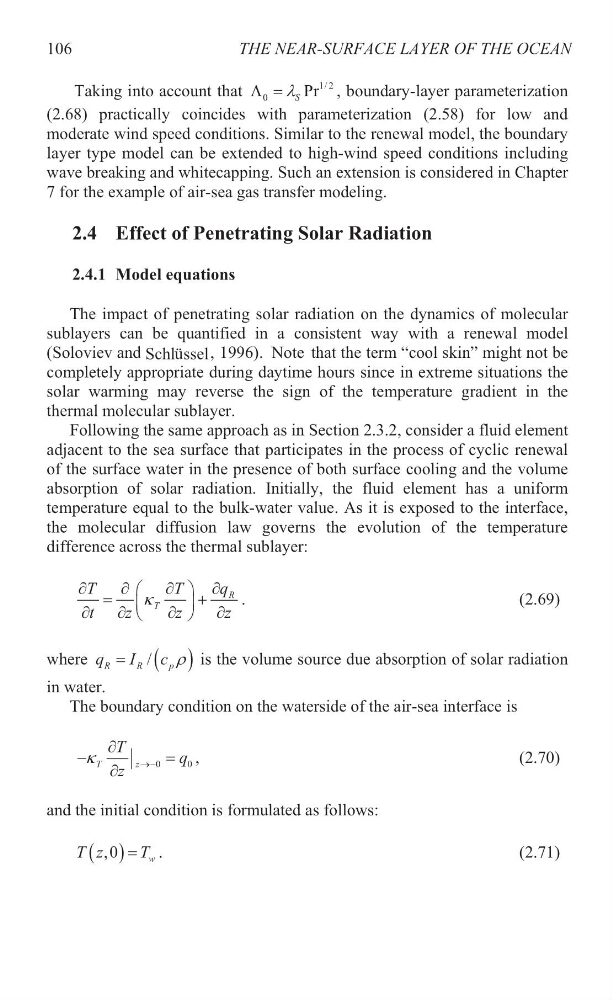
Following the same approach as in Section 2.3.2, consider a fluid element
adjacent to the sea surface that participates in the process of cyclic renewal
of the surface water in the presence of both surface cooling and the volume
absorption of solar radiation. Initially, the fluid element has a uniform
temperature equal to the bulk-water value. As it is exposed to the interface,
the molecular diffusion law governs the evolution of the temperature
difference across the thermal sublayer:
R
T
q
T
T
t
z
z
z
N
w
w
w
w
§
·
¨
¸
w
w
w
w
©
¹
.
(2.69)
where
/
R
R
p
q
I c U is the volume source due absorption of solar radiation
in water.
The boundary condition on the waterside of the air-sea interface is
0
0
T
z
T
q
z
N
o
w
w
,
(2.70)
and the initial condition is formulated as follows:
,0
w
T z
T .
(2.71)
106
S
Schl ssel
ü
Taking into account that
1/ 2
0
Pr
O
/
, boundary-layer parameterization
(2.68) practically coincides with parameterization (2.58) for low and
moderate wind speed conditions. Similar to the renewal model, the boundary
layer type model can be extended to high-wind speed conditions including
wave breaking and whitecapping. Such an extension is considered in Chapter
7 for the example of air-sea gas transfer modeling.
2.4 Effect of Penetrating Solar Radiation
2.4.1 Model equations
The impact of penetrating solar radiation on the dynamics of molecular
sublayers can be quantified in a consistent way with a renewal model
(Soloviev and
, 1996). Note that the term “cool skin” might not be
completely appropriate during daytime hours since in extreme situations the
solar warming may reverse the sign of the temperature gradient in the
thermal molecular sublayer.
Following the same approach as in Section 2.3.2, consider a fluid element
adjacent to the sea surface that participates in the process of cyclic renewal
of the surface water in the presence of both surface cooling and the volume
absorption of solar radiation. Initially, the fluid element has a uniform
temperature equal to the bulk-water value. As it is exposed to the interface,
the molecular diffusion law governs the evolution of the temperature
difference across the thermal sublayer:
R
T
q
T
T
t
z
z
z
N
w
w
w
w
§
·
¨
¸
w
w
w
w
©
¹
.
(2.69)
where
/
R
R
p
q
I c U is the volume source due absorption of solar radiation
in water.
The boundary condition on the waterside of the air-sea interface is
0
0
T
z
T
q
z
N
o
w
w
,
(2.70)
and the initial condition is formulated as follows:
,0
w
T z
T .
(2.71)
106
S
Schl ssel
ü