

THE NEAR-SURFACE LAYER OF THE OCEAN
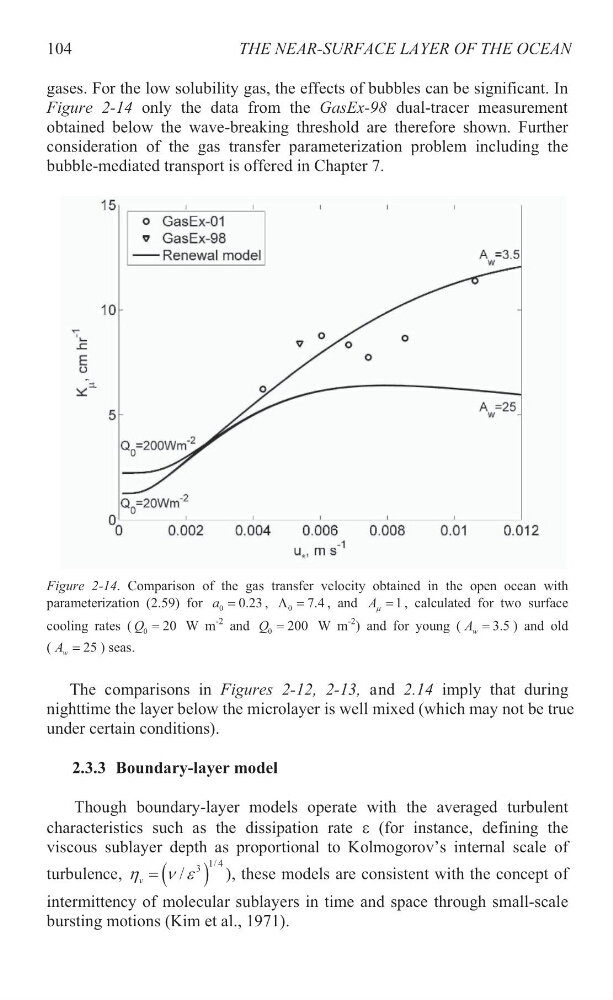
gases. For the low solubility gas, the effects of bubbles can be significant. In
Figure 2-14 only the data from the GasEx-98 dual-tracer measurement
obtained below the wave-breaking threshold are therefore shown. Further
consideration of the gas transfer parameterization problem including the
bubble-mediated transport is offered in Chapter 7.
Figure 2-14. Comparison of the gas transfer velocity obtained in the open ocean with
parameterization (2.59) for 0 0.23
a
, 0 7.4
/
, and
1
A P
, calculated for two surface
cooling rates ( 0 20
Q
W m
-2 and 0 200
Q
W m
-2 ) and for young (
3.5
w
A
) and old
(
25
w
A
) seas.
nighttime the layer below the microlayer is well mixed (which may not be true
under certain conditions).
2.3.3 Boundary-layer model
Though boundary-layer models operate with the averaged turbulent
characteristics such as the dissipation rate H for instance, defining the
viscous sublayer depth as proportional to Kolmogorov’s internal scale of
turbulence,
1/ 4
3
/
v
K
Q H
), these models are consistent with the concept of
intermittency of molecular sublayers in time and space through small-scale
bursting motions (Kim et al., 1971).
104
The comparisons in Figures 2-12, 2-13, and 2.14 imply that during
gases. For the low solubility gas, the effects of bubbles can be significant. In
Figure 2-14 only the data from the GasEx-98 dual-tracer measurement
obtained below the wave-breaking threshold are therefore shown. Further
consideration of the gas transfer parameterization problem including the
bubble-mediated transport is offered in Chapter 7.
Figure 2-14. Comparison of the gas transfer velocity obtained in the open ocean with
parameterization (2.59) for 0 0.23
a
, 0 7.4
/
, and
1
A P
, calculated for two surface
cooling rates ( 0 20
Q
W m
-2 and 0 200
Q
W m
-2 ) and for young (
3.5
w
A
) and old
(
25
w
A
) seas.
nighttime the layer below the microlayer is well mixed (which may not be true
under certain conditions).
2.3.3 Boundary-layer model
Though boundary-layer models operate with the averaged turbulent
characteristics such as the dissipation rate H for instance, defining the
viscous sublayer depth as proportional to Kolmogorov’s internal scale of
turbulence,
1/ 4
3
/
v
K
Q H
), these models are consistent with the concept of
intermittency of molecular sublayers in time and space through small-scale
bursting motions (Kim et al., 1971).
104
The comparisons in Figures 2-12, 2-13, and 2.14 imply that during