

THE NEAR-SURFACE LAYER OF THE OCEAN
1/ 4
3 4
0
0
0
0
/
1
u u
a
Rf
'
/ /
(2.57)
1/ 4
1/ 2
1/ 2
3 4
0
0
0
0
/
P r 1
1
/ cr
T T
a
Rf
Ke Ke
'
/
/
(2.58)
1/ 4
1/ 2
1
1 /2
3 3
0 0
0
0
0
/
1
1
/ cr
K u A
Sc
a
Rf
Ke Ke
P
/
/
(2.59)
Replacing the surface cooling 0
E
T
L
Q Q Q I
with the virtual cooling,
which includes the buoyancy effects of salinity due to evaporation
0 S p
v
E
T
L
E
T
S c
Q Q Q I
Q
L
E
D
,
(2.60)
the expression for the surface Richardson number transforms in the
following way:
0
0
4
S
p
T
E
T
L
E
p
T
S c
g
Rf
Q Q I
Q
c u
L
E
D Q
U
D
§
·
¨
¸
©
¹
.
(2.61)
Coefficients 0
/ , 0
a ,
cr
Ke , and 0
A are now to be determined from the
comparison with experimental data.
From the comparison with Grassl’s (1976) data, which represented a
relatively small number of field observations, Kudrayvtsev and Soloviev
(1985) derived tentative estimates of the two constants 0 13.3
/ |
and
4
1.5 10
cr
Rf
|
, treating them as independent constants. From relationship
(2.48) it then follows that 0
a § 0.6, which is much bigger than the commonly
accepted estimate 0
a = 0.25 (Fedorov and Ginzburg, 1988). Since the
publication of the Kudryavtsev and Soloviev (1985) work, new laboratory
data sets on the surface wind drift current using particle image velocimetry
and infrared imaging have been obtained, which allow us to specify more
accurately numerical constant 0
/ .
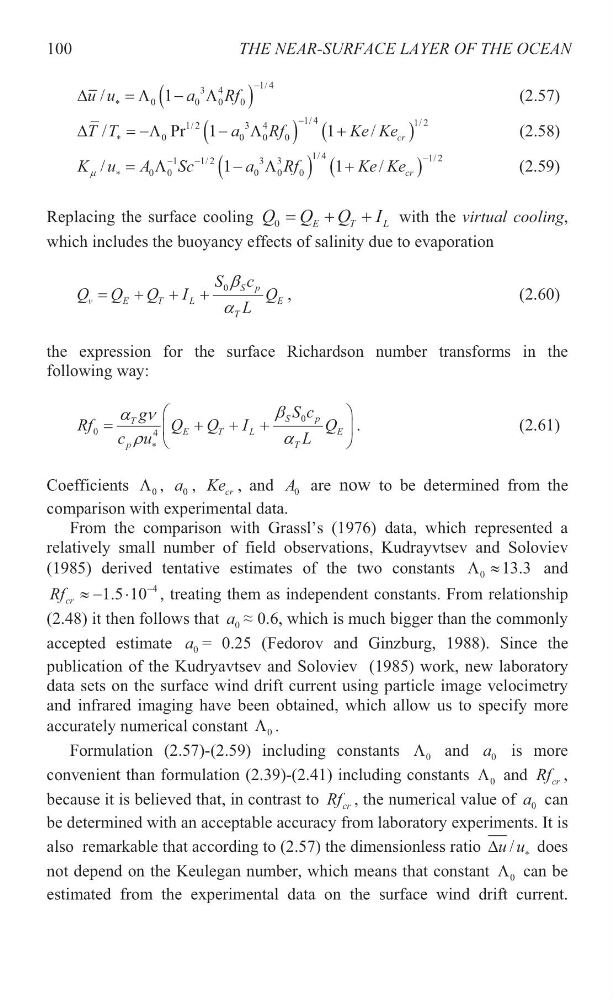
Formulation (2.57)-(2.59) including constants
0
/ and 0
a is more
convenient than formulation (2.39)-(2.41) including constants 0
/ and cr
Rf ,
because it is believed that, in contrast to cr
Rf , the numerical value of 0
a can
be determined with an acceptable accuracy from laboratory experiments. It is
also remarkable that according to (2.57) the dimensionless ratio
/
u u
'
does
not depend on the Keulegan number, which means that constant 0
/ can be
estimated from the experimental data on the surface wind drift current.
100
1/ 4
3 4
0
0
0
0
/
1
u u
a
Rf
'
/ /
(2.57)
1/ 4
1/ 2
1/ 2
3 4
0
0
0
0
/
P r 1
1
/ cr
T T
a
Rf
Ke Ke
'
/
/
(2.58)
1/ 4
1/ 2
1
1 /2
3 3
0 0
0
0
0
/
1
1
/ cr
K u A
Sc
a
Rf
Ke Ke
P
/
/
(2.59)
Replacing the surface cooling 0
E
T
L
Q Q Q I
with the virtual cooling,
which includes the buoyancy effects of salinity due to evaporation
0 S p
v
E
T
L
E
T
S c
Q Q Q I
Q
L
E
D
,
(2.60)
the expression for the surface Richardson number transforms in the
following way:
0
0
4
S
p
T
E
T
L
E
p
T
S c
g
Rf
Q Q I
Q
c u
L
E
D Q
U
D
§
·
¨
¸
©
¹
.
(2.61)
Coefficients 0
/ , 0
a ,
cr
Ke , and 0
A are now to be determined from the
comparison with experimental data.
From the comparison with Grassl’s (1976) data, which represented a
relatively small number of field observations, Kudrayvtsev and Soloviev
(1985) derived tentative estimates of the two constants 0 13.3
/ |
and
4
1.5 10
cr
Rf
|
, treating them as independent constants. From relationship
(2.48) it then follows that 0
a § 0.6, which is much bigger than the commonly
accepted estimate 0
a = 0.25 (Fedorov and Ginzburg, 1988). Since the
publication of the Kudryavtsev and Soloviev (1985) work, new laboratory
data sets on the surface wind drift current using particle image velocimetry
and infrared imaging have been obtained, which allow us to specify more
accurately numerical constant 0
/ .
Formulation (2.57)-(2.59) including constants
0
/ and 0
a is more
convenient than formulation (2.39)-(2.41) including constants 0
/ and cr
Rf ,
because it is believed that, in contrast to cr
Rf , the numerical value of 0
a can
be determined with an acceptable accuracy from laboratory experiments. It is
also remarkable that according to (2.57) the dimensionless ratio
/
u u
'
does
not depend on the Keulegan number, which means that constant 0
/ can be
estimated from the experimental data on the surface wind drift current.
100