

60 George L. Mellor, Sirpa M. Hiikkinen, TaI Ezer and Richard C. Patchen
isopycnal surfaces large vertical flux terms normal to top or bottom surfaces can be
created and can compete with the vertical mixing parameterization denoted by KM
and K H ; these recognize that turbulent motion normal to surfaces are small whereas
AM and AH are not. On the other hand, mixing along k surfaces creates problems in,
say, the interior ocean in the presence of vertical temperature or salinity gradients;
this will be discussed below.
Values for the horizontal viscosity, AM' and diffusivity, AH' will play an important role in the solutions to be discussed below.
4.4 Finite Difference Equations
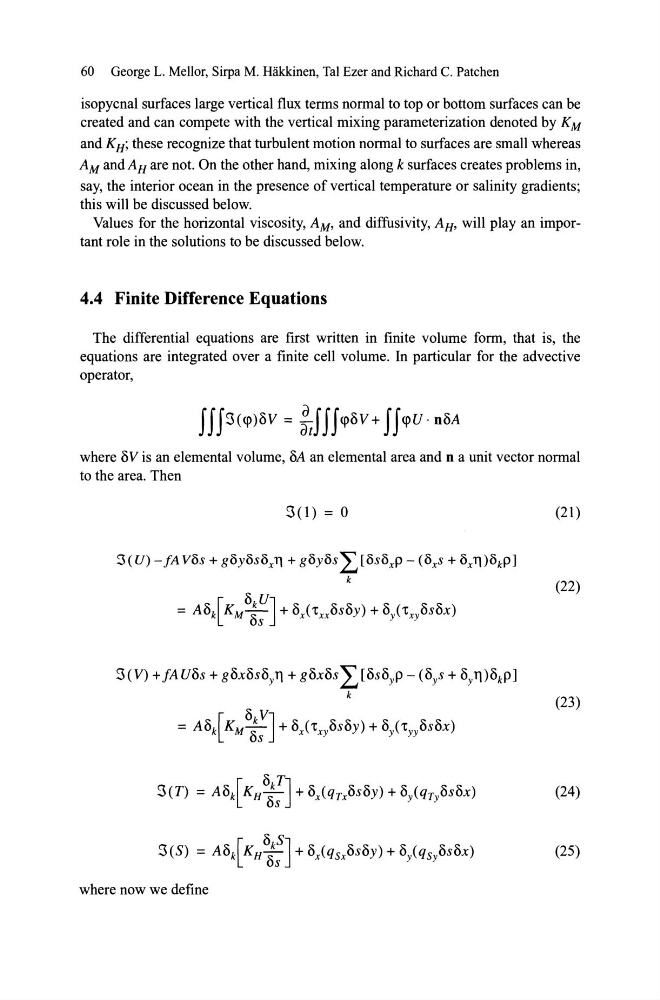
The differential equations are first written in finite volume form, that is, the
equations are integrated over a finite ceH volume. In particular for the advective
operator,
fff~(cp)OV = ;JffCPov+ ffcpu.noA
where OV is an elemental volume, oA an elemental area and n a unit vector normal
to the area. Then
~(1) = O
~(U) - fA VOS + goyOSOxT\ + goyos L[OSOxP - (Oxs + 0xT\)OkP]
k
~(V) + jAUos + goxosoyT\ + goxos L[OSOyP - (OyS + 0yT\)OkP]
k
where now we define
(21)
(22)
(23)
(24)
(25)
isopycnal surfaces large vertical flux terms normal to top or bottom surfaces can be
created and can compete with the vertical mixing parameterization denoted by KM
and K H ; these recognize that turbulent motion normal to surfaces are small whereas
AM and AH are not. On the other hand, mixing along k surfaces creates problems in,
say, the interior ocean in the presence of vertical temperature or salinity gradients;
this will be discussed below.
Values for the horizontal viscosity, AM' and diffusivity, AH' will play an important role in the solutions to be discussed below.
4.4 Finite Difference Equations
The differential equations are first written in finite volume form, that is, the
equations are integrated over a finite ceH volume. In particular for the advective
operator,
fff~(cp)OV = ;JffCPov+ ffcpu.noA
where OV is an elemental volume, oA an elemental area and n a unit vector normal
to the area. Then
~(1) = O
~(U) - fA VOS + goyOSOxT\ + goyos L[OSOxP - (Oxs + 0xT\)OkP]
k
~(V) + jAUos + goxosoyT\ + goxos L[OSOyP - (OyS + 0yT\)OkP]
k
where now we define
(21)
(22)
(23)
(24)
(25)