

30 Pierre-Yves Le Traon
Sterie effeet related to beat fluxes
The dominant signal in seasonal large-scale variations in sea level is due to beat
fluxes. Tbis has been well illustrated with TIP (e.g. Starnmer, 1997). It is important
to accurately estimate this effect before analyzing other dynarnically more significant effects, like the influence of wind forcing on circulation, for example.
jur/ace
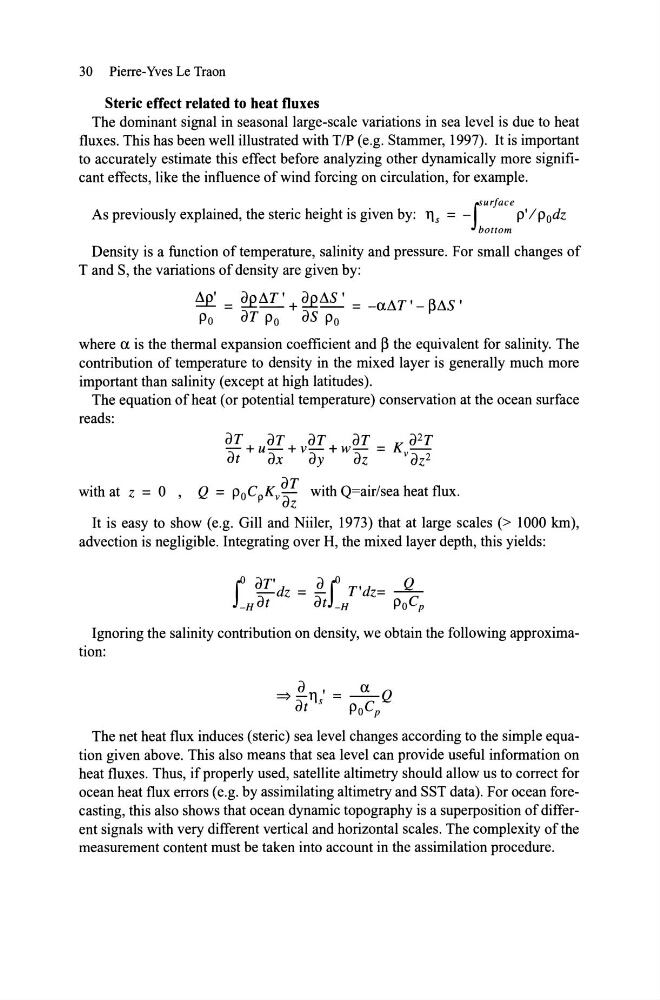
As previously explained, the steric height is given by: 11s = -J.
p' / Podz
bottom
Density is a function of temperature, salinity and pressure. For small changes of
T and S, the variations of density are given by:
~ = ~LlT' + ~LlS ' = -aLlT'- ~LlS'
Po
dT Po dS Po
where a is the thermal expansion coefficient and ~ the equivalent for salinity. The
contribution of temperature to density in the mixed layer is generally much more
important than salinity (except at high latitudes).
The equation of heat (or potential temperature) conservation at the ocean surf ace
reads:
dT + udT + vdT + wdT = K d 2 T
dt
dx
dy
dz
v dZ2
with at z = O , Q = PoCpKv ~~ with Q=air/sea heat flux.
It is easy to show (e.g. Gill and Niiler, 1973) that at large scales (> 1000 km),
advection is negligible. Integrating over R, the mixed layer depth, this yields:
f dT'dz = ~ f T'dz= -.iL
tHdt
dd_H
PoCp
Ignoring the salinity contribution on density, we obtain the following approximation:
=>~11' = ~Q
dt S
PoCp
The net heat flux induces (steric) sea level changes according to the simple equation given above. This also means that sea level can provide useful information on
heat fluxes. Thus, if properly used, satellite altimetry should allow us to correct for
ocean heat flux errors (e.g. by assimilating altimetry and SST data). For ocean forecasting, this also shows that ocean dynamic topography is a superposition of different signals with very different vertical and horizontal scales. The complexity ofthe
measurement content must be taken into account in the assimilation procedure.
Sterie effeet related to beat fluxes
The dominant signal in seasonal large-scale variations in sea level is due to beat
fluxes. Tbis has been well illustrated with TIP (e.g. Starnmer, 1997). It is important
to accurately estimate this effect before analyzing other dynarnically more significant effects, like the influence of wind forcing on circulation, for example.
jur/ace
As previously explained, the steric height is given by: 11s = -J.
p' / Podz
bottom
Density is a function of temperature, salinity and pressure. For small changes of
T and S, the variations of density are given by:
~ = ~LlT' + ~LlS ' = -aLlT'- ~LlS'
Po
dT Po dS Po
where a is the thermal expansion coefficient and ~ the equivalent for salinity. The
contribution of temperature to density in the mixed layer is generally much more
important than salinity (except at high latitudes).
The equation of heat (or potential temperature) conservation at the ocean surf ace
reads:
dT + udT + vdT + wdT = K d 2 T
dt
dx
dy
dz
v dZ2
with at z = O , Q = PoCpKv ~~ with Q=air/sea heat flux.
It is easy to show (e.g. Gill and Niiler, 1973) that at large scales (> 1000 km),
advection is negligible. Integrating over R, the mixed layer depth, this yields:
f dT'dz = ~ f T'dz= -.iL
tHdt
dd_H
PoCp
Ignoring the salinity contribution on density, we obtain the following approximation:
=>~11' = ~Q
dt S
PoCp
The net heat flux induces (steric) sea level changes according to the simple equation given above. This also means that sea level can provide useful information on
heat fluxes. Thus, if properly used, satellite altimetry should allow us to correct for
ocean heat flux errors (e.g. by assimilating altimetry and SST data). For ocean forecasting, this also shows that ocean dynamic topography is a superposition of different signals with very different vertical and horizontal scales. The complexity ofthe
measurement content must be taken into account in the assimilation procedure.