

Primitive Equation Modelling of Plankton Ecosystems
423
18.18.2 Experience in engineering
It is helpful to folIow the procedure used by engineers in analysing the source
errors in their systems (Ghanem and Knio 2001). Engineers analyse source errors
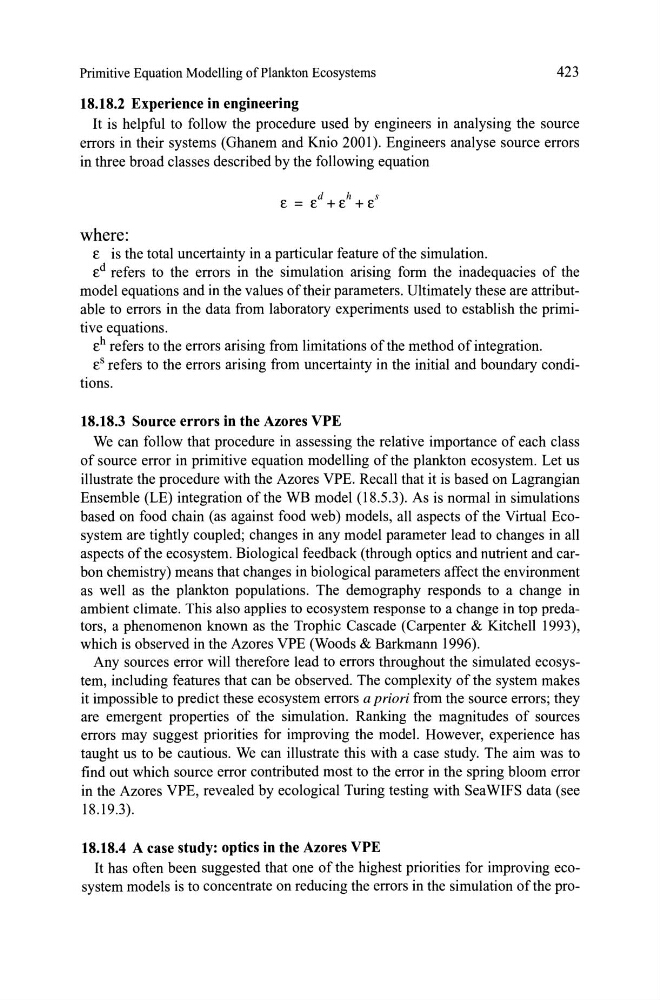
in three broad c1asses described by the folIowing equation
where:
E is the total uncertainty in a particular feature of the simulation.
E d refers to the errors in the simulation arising form the inadequacies of the
model equations and in the values of their parameters. Ultimately these are attributable to errors in the data from laboratory experiments used to establish the primitive equations.
E h refers to the errors arising from limitations of the method of integration.
E S refers to the errors arising from uncertainty in the initial and boundary conditions.
18.18.3 Source errors in the Azores VPE
We can folIow that procedure in assessing the relative importance of each c1ass
of source error in primitive equation modelling of the plankton ecosystem. Let us
illustrate the procedure with the Azores VPE. Recall that it is based on Lagrangian
Ensemble (LE) integration ofthe WB model (18.5.3). As is normal in simulations
based on food chain (as against food web) models, alI aspects of the Virtual Ecosystem are tightly coupled; changes in any model parameter lead to changes in alI
aspects ofthe ecosystem. Biological feedback (through optics and nutrient and carbon chemistry) means that changes in biological parameters affect the environment
as well as the plankton populations. The demography responds to a change in
ambient c1imate. This also applies to ecosystem response to a change in top predators, a phenomenon known as the Trophic Cascade (Carpenter & Kitchell 1993),
which is observed in the Azores VPE (Woods & Barkmann 1996).
Any sources error will therefore lead to errors throughout the simulated ecosystem, inc1uding features that can be observed. The complexity of the system makes
it impossible to predict these ecosystem errors a priori from the source errors; they
are emergent properties of the simulation. Ranking the magnitudes of sources
errors may suggest priorities for improving the model. However, experience has
taught us to be cautious. We can illustrate this with a case study. The aim was to
find out which source error contributed most to the error in the spring bloom error
in the Azores VPE, revealed by ecological Turing testing with SeaWIFS data (see
18.19.3).
18.18.4 A case study: optics in the Azores VPE
It has often been suggested that one of the highest priorities for improving ecosystem models is to concentrate on reducing the errors in the simulation of the pro-
423
18.18.2 Experience in engineering
It is helpful to folIow the procedure used by engineers in analysing the source
errors in their systems (Ghanem and Knio 2001). Engineers analyse source errors
in three broad c1asses described by the folIowing equation
where:
E is the total uncertainty in a particular feature of the simulation.
E d refers to the errors in the simulation arising form the inadequacies of the
model equations and in the values of their parameters. Ultimately these are attributable to errors in the data from laboratory experiments used to establish the primitive equations.
E h refers to the errors arising from limitations of the method of integration.
E S refers to the errors arising from uncertainty in the initial and boundary conditions.
18.18.3 Source errors in the Azores VPE
We can folIow that procedure in assessing the relative importance of each c1ass
of source error in primitive equation modelling of the plankton ecosystem. Let us
illustrate the procedure with the Azores VPE. Recall that it is based on Lagrangian
Ensemble (LE) integration ofthe WB model (18.5.3). As is normal in simulations
based on food chain (as against food web) models, alI aspects of the Virtual Ecosystem are tightly coupled; changes in any model parameter lead to changes in alI
aspects ofthe ecosystem. Biological feedback (through optics and nutrient and carbon chemistry) means that changes in biological parameters affect the environment
as well as the plankton populations. The demography responds to a change in
ambient c1imate. This also applies to ecosystem response to a change in top predators, a phenomenon known as the Trophic Cascade (Carpenter & Kitchell 1993),
which is observed in the Azores VPE (Woods & Barkmann 1996).
Any sources error will therefore lead to errors throughout the simulated ecosystem, inc1uding features that can be observed. The complexity of the system makes
it impossible to predict these ecosystem errors a priori from the source errors; they
are emergent properties of the simulation. Ranking the magnitudes of sources
errors may suggest priorities for improving the model. However, experience has
taught us to be cautious. We can illustrate this with a case study. The aim was to
find out which source error contributed most to the error in the spring bloom error
in the Azores VPE, revealed by ecological Turing testing with SeaWIFS data (see
18.19.3).
18.18.4 A case study: optics in the Azores VPE
It has often been suggested that one of the highest priorities for improving ecosystem models is to concentrate on reducing the errors in the simulation of the pro-