

398 John Woods
b)
e 3SO
ii
E
~
~:m
~
~
B
.!li
'O
c:
~
E
g
eL
Diatom versus eopepod populatioD
ou Ist lareh each year (or 2.5 years
Demographlc drift
due to slow rise In
nitrogen s10ck of
e~otic zone
501~0----~1~5------~ ro~----~25~----~~~----~~~----~~~--~~
Z(60) [thousand copepods per square metraJ
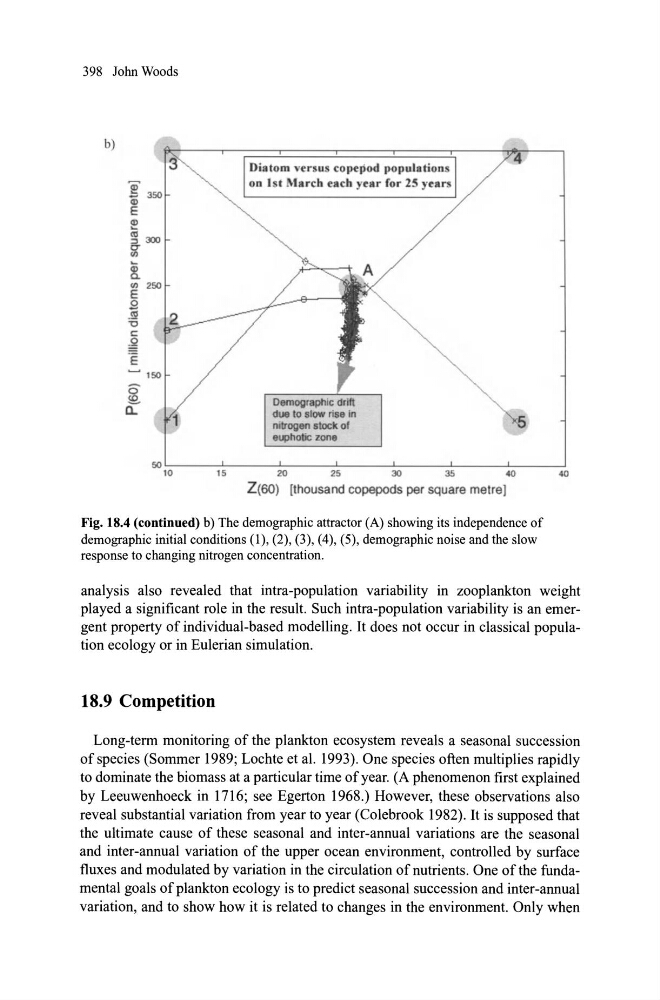
Fig. 18.4 (continued) b) The demographic attractor (A) showing its independence of
demographic initial conditions (1), (2), (3), (4), (5), demographic noise and the slow
response to changing nitrogen concentration.
analysis also revealed that intra-population variability in zooplankton weight
played a significant role in the result. Such intra-population variability is an emergent property of individual-based modelling. It does not occur in classical population ecology or in Eulerian simulation.
18.9 Competition
Long-term monitoring of the plankton ecosystem reveals a seasonal succes sion
of species (Sommer 1989; Lochte et al. 1993). One species often multiplies rapidly
to dominate the biomass at a particular time ofyear. (A phenomenon first explained
by Leeuwenhoeck in 1716; see Egerton 1968.) However, these observations also
reveal substantial variation from year to year (Colebrook 1982). It is supposed that
the ultimate cause of these seasonal and inter-annual variations are the seasonal
and inter-annual variation of the upper ocean environment, controlled by surface
fluxes and modulated by variation in the circulation of nutrients. One of the fundamental goals ofplankton ecology is to predict seasonal succession and inter-annual
variation, and to show how it is related to changes in the environment. Only when
b)
e 3SO
ii
E
~
~:m
~
~
B
.!li
'O
c:
~
E
g
eL
Diatom versus eopepod populatioD
ou Ist lareh each year (or 2.5 years
Demographlc drift
due to slow rise In
nitrogen s10ck of
e~otic zone
501~0----~1~5------~ ro~----~25~----~~~----~~~----~~~--~~
Z(60) [thousand copepods per square metraJ
Fig. 18.4 (continued) b) The demographic attractor (A) showing its independence of
demographic initial conditions (1), (2), (3), (4), (5), demographic noise and the slow
response to changing nitrogen concentration.
analysis also revealed that intra-population variability in zooplankton weight
played a significant role in the result. Such intra-population variability is an emergent property of individual-based modelling. It does not occur in classical population ecology or in Eulerian simulation.
18.9 Competition
Long-term monitoring of the plankton ecosystem reveals a seasonal succes sion
of species (Sommer 1989; Lochte et al. 1993). One species often multiplies rapidly
to dominate the biomass at a particular time ofyear. (A phenomenon first explained
by Leeuwenhoeck in 1716; see Egerton 1968.) However, these observations also
reveal substantial variation from year to year (Colebrook 1982). It is supposed that
the ultimate cause of these seasonal and inter-annual variations are the seasonal
and inter-annual variation of the upper ocean environment, controlled by surface
fluxes and modulated by variation in the circulation of nutrients. One of the fundamental goals ofplankton ecology is to predict seasonal succession and inter-annual
variation, and to show how it is related to changes in the environment. Only when