

394 John Woods
c)
zoopl81\1(\On .roj9CIory
zooplanl
o
' 0
1 11111111
'0
20
20
30
111 1111111
30
I40
î 40
~ 50
~50
a.
!
'O 60
~60
'" ~ 70
t 70
."
-a
80
80
90
90
360.
4200 I
'OD
I
I
IOD
JuM
JlAy
June
I
JuIy
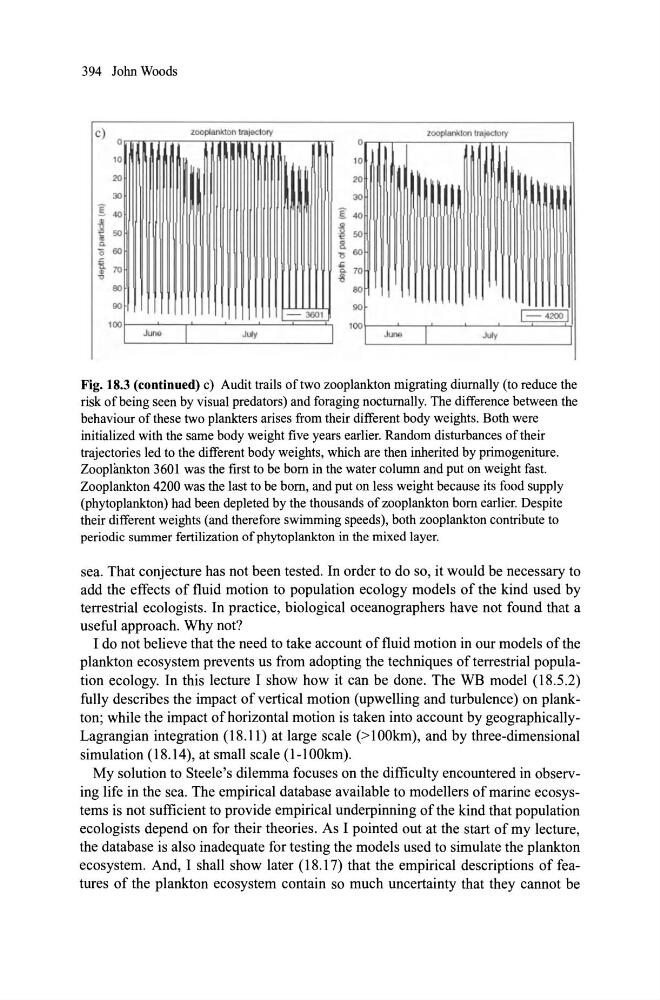
Fig. 18.3 (continued) c) Audit trails oftwo zooplankton migrating diurnally (to reduce the
risk ofbeing seen by visual predators) and foraging nocturnally. The ditference between the
behaviour of these two plankters arises from their ditferent body weights. Both were
initialized with the same body weight five years earlier. Random disturbances oftheir
trajectories led to the ditferent body weights, which are then inherited by primogeniture.
Zooplimkton 3601 was the first to be born in the water column and put on weight fast.
Zooplankton 4200 was the last to be born, and put on less weight because its food supply
(phytoplankton) had been depleted by the thousands ofzooplankton born earlier. Despite
their ditferent weights (and therefore swimming speeds), both zooplankton contribute to
periodic summer fertilization of phytoplankton in the mixed layer.
sea. That conjecture has not been tested. In order to do so, it would be necessary to
add the effects of fluid motion to populat ion ecology rnodels of the kind used by
terrestrial ecologists. In practice, biological oceanographers have not found that a
useful approach. Why not?
Ido not believe that the need to take account of fluid motion in our rnodels ofthe
plankton ecosystem prevents us from adopting the techniques of terrestrial population ecology. In this lecture 1 show how it can be done. The WB model (18.5.2)
fully describes the impact of vertical motion (upwelling and turbulence) on plankton; while the impact ofhorizontal motion is taken into account by geographicallyLagrangian integration (18.11) at large scale (> 1 OOkm), and by three-dimensional
simulation (18.14), at small scale (1-1 OOkm).
My solution to Steele's dilemma focuses on the difficulty encountered in observing life in the sea. The empirical database available to modellers of marine ecosystems is not sufficient to provide empirical underpinning of the kind that population
ecologists depend on for their theories. As I pointed out at the start of my lecture,
the database is also inadequate for testing the models used to simulate the plankton
ecosystem. And, 1 shall show later (18.17) that the empirical descriptions of features of the plankton ecosystem contain so much uncertainty that they cannot be
c)
zoopl81\1(\On .roj9CIory
zooplanl
o
' 0
1 11111111
'0
20
20
30
111 1111111
30
I40
î 40
~ 50
~50
a.
!
'O 60
~60
'" ~ 70
t 70
."
-a
80
80
90
90
360.
4200 I
'OD
I
I
IOD
JuM
JlAy
June
I
JuIy
Fig. 18.3 (continued) c) Audit trails oftwo zooplankton migrating diurnally (to reduce the
risk ofbeing seen by visual predators) and foraging nocturnally. The ditference between the
behaviour of these two plankters arises from their ditferent body weights. Both were
initialized with the same body weight five years earlier. Random disturbances oftheir
trajectories led to the ditferent body weights, which are then inherited by primogeniture.
Zooplimkton 3601 was the first to be born in the water column and put on weight fast.
Zooplankton 4200 was the last to be born, and put on less weight because its food supply
(phytoplankton) had been depleted by the thousands ofzooplankton born earlier. Despite
their ditferent weights (and therefore swimming speeds), both zooplankton contribute to
periodic summer fertilization of phytoplankton in the mixed layer.
sea. That conjecture has not been tested. In order to do so, it would be necessary to
add the effects of fluid motion to populat ion ecology rnodels of the kind used by
terrestrial ecologists. In practice, biological oceanographers have not found that a
useful approach. Why not?
Ido not believe that the need to take account of fluid motion in our rnodels ofthe
plankton ecosystem prevents us from adopting the techniques of terrestrial population ecology. In this lecture 1 show how it can be done. The WB model (18.5.2)
fully describes the impact of vertical motion (upwelling and turbulence) on plankton; while the impact ofhorizontal motion is taken into account by geographicallyLagrangian integration (18.11) at large scale (> 1 OOkm), and by three-dimensional
simulation (18.14), at small scale (1-1 OOkm).
My solution to Steele's dilemma focuses on the difficulty encountered in observing life in the sea. The empirical database available to modellers of marine ecosystems is not sufficient to provide empirical underpinning of the kind that population
ecologists depend on for their theories. As I pointed out at the start of my lecture,
the database is also inadequate for testing the models used to simulate the plankton
ecosystem. And, 1 shall show later (18.17) that the empirical descriptions of features of the plankton ecosystem contain so much uncertainty that they cannot be