

Primitive Equation Modelling ofPlankton Ecosystems
The WB food chain model
Boundary condi!ions
Envl ronment
Plank!on
Deui!us
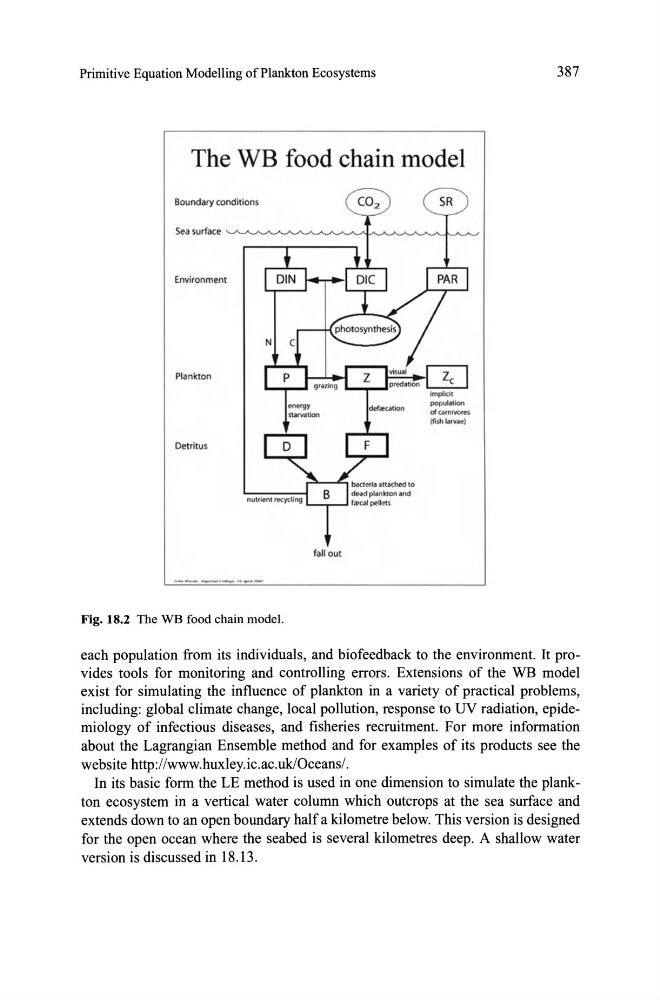
Fig. 18.2 The WB food chain model.
f.Uou!
population
~C..!IrnÎ'J'Ofei
(fi"''''''''
387
each population from its individuals, and biofeedback to the environment. It provides tools for monitoring and controlling errors. Extensions of the WB model
exist for simulating the influence of plankton in a variety of practical problems,
including: global climate change, local pollution, response to UV radiation, epidemiology of infectious diseases, and fisheries recruitment. For more information
about the Lagrangian Ensemble method and for examples of its products see the
web site http://www.huxley.ic.ac.uk/Oceans/.
In its basic form the LE method is used in one dimension to simulate the plankton ecosystem in a vertical water column which outcrops at the sea surface and
extends down to an open boundary half a kilometre below. This version is designed
for the open ocean where the seabed is several kilometres deep. A shallow water
versi on is discussed in 18.13.
The WB food chain model
Boundary condi!ions
Envl ronment
Plank!on
Deui!us
Fig. 18.2 The WB food chain model.
f.Uou!
population
~C..!IrnÎ'J'Ofei
(fi"''''''''
387
each population from its individuals, and biofeedback to the environment. It provides tools for monitoring and controlling errors. Extensions of the WB model
exist for simulating the influence of plankton in a variety of practical problems,
including: global climate change, local pollution, response to UV radiation, epidemiology of infectious diseases, and fisheries recruitment. For more information
about the Lagrangian Ensemble method and for examples of its products see the
web site http://www.huxley.ic.ac.uk/Oceans/.
In its basic form the LE method is used in one dimension to simulate the plankton ecosystem in a vertical water column which outcrops at the sea surface and
extends down to an open boundary half a kilometre below. This version is designed
for the open ocean where the seabed is several kilometres deep. A shallow water
versi on is discussed in 18.13.