

Primitive Equation Modelling ofPlankton Ecosystems
385
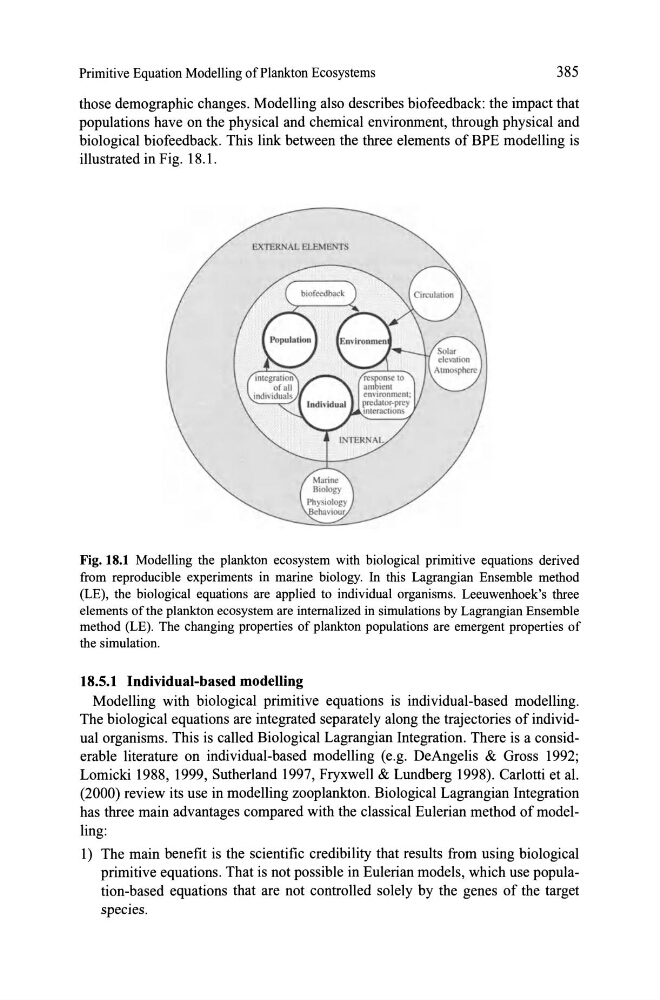
those demographic changes. Modelling also describes biofeedback: the impact that
populations have on the physical and chemi cal environment, through physical and
biological biofeedback. This link between the three elements of BPE modelling is
illustrated in Fig. 18.1.
EXTERNAL ELEMENTS
Fig. 18.1 Modelling the plankton ecosystem with biologic al primitive equations derived
from reproducible experiments in marine biology. In this Lagrangian Ensemble method
(LE), the biologica] equations are applied to individual organisms. Leeuwenhoek's three
elements ofthe plankton ecosystem are intemalized in simulations by Lagrangian Ensemble
method (LE). The changing properties of plankton populations are emergent properties of
the simulation.
18.5.1 Individual-based modelling
Modelling with biological primitive equations is individual-based modelling.
The biological equations are integrated separately along the trajectories of individual organisms. This is called Biological Lagrangian Integration. There is a considerable literature on individual-based modelling (e.g. DeAngelis & Gross 1992;
Lomicki 1988, 1999, Sutherland 1997, Fryxwell & Lundberg 1998). Carlotti et al.
(2000) review its use in modelling zooplankton. Biological Lagrangian Integration
has three main advantages compared with the classical Eulerian method of modelling:
1) The main benefit is the scientific credibility that results from using biological
primitive equations. That is not possible in Eulerian models, which use population-based equations that are not controlled solely by the genes of the target
species.
385
those demographic changes. Modelling also describes biofeedback: the impact that
populations have on the physical and chemi cal environment, through physical and
biological biofeedback. This link between the three elements of BPE modelling is
illustrated in Fig. 18.1.
EXTERNAL ELEMENTS
Fig. 18.1 Modelling the plankton ecosystem with biologic al primitive equations derived
from reproducible experiments in marine biology. In this Lagrangian Ensemble method
(LE), the biologica] equations are applied to individual organisms. Leeuwenhoek's three
elements ofthe plankton ecosystem are intemalized in simulations by Lagrangian Ensemble
method (LE). The changing properties of plankton populations are emergent properties of
the simulation.
18.5.1 Individual-based modelling
Modelling with biological primitive equations is individual-based modelling.
The biological equations are integrated separately along the trajectories of individual organisms. This is called Biological Lagrangian Integration. There is a considerable literature on individual-based modelling (e.g. DeAngelis & Gross 1992;
Lomicki 1988, 1999, Sutherland 1997, Fryxwell & Lundberg 1998). Carlotti et al.
(2000) review its use in modelling zooplankton. Biological Lagrangian Integration
has three main advantages compared with the classical Eulerian method of modelling:
1) The main benefit is the scientific credibility that results from using biological
primitive equations. That is not possible in Eulerian models, which use population-based equations that are not controlled solely by the genes of the target
species.