

ENSO Predictions with Coupled Ocean Atmosphere Models
331
SST Anomaly Correlation, NINO-3
1.0
0.8
0.6
0.4
0.2
0.0
..
".. ,,:' ........... ; ., .... ~ ..... _----------',
....... \. ..........
FhA (Jul)
... \; .. , SDA 1 (Jan)
-,
\ "
,
\"~'" .............. :;;::.:.:.:.:.:.\
'\
..... ,... '., \
, ' , '
' .,
\
" . . . . . . . f..
. . . .
\ /" . .
.... , ....... ,
f;..
\ , ..........
v
\ . \ .
\".....
X SDA2(Jan)
" ......
" \
Persistence (Jan) '\.\ ...... : ..... :.< . . . . . . . . ~>"
2
4
6
8
\.~.o
··h .....
\.\._._._._._ ..
forecast lead in months
-0.2
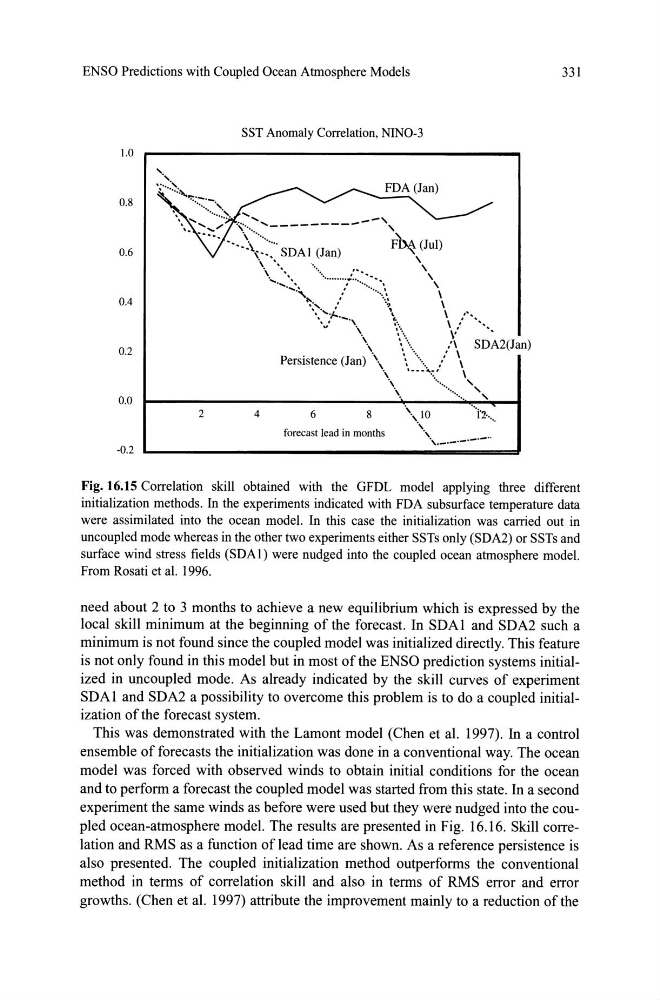
Fig. 16.15 Correlation skill obtained with the GFDL model applying three different
initialization methods. In the experiments indicated with FDA subsurface temperature data
were assimilated into the ocean model. In this case the initialization was carried out in
uncoupled mode whereas in the other two experiments either SSTs only (SDA2) Of SSTs and
surface wind stress fields (SDAI) were nudged into the coupled ocean atmosphere model.
From Rosati et al. 1996.
need about 2 to 3 months to achieve a new equilibrium which is expres sed by the
local skill minimum at the beginning of the forecast. In SDAI and SDA2 such a
minimum is not found since the coupled model was initialized directly. This feature
is not only found in this model but in most of the ENSO prediction systems initialized in uncoupled mode. As already indicated by the skill curves of experiment
SDAI and SDA2 a possibility to overcome this problem is to do a coupled initialization of the forecast system.
This was demonstrated with the Lamont model (Chen et al. 1997). In a control
ensemble of forecasts the initialization was done in a conventional way. The ocean
model was forced with observed winds to obtain initial conditions for the ocean
and to perform a forecast the coupled model was started from this state. In a second
experiment the same winds as before were used but they were nudged into the coupled ocean-atmosphere model. The results are presented in Fig. 16.16. Skill correlation and RMS as a function of lead time are shown. As a reference persistence is
also presented. The coupled initialization method outperforms the conventional
method in terms of correlation skill and also in terms of RMS error and error
growths. (Chen et al. 1997) attribute the improvement mainly to a reduction ofthe
331
SST Anomaly Correlation, NINO-3
1.0
0.8
0.6
0.4
0.2
0.0
..
".. ,,:' ........... ; ., .... ~ ..... _----------',
....... \. ..........
FhA (Jul)
... \; .. , SDA 1 (Jan)
-,
\ "
,
\"~'" .............. :;;::.:.:.:.:.:.\
'\
..... ,... '., \
, ' , '
' .,
\
" . . . . . . . f..
. . . .
\ /" . .
.... , ....... ,
f;..
\ , ..........
v
\ . \ .
\".....
X SDA2(Jan)
" ......
" \
Persistence (Jan) '\.\ ...... : ..... :.< . . . . . . . . ~>"
2
4
6
8
\.~.o
··h .....
\.\._._._._._ ..
forecast lead in months
-0.2
Fig. 16.15 Correlation skill obtained with the GFDL model applying three different
initialization methods. In the experiments indicated with FDA subsurface temperature data
were assimilated into the ocean model. In this case the initialization was carried out in
uncoupled mode whereas in the other two experiments either SSTs only (SDA2) Of SSTs and
surface wind stress fields (SDAI) were nudged into the coupled ocean atmosphere model.
From Rosati et al. 1996.
need about 2 to 3 months to achieve a new equilibrium which is expres sed by the
local skill minimum at the beginning of the forecast. In SDAI and SDA2 such a
minimum is not found since the coupled model was initialized directly. This feature
is not only found in this model but in most of the ENSO prediction systems initialized in uncoupled mode. As already indicated by the skill curves of experiment
SDAI and SDA2 a possibility to overcome this problem is to do a coupled initialization of the forecast system.
This was demonstrated with the Lamont model (Chen et al. 1997). In a control
ensemble of forecasts the initialization was done in a conventional way. The ocean
model was forced with observed winds to obtain initial conditions for the ocean
and to perform a forecast the coupled model was started from this state. In a second
experiment the same winds as before were used but they were nudged into the coupled ocean-atmosphere model. The results are presented in Fig. 16.16. Skill correlation and RMS as a function of lead time are shown. As a reference persistence is
also presented. The coupled initialization method outperforms the conventional
method in terms of correlation skill and also in terms of RMS error and error
growths. (Chen et al. 1997) attribute the improvement mainly to a reduction ofthe