

ENSO Predictions with Coupled Ocean Atmosphere Models
2.0
1.0
0.0
-1.0
-2.0 82
84
86
88
year
real part
-imaginary part
90
92
313
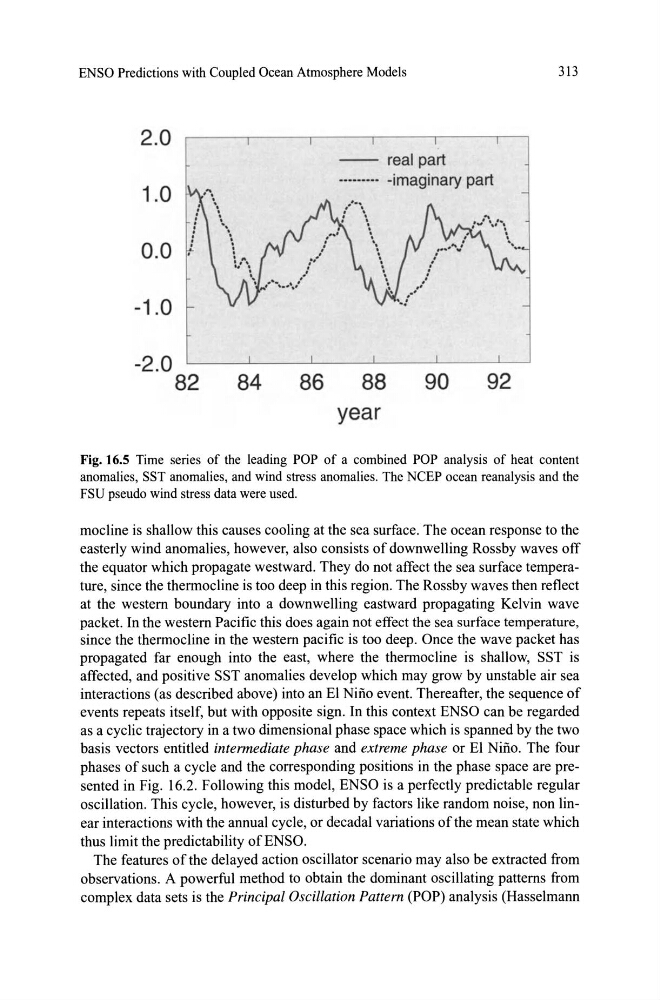
Fig. 16.5 Time series of the leading POP of a combined POP analysis of heat content
anomalies, SST anomalies, and wind stress anomalies. The NCEP ocean reanalysis and the
FSU pseudo wind stress data were used.
mocline is shallow this causes cooling at the sea surface. The ocean response to the
easterly wind anomalies, however, also consists of downwelling Rossby waves off
the equator which propagate westward. They do not affect the sea surface temperature, since the thermocline is too deep in this region. The Rossby waves then reflect
at the westem boundary into a downwelling eastward propagating Kelvin wave
packet. In the westem Pacific this does again not effect the sea surface temperature,
since the thermocline in the westem pacific is too deep. Once the wave packet has
propagated far enough into the east, where the thermocline is shallow, SST is
affected, and positive SST anomalies develop which may grow by unstable air sea
interactions (as described above) into an EI Nifio event. Thereafter, the sequence of
events repeats itself, but with opposite sign. In this context ENSO can be regarded
as a cyclic trajectory in a two dimensional phase space which is spanned by the two
basis vectors entitled intermediate phase and extreme phase or EI Nifio. The four
phases of such a cycle and the corresponding positions in the phase space are presented in Fig. 16.2. Following this model, ENSO is a perfectly predictable regular
osci1lation. This cycle, however, is disturbed by factors like random noise, non linear interactions with the annual cycle, or decadal variations of the mean state which
thus limit the predictability ofENSO.
The features of the delayed action oscillator scenario may also be extracted from
observations. A powerful method to obtain the dominant oscillating pattems from
complex data sets is the Principal Oscillation Pattern (POP) analysis (Hasselmann
2.0
1.0
0.0
-1.0
-2.0 82
84
86
88
year
real part
-imaginary part
90
92
313
Fig. 16.5 Time series of the leading POP of a combined POP analysis of heat content
anomalies, SST anomalies, and wind stress anomalies. The NCEP ocean reanalysis and the
FSU pseudo wind stress data were used.
mocline is shallow this causes cooling at the sea surface. The ocean response to the
easterly wind anomalies, however, also consists of downwelling Rossby waves off
the equator which propagate westward. They do not affect the sea surface temperature, since the thermocline is too deep in this region. The Rossby waves then reflect
at the westem boundary into a downwelling eastward propagating Kelvin wave
packet. In the westem Pacific this does again not effect the sea surface temperature,
since the thermocline in the westem pacific is too deep. Once the wave packet has
propagated far enough into the east, where the thermocline is shallow, SST is
affected, and positive SST anomalies develop which may grow by unstable air sea
interactions (as described above) into an EI Nifio event. Thereafter, the sequence of
events repeats itself, but with opposite sign. In this context ENSO can be regarded
as a cyclic trajectory in a two dimensional phase space which is spanned by the two
basis vectors entitled intermediate phase and extreme phase or EI Nifio. The four
phases of such a cycle and the corresponding positions in the phase space are presented in Fig. 16.2. Following this model, ENSO is a perfectly predictable regular
osci1lation. This cycle, however, is disturbed by factors like random noise, non linear interactions with the annual cycle, or decadal variations of the mean state which
thus limit the predictability ofENSO.
The features of the delayed action oscillator scenario may also be extracted from
observations. A powerful method to obtain the dominant oscillating pattems from
complex data sets is the Principal Oscillation Pattern (POP) analysis (Hasselmann