

ENSO Predictions with Coupled Ocean Atmosphere Models
Normal Conditions
r - - - - ..... - - -con~ective-loop - ,
t
convection
trade winds
•
.. .... .... -ro ----------------,--------------------;)ro
~ ~arm pool
.~
....,
\{\e
~
~
oc\
5
~
'ţ"e{~
.....
..c
....,
;:l
O
CI)
....,
;:l
O
CI)
El Nino Conditions
r---------' convective loop
convectio 1 d ' d t
III tra e wm s
ro ____________________________________ ~
.~
~
....,
II)
ro
U.l
..c: ....,
;:l
o
CI)
Thermocline
(j)
E
;:l
o
CI)
309
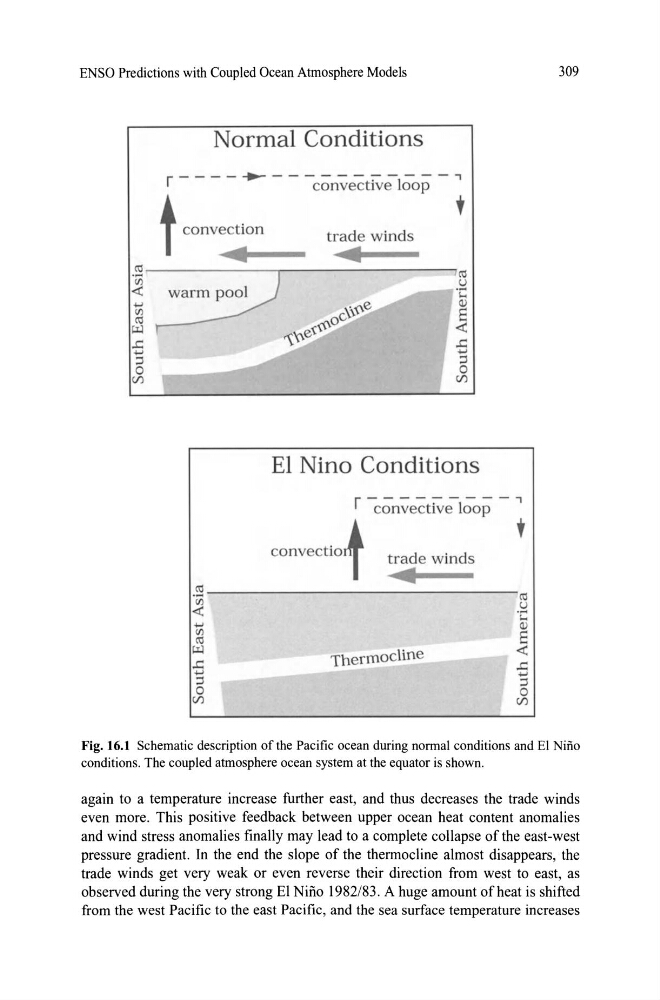
Fig. 16.1 Schematic description ofthe Pacific ocean during normal conditions and El Nifio
conditions. The coupled atmosphere ocean system at the equator is shown.
again to a temperature increase further east, and thus decreases the trade winds
even more. This positive feedback between upper ocean heat content anomalies
and wind stress anomalies finally may lead to a complete collapse of the east-west
pressure gradient. In the end the slope of the thermocline almost disappears, the
trade winds get very weak or even reverse their direction from west to east, as
observed during the very strong El Niiio 1982/83. A huge amount ofheat is shifted
from the west Pacific to the east Pacific, and the sea surface temperature increases
Normal Conditions
r - - - - ..... - - -con~ective-loop - ,
t
convection
trade winds
•
.. .... .... -ro ----------------,--------------------;)ro
~ ~arm pool
.~
....,
\{\e
~
~
oc\
5
~
'ţ"e{~
.....
..c
....,
;:l
O
CI)
....,
;:l
O
CI)
El Nino Conditions
r---------' convective loop
convectio 1 d ' d t
III tra e wm s
ro ____________________________________ ~
.~
~
....,
II)
ro
U.l
..c: ....,
;:l
o
CI)
Thermocline
(j)
E
;:l
o
CI)
309
Fig. 16.1 Schematic description ofthe Pacific ocean during normal conditions and El Nifio
conditions. The coupled atmosphere ocean system at the equator is shown.
again to a temperature increase further east, and thus decreases the trade winds
even more. This positive feedback between upper ocean heat content anomalies
and wind stress anomalies finally may lead to a complete collapse of the east-west
pressure gradient. In the end the slope of the thermocline almost disappears, the
trade winds get very weak or even reverse their direction from west to east, as
observed during the very strong El Niiio 1982/83. A huge amount ofheat is shifted
from the west Pacific to the east Pacific, and the sea surface temperature increases