

304 Pierre De Mey and Mounir Benkiran
Appendix A. Properties of the order-reduction operator S
Let us call an "increment vector" any variation of that vector, i.e. ()x a variation
of the state x. The problem at hand is to fmd the state increment that minimizes
some optimality criterion. In the order-reduction approach followed in this chapter, the optimal solution is sought in the subspace defined by the simplification
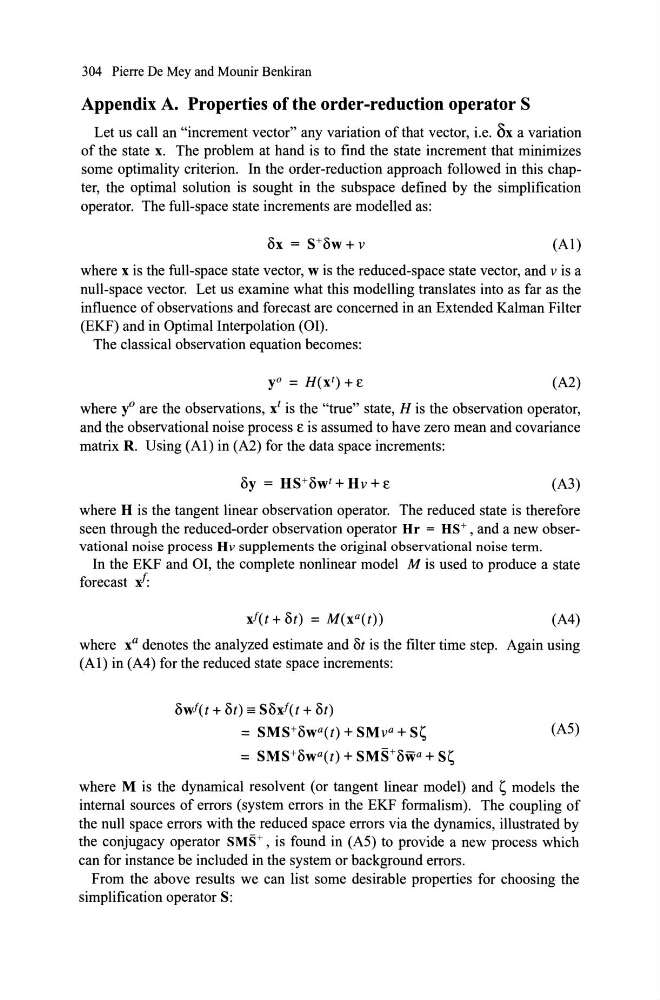
operator. The full-space state increments are modelled as:
Ox = S+Ow+v
(Al)
where x is the full-space state vector, w is the reduced-space state vector, and v is a
null-space vector. Let us examine what this modelling translates into as far as the
influence of observations and forecast are concerned in an Extended Kalman Filter
(EKF) and in Optimal Interpolation (OI).
The classical observation equation becomes:
(A2)
where yO are the observations, x t is the "true" state, H is the observation operator,
and the observational noise process E is assumed to have zero mean and covariance
matrix R. Using (Al) in (A2) for the data space increments:
(A3)
where H is the tangent linear observation operator. The reduced state is therefore
seen through the reduced-order observation operator Hr = HS+, and a new observational noise process Hv supplements the original observational noise tenn.
In the EKF and OI, the complete nonlinear model M is used to produce a state
forecast J':
(A4)
where x a denotes the analyzed estimate and Ot is the filter time step. Again using
(Al) in (A4) for the reduced state space increments:
Owf(t + Ot) == SOxf(t + Ot)
= SMS+owa(t) + SMv a + SI;
(A5)
= SMS+owa(t) + SMS+Ow a + SI;
where M is the dynamical resolvent (or tangent linear model) and 1; models the
internal sources of errors (system errors in the EKF formalism). The coupling of
the null space errors with the reduced space errors via the dynamics, illustrated by
the conjugacy operator SMS+ , is found in (A5) to provide a new process which
can for instance be included in the system or background errors.
From the above results we can list some desirable properties for choosing the
simplification operator S:
Appendix A. Properties of the order-reduction operator S
Let us call an "increment vector" any variation of that vector, i.e. ()x a variation
of the state x. The problem at hand is to fmd the state increment that minimizes
some optimality criterion. In the order-reduction approach followed in this chapter, the optimal solution is sought in the subspace defined by the simplification
operator. The full-space state increments are modelled as:
Ox = S+Ow+v
(Al)
where x is the full-space state vector, w is the reduced-space state vector, and v is a
null-space vector. Let us examine what this modelling translates into as far as the
influence of observations and forecast are concerned in an Extended Kalman Filter
(EKF) and in Optimal Interpolation (OI).
The classical observation equation becomes:
(A2)
where yO are the observations, x t is the "true" state, H is the observation operator,
and the observational noise process E is assumed to have zero mean and covariance
matrix R. Using (Al) in (A2) for the data space increments:
(A3)
where H is the tangent linear observation operator. The reduced state is therefore
seen through the reduced-order observation operator Hr = HS+, and a new observational noise process Hv supplements the original observational noise tenn.
In the EKF and OI, the complete nonlinear model M is used to produce a state
forecast J':
(A4)
where x a denotes the analyzed estimate and Ot is the filter time step. Again using
(Al) in (A4) for the reduced state space increments:
Owf(t + Ot) == SOxf(t + Ot)
= SMS+owa(t) + SMv a + SI;
(A5)
= SMS+owa(t) + SMS+Ow a + SI;
where M is the dynamical resolvent (or tangent linear model) and 1; models the
internal sources of errors (system errors in the EKF formalism). The coupling of
the null space errors with the reduced space errors via the dynamics, illustrated by
the conjugacy operator SMS+ , is found in (A5) to provide a new process which
can for instance be included in the system or background errors.
From the above results we can list some desirable properties for choosing the
simplification operator S: