

A Multivariate Reduced-order Optimal Interpolation Method and its Application
293
a)
rms mistit T(120)
0.0
.'
, ,' , " .. :-- :--- ....... ' ,~, .• . " ... ', ... - .. ~' ...
., ' ,
... . ,
' .. '.:- .- _ .•. . . ' ..... .
' ... :~.....
" .
~
'" " ~ '
0.0
o .•
rms mistit T(280)
b) o.,
o ...
o .•
0.25
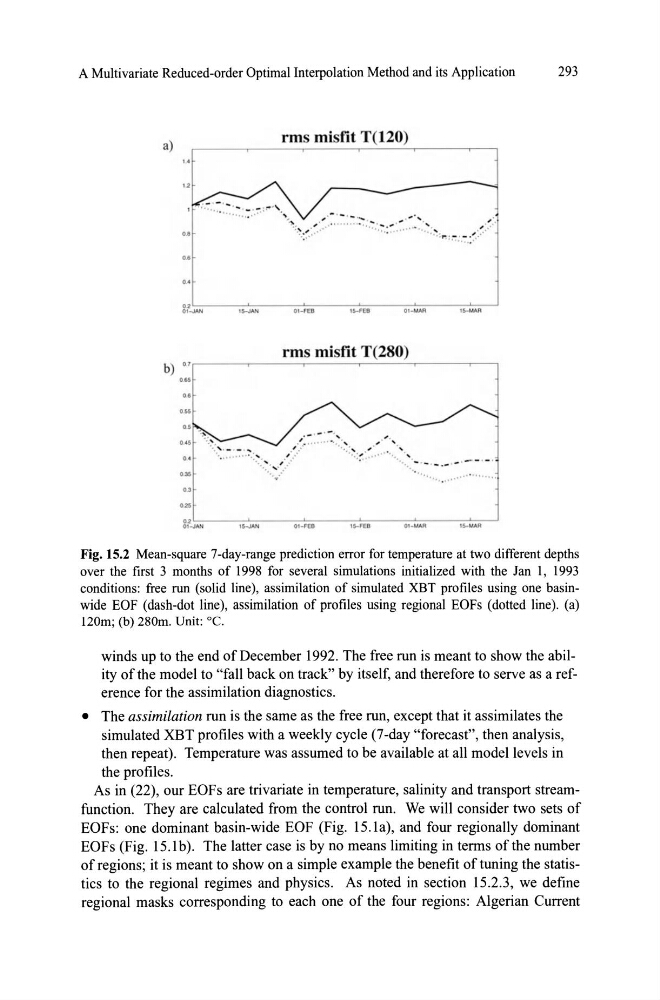
Fig. 15.2 Mean-square 7-day-range prediction error for temperature at two different depths
over the tirst 3 months of 1998 for several simulations initialized with the Jan 1, 1993
conditions: free run (solid line), assimilation of simulated XBT protiles using one basinwide EOF (dash-dot line), assimilation of profiles using regional EOFs (dotted line). (a)
120m; (b) 280m. Unit: ac.
winds up to the end of December 1992. The free run is meant to show the ability of the model to "fali back on track" by itself, and therefore to serve as a reference for the assimilation diagnostics.
• The assimilation run is the same as the free run, except that it assimilates the
simulated XBT profiles with a weekly cyc1e (7-day "forecast", then analysis,
then repeat). Temperature was assumed to be available at ali modellevels in
the profiles.
As in (22), our EOFs are trivariate in temperature, salinity and transport streamfunction. They are calculated from the control ron. We will consider two sets of
EOFs: one dominant basin-wide EOF (Fig. 15.1a), and four regionally dominant
EOFs (Fig. 15.1 b). The latter case is by no means limiting in terms of the number
of regions; it is meant to show on a simple example the benefit of tuning the statistics to the regional regimes and physics. As noted in section 15.2.3, we detine
regional masks corresponding to each one of the four regions: Aigerian Current
293
a)
rms mistit T(120)
0.0
.'
, ,' , " .. :-- :--- ....... ' ,~, .• . " ... ', ... - .. ~' ...
., ' ,
... . ,
' .. '.:- .- _ .•. . . ' ..... .
' ... :~.....
" .
~
'" " ~ '
0.0
o .•
rms mistit T(280)
b) o.,
o ...
o .•
0.25
Fig. 15.2 Mean-square 7-day-range prediction error for temperature at two different depths
over the tirst 3 months of 1998 for several simulations initialized with the Jan 1, 1993
conditions: free run (solid line), assimilation of simulated XBT protiles using one basinwide EOF (dash-dot line), assimilation of profiles using regional EOFs (dotted line). (a)
120m; (b) 280m. Unit: ac.
winds up to the end of December 1992. The free run is meant to show the ability of the model to "fali back on track" by itself, and therefore to serve as a reference for the assimilation diagnostics.
• The assimilation run is the same as the free run, except that it assimilates the
simulated XBT profiles with a weekly cyc1e (7-day "forecast", then analysis,
then repeat). Temperature was assumed to be available at ali modellevels in
the profiles.
As in (22), our EOFs are trivariate in temperature, salinity and transport streamfunction. They are calculated from the control ron. We will consider two sets of
EOFs: one dominant basin-wide EOF (Fig. 15.1a), and four regionally dominant
EOFs (Fig. 15.1 b). The latter case is by no means limiting in terms of the number
of regions; it is meant to show on a simple example the benefit of tuning the statistics to the regional regimes and physics. As noted in section 15.2.3, we detine
regional masks corresponding to each one of the four regions: Aigerian Current