

284 Pierre De Mey and Mounir Benkiran
(8)
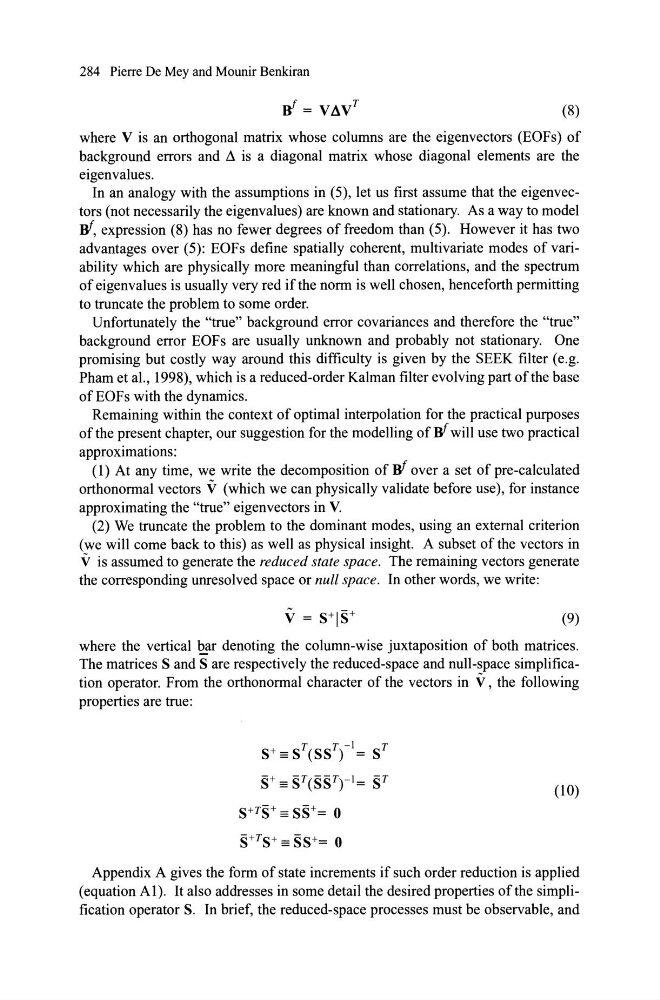
where V is an orthogonal matrix whose columns are the eigenvectors (EOFs) of
background errors and L1 is a diagonal matrix whose diagonal elements are the
eigenvalues.
In an analogy with the assumptions in (5), let us first as sume that the eigenvectors (not necessarily the eigenvalues) are known and stationary. As a way to model
.sf, expression (8) has no fewer degrees of freedom than (5). However it has two
advantages over (5): EOFs define spatially coherent, multivariate modes of variability which are physically more meaningful than correlations, and the spectrum
of eigenvalues is usually very red if the norm is well chosen, henceforth permitting
to truncate the problem to some order.
Unfortunately the "true" background error covariances and therefore the "true"
background error EOFs are usually unknown and probably not stationary. One
promising but costly way around this difficulty is given by the SEEK filter (e.g.
Pham et al., 1998), which is a reduced-order Kalman filter evolving part ofthe base
ofEOFs with the dynamics.
Remaining within the context of optimal interpolation for the practical purposes
of the present chapter, our suggestion for the modelling of.sf will use two practical
approximations:
(1) At any time, we write the decomposition of .sf over a set of pre-calculated
orthonormal vectors V (which we can physically validate before use), for instance
approximating the "true" eigenvectors in V.
(2) We truncate the problem to the dominant modes, using an external criterion
(we will come back to this) as well as physical insight. A subset ofthe vectors in
V is assumed to generate the reduced state space. The remaining vectors generate
the corresponding unresolved space or null space. In other words, we write:
(9)
where the vertical ~r denoting the column-wise juxtaposition of both matrices.
The matrices S and Sare respectively the reduced-space and null-space simplification operator. From the orthonormal character of the vectors in V, the following
properties are true:
S+ == ST(SST) -1 = ST
S+ == ST(SST)-I= ST
S+TS+ == SS+ = O
S+TS+ == SS+= O
(10)
Appendix A gives the form of state increments if such order reduction is applied
(equation Al). It also addresses in some detail the desired properties ofthe simplification operator S. In brief, the reduced-space processes must be observable, and
(8)
where V is an orthogonal matrix whose columns are the eigenvectors (EOFs) of
background errors and L1 is a diagonal matrix whose diagonal elements are the
eigenvalues.
In an analogy with the assumptions in (5), let us first as sume that the eigenvectors (not necessarily the eigenvalues) are known and stationary. As a way to model
.sf, expression (8) has no fewer degrees of freedom than (5). However it has two
advantages over (5): EOFs define spatially coherent, multivariate modes of variability which are physically more meaningful than correlations, and the spectrum
of eigenvalues is usually very red if the norm is well chosen, henceforth permitting
to truncate the problem to some order.
Unfortunately the "true" background error covariances and therefore the "true"
background error EOFs are usually unknown and probably not stationary. One
promising but costly way around this difficulty is given by the SEEK filter (e.g.
Pham et al., 1998), which is a reduced-order Kalman filter evolving part ofthe base
ofEOFs with the dynamics.
Remaining within the context of optimal interpolation for the practical purposes
of the present chapter, our suggestion for the modelling of.sf will use two practical
approximations:
(1) At any time, we write the decomposition of .sf over a set of pre-calculated
orthonormal vectors V (which we can physically validate before use), for instance
approximating the "true" eigenvectors in V.
(2) We truncate the problem to the dominant modes, using an external criterion
(we will come back to this) as well as physical insight. A subset ofthe vectors in
V is assumed to generate the reduced state space. The remaining vectors generate
the corresponding unresolved space or null space. In other words, we write:
(9)
where the vertical ~r denoting the column-wise juxtaposition of both matrices.
The matrices S and Sare respectively the reduced-space and null-space simplification operator. From the orthonormal character of the vectors in V, the following
properties are true:
S+ == ST(SST) -1 = ST
S+ == ST(SST)-I= ST
S+TS+ == SS+ = O
S+TS+ == SS+= O
(10)
Appendix A gives the form of state increments if such order reduction is applied
(equation Al). It also addresses in some detail the desired properties ofthe simplification operator S. In brief, the reduced-space processes must be observable, and