

282 Pierre De Mey and Mounir Benkiran
and De Mey, 1997) and consistent with the large-scale conservation of properties
(Cooper and Haines, 1996). One of the advantages of the method presented here
over previous statistical methods based on regression in the ocean (e.g. Mellor and
Ezer, 1991; Oschlies and Willebrand, 1996) lies in the fact that it directly derives
from the Reduced-Order Extended Kalman Filter (ROEKF) equations. Therefore
the assumptions and limitations can be clearly stated, and it is relatively straightforward to add a forecast error estimation scheme.
Section 15.2 describes the assimilation algorithm, rationale and limitations. Section 15.3 deals with some results of applying the algorithm to basin-scale circulation estimation in the Mediterranean in twin experiments and with real
observations. A briefperspective is given in section 15.4.
15.2 Optimal Interpolation on a base of EOFs
15.2.1 Optimal interpolation
We will use the Ide et al. (1997) classic notations. In the Extended Kalman Filter
(EKF, e.g. Gelb, 1974), observations yO are forrnally linked to the true state Xl by
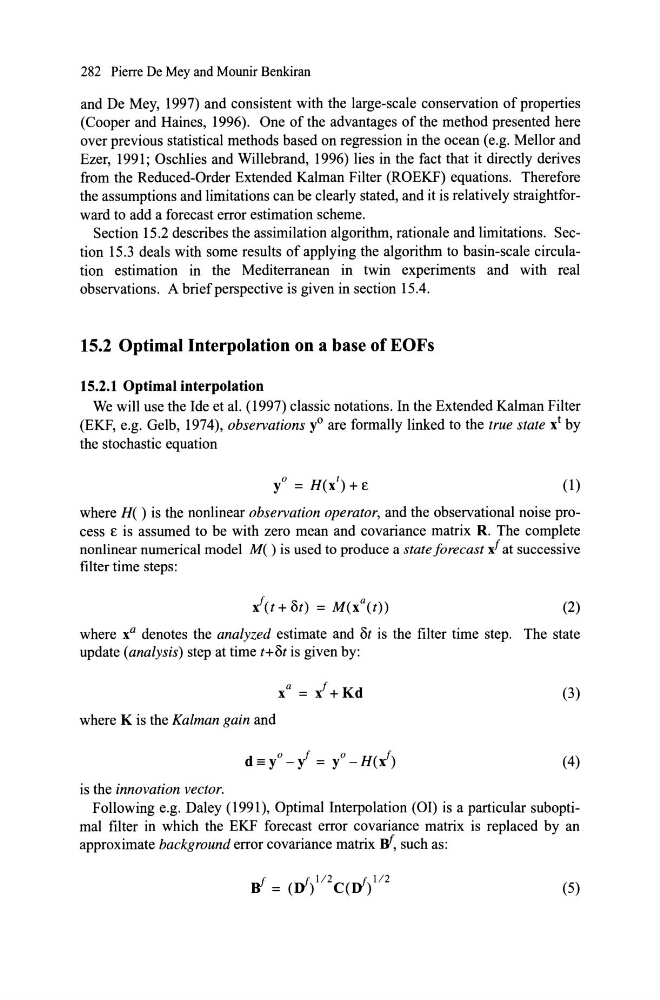
the stochastic equation
(1)
where H( ) is the nonlinear observation operator, and the observational noi se process t is assumed to be with zero mean and covariance matrix R. The complete
nonlinear numerical model M() is used to produce a state forecast xi at successive
filter time steps:
(2)
where x a denotes the analyzed estimate and Dt is the filter time step. The state
update (analysis) step at time t+Ot is given by:
(3)
where K is the Kalman gain and
(4)
is the innovation vector.
Following e.g. Daley (1991), Optimal Interpolation (OI) is a particular suboptimal filter in which the EKF forecast error covariance matrix is replaced by an
approximate background error covariance matrix sf, such as:
(5)
and De Mey, 1997) and consistent with the large-scale conservation of properties
(Cooper and Haines, 1996). One of the advantages of the method presented here
over previous statistical methods based on regression in the ocean (e.g. Mellor and
Ezer, 1991; Oschlies and Willebrand, 1996) lies in the fact that it directly derives
from the Reduced-Order Extended Kalman Filter (ROEKF) equations. Therefore
the assumptions and limitations can be clearly stated, and it is relatively straightforward to add a forecast error estimation scheme.
Section 15.2 describes the assimilation algorithm, rationale and limitations. Section 15.3 deals with some results of applying the algorithm to basin-scale circulation estimation in the Mediterranean in twin experiments and with real
observations. A briefperspective is given in section 15.4.
15.2 Optimal Interpolation on a base of EOFs
15.2.1 Optimal interpolation
We will use the Ide et al. (1997) classic notations. In the Extended Kalman Filter
(EKF, e.g. Gelb, 1974), observations yO are forrnally linked to the true state Xl by
the stochastic equation
(1)
where H( ) is the nonlinear observation operator, and the observational noi se process t is assumed to be with zero mean and covariance matrix R. The complete
nonlinear numerical model M() is used to produce a state forecast xi at successive
filter time steps:
(2)
where x a denotes the analyzed estimate and Dt is the filter time step. The state
update (analysis) step at time t+Ot is given by:
(3)
where K is the Kalman gain and
(4)
is the innovation vector.
Following e.g. Daley (1991), Optimal Interpolation (OI) is a particular suboptimal filter in which the EKF forecast error covariance matrix is replaced by an
approximate background error covariance matrix sf, such as:
(5)