

262 David Prandle
term predominates, the amplitude of the current response reduces and the direction
is aligned with the wind.
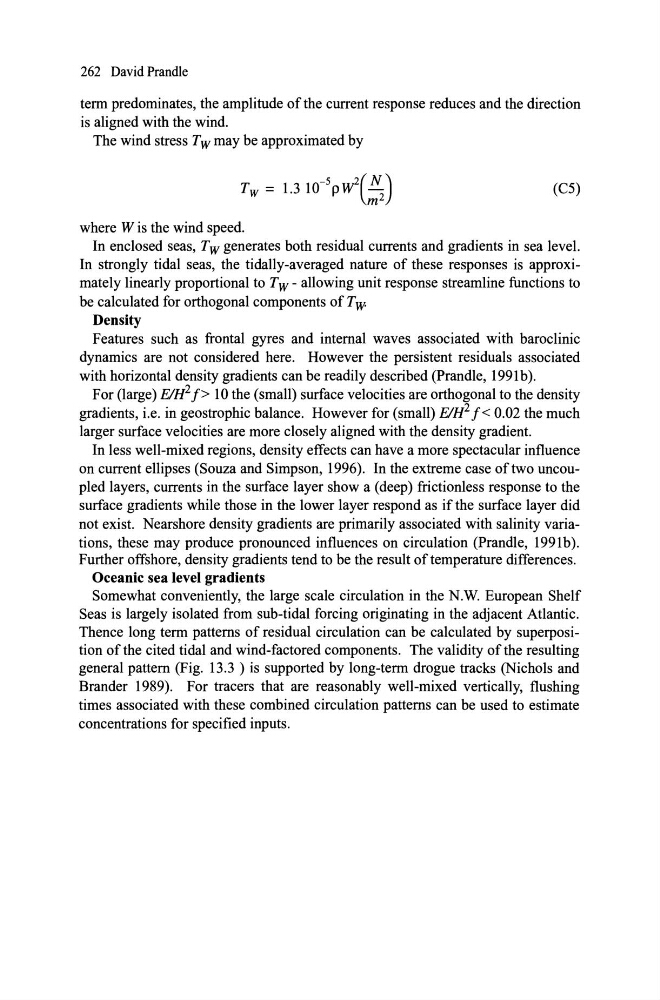
The wind stress T w may be approximated by
(CS)
where W is the wind speed.
In enc10sed seas, T w generates both residual currents and gradients in sea level.
In strongly tidal seas, the tidally-averaged nature of these responses is approximately linearly proportional to T w - allowing unit response streamline functions to
be ca1culated for orthogonal components of T w
Density
Features such as frontal gyres and internal waves associated with baroclinic
dynamics are not considered here. However the persistent residuals associated
with horizontal density gradients can be readily described (prandle, 1991b).
For (large) ElH 2 f> 10 the (small) surf ace velocities are orthogonal to the density
gradients, i.e. in geostrophic balance. However for (small) ElH 2 f < 0.02 the much
larger surf ace velocities are more c10sely aligned with the density gradient.
In less well-mixed regions, density effects can have a more spectacular influence
on current ellipses (Souza and Simpson, 1996). In the extreme case of two uncoupled layers, currents in the surface layer show a (deep) frictionless response to the
surface gradients while those in the lower layer respond as if the surface layer did
not exist. Nearshore density gradients are primarily associated with salinity variations, these may produce pronounced influences on circulation (Prandle, 1991b).
Further offshore, density gradients tend to be the re suit of temperature differences.
Oceanic sea level gradients
Somewhat conveniently, the large scale circulation in the N.W. European Shelf
Seas is largely isolated from sub-tidal forcing originating in the adjacent Atlantic.
Thence long term patterns of residual circulation can be ca1culated by superposition ofthe cited tidal and wind-factored components. The validity ofthe resulting
general pattern (Fig. 13.3 ) is supported by long-term drogue tracks (Nichols and
Brander 1989). For tracers that are reasonably well-mixed vertically, flushing
times associated with these combined circulation patterns can be used to estimate
concentrations for specified inputs.
term predominates, the amplitude of the current response reduces and the direction
is aligned with the wind.
The wind stress T w may be approximated by
(CS)
where W is the wind speed.
In enc10sed seas, T w generates both residual currents and gradients in sea level.
In strongly tidal seas, the tidally-averaged nature of these responses is approximately linearly proportional to T w - allowing unit response streamline functions to
be ca1culated for orthogonal components of T w
Density
Features such as frontal gyres and internal waves associated with baroclinic
dynamics are not considered here. However the persistent residuals associated
with horizontal density gradients can be readily described (prandle, 1991b).
For (large) ElH 2 f> 10 the (small) surf ace velocities are orthogonal to the density
gradients, i.e. in geostrophic balance. However for (small) ElH 2 f < 0.02 the much
larger surf ace velocities are more c10sely aligned with the density gradient.
In less well-mixed regions, density effects can have a more spectacular influence
on current ellipses (Souza and Simpson, 1996). In the extreme case of two uncoupled layers, currents in the surface layer show a (deep) frictionless response to the
surface gradients while those in the lower layer respond as if the surface layer did
not exist. Nearshore density gradients are primarily associated with salinity variations, these may produce pronounced influences on circulation (Prandle, 1991b).
Further offshore, density gradients tend to be the re suit of temperature differences.
Oceanic sea level gradients
Somewhat conveniently, the large scale circulation in the N.W. European Shelf
Seas is largely isolated from sub-tidal forcing originating in the adjacent Atlantic.
Thence long term patterns of residual circulation can be ca1culated by superposition ofthe cited tidal and wind-factored components. The validity ofthe resulting
general pattern (Fig. 13.3 ) is supported by long-term drogue tracks (Nichols and
Brander 1989). For tracers that are reasonably well-mixed vertically, flushing
times associated with these combined circulation patterns can be used to estimate
concentrations for specified inputs.