

Predictions in the North Sea
259
Appendix B Dynamics And Mixing
This appendix on 'dynamics' presents the basic equations and provides references
which show how these can be simplified for use in specific applications.
The dynamics of tides and surges are briefly described as a pre-cursor to Appendix C and D dealing with residual circulation and vertical exchange respectively.
The dynamics of surface waves and baroclinic processes are described elsewhere
in this volume.
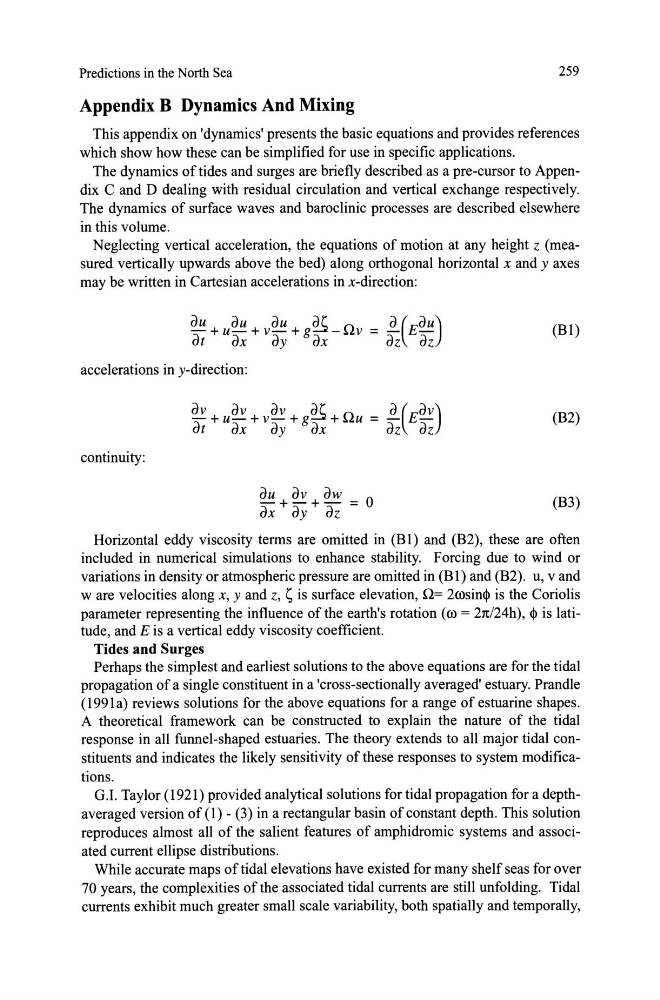
Neglecting vertical acceleration, the equations of motion at any height z (measured vertically upwards above the bed) along orthogonal horizontal x and y axes
may be written in Cartesian accelerations in x-direction:
au
au
au
ar
a ( au)
-+u-+v-+g~-Qv = - Eat
ax ay ax
az az
accelerations in y-direction:
continuity:
av av avar
- + u- + v- + g~ + Qu =
at
ax ay ax
au + av + aw = o
ax ay az
(Bl)
(B2)
(B3)
Horizontal eddy viscosity terms are omitted in (Bl) and (B2), these are often
included in numerical simulations to enhance stability. Forcing due to wind or
variations in density or atmospheric pressure are omitted in (Bl) and (B2). u, vand
w are velocities along x, y and z, S is surface elevation, Q= 200sin is the Coriolis
parameter representing the influence of the earth's rotation (00 = 21t124h), is latitude, and E is a vertical eddy viscosity coefficient.
Tides and Surges
Perhaps the simplest and earliest solutions to the above equations are for the tidal
propagation of a single constituent in a 'cross-sectionally averaged' estuary. Prandle
(1991 a) reviews solutions for the above equations for a range of estuarine shapes.
A theoretical framework can be constructed to explain the nature of the tidal
response in all funnel-shaped estuaries. The theory extends to all major tidal constituents and indicates the likely sensitivity of these responses to system modifications.
G.I. Taylor (1921) provided analytical solutions for tidal propagation for a depthaveraged version of (1) - (3) in a rectangular basin of constant depth. This solution
reproduces almost all of the salient features of amphidromic systems and associated current ellipse distributions.
While ac curate maps of tidal elevations have existed for many shelf seas for over
70 years, the complexities of the associated tidal currents are stiH unfolding. Tidal
currents exhibit much greater small scale variability, both spatially and temporally,
259
Appendix B Dynamics And Mixing
This appendix on 'dynamics' presents the basic equations and provides references
which show how these can be simplified for use in specific applications.
The dynamics of tides and surges are briefly described as a pre-cursor to Appendix C and D dealing with residual circulation and vertical exchange respectively.
The dynamics of surface waves and baroclinic processes are described elsewhere
in this volume.
Neglecting vertical acceleration, the equations of motion at any height z (measured vertically upwards above the bed) along orthogonal horizontal x and y axes
may be written in Cartesian accelerations in x-direction:
au
au
au
ar
a ( au)
-+u-+v-+g~-Qv = - Eat
ax ay ax
az az
accelerations in y-direction:
continuity:
av av avar
- + u- + v- + g~ + Qu =
at
ax ay ax
au + av + aw = o
ax ay az
(Bl)
(B2)
(B3)
Horizontal eddy viscosity terms are omitted in (Bl) and (B2), these are often
included in numerical simulations to enhance stability. Forcing due to wind or
variations in density or atmospheric pressure are omitted in (Bl) and (B2). u, vand
w are velocities along x, y and z, S is surface elevation, Q= 200sin
parameter representing the influence of the earth's rotation (00 = 21t124h),
Tides and Surges
Perhaps the simplest and earliest solutions to the above equations are for the tidal
propagation of a single constituent in a 'cross-sectionally averaged' estuary. Prandle
(1991 a) reviews solutions for the above equations for a range of estuarine shapes.
A theoretical framework can be constructed to explain the nature of the tidal
response in all funnel-shaped estuaries. The theory extends to all major tidal constituents and indicates the likely sensitivity of these responses to system modifications.
G.I. Taylor (1921) provided analytical solutions for tidal propagation for a depthaveraged version of (1) - (3) in a rectangular basin of constant depth. This solution
reproduces almost all of the salient features of amphidromic systems and associated current ellipse distributions.
While ac curate maps of tidal elevations have existed for many shelf seas for over
70 years, the complexities of the associated tidal currents are stiH unfolding. Tidal
currents exhibit much greater small scale variability, both spatially and temporally,