

216 Allan R. Robinson and Jurgen Sellschopp
the instability of the MW veins causing generation and detachment of meddies
(Onken, 1998, personal communication).
o "
200
400
600
800
km
HARV A RD I SACL A NTCEN RR98
TEM PERA TURE - 08 MAR 98
518 (XlCTO. 635 (A)X8T.
FNMOC SURF . FIl'IC I Ne
5 . 5
3. 9
2.3
1 . 5
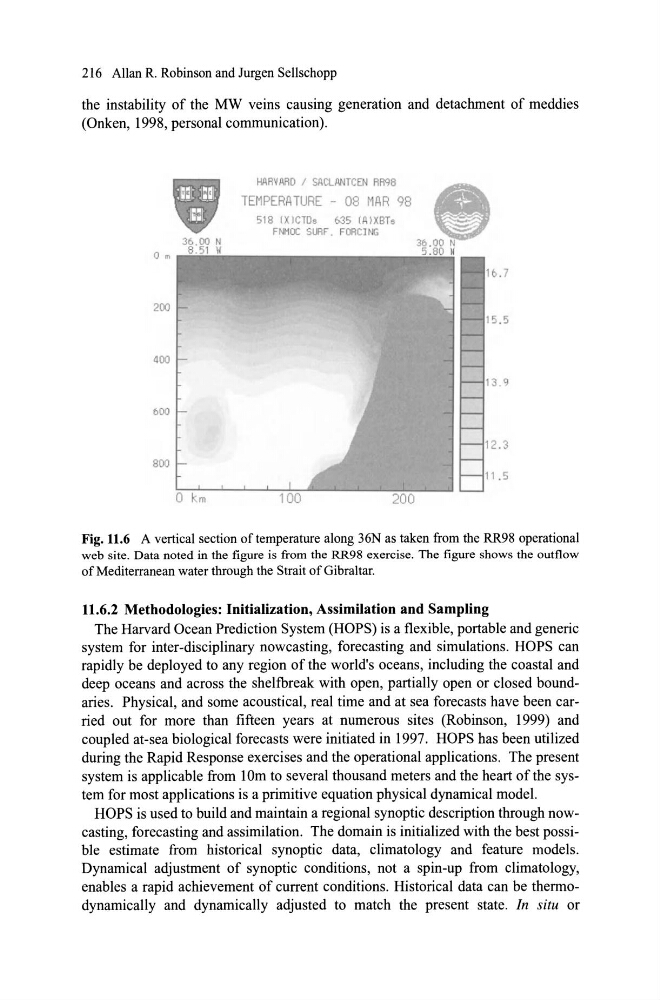
Fig. 11.6 A vertical section of temperature along 36N as taken from the RR98 operational
web site. Data noted in the figure is from the RR98 exercise. The figure shows the outflow
of Mediterranean water through the Strait of Gibraltar.
11.6.2 Methodologies: Initialization, Assimilation and Sampling
The Harvard Ocean Prediction System (HOPS) is a flexible, portable and generic
system for inter-disciplinary nowcasting, forecasting and simulations. HOPS can
rapidly be deployed to any region of the worId's oceans, including the coastal and
deep oceans and across the shelfbreak with open, partiaIly open Of cIosed boundaries. Physical, and some acoustical, real time and at sea forecasts have been carried out for more than fifteen years at numerous sites (Robinson, 1999) and
coupled at-sea biologic al forecasts were initiated in 1997. HOPS has been utiIized
during the Rapid Response exercises and the operational applications. The present
system is applicable from 10m to several thousand meters and the heart of the system for most applications is a primitive equation physical dynamical model.
HOPS is used to build and maintain a regional synoptic description through nowcasting, forecasting and assimilation. The domain is initialized with the best possibie estimate from bistorical synoptic data, cIimatology and feature models.
Dynamical adjustment of synoptic conditions, not a spin-up from cIimatology,
enables a rapid achievement of current conditions. Historical data can be thermodynamicaIly and dynamicaIly adjusted to match the present state. In situ Of
the instability of the MW veins causing generation and detachment of meddies
(Onken, 1998, personal communication).
o "
200
400
600
800
km
HARV A RD I SACL A NTCEN RR98
TEM PERA TURE - 08 MAR 98
518 (XlCTO. 635 (A)X8T.
FNMOC SURF . FIl'IC I Ne
5 . 5
3. 9
2.3
1 . 5
Fig. 11.6 A vertical section of temperature along 36N as taken from the RR98 operational
web site. Data noted in the figure is from the RR98 exercise. The figure shows the outflow
of Mediterranean water through the Strait of Gibraltar.
11.6.2 Methodologies: Initialization, Assimilation and Sampling
The Harvard Ocean Prediction System (HOPS) is a flexible, portable and generic
system for inter-disciplinary nowcasting, forecasting and simulations. HOPS can
rapidly be deployed to any region of the worId's oceans, including the coastal and
deep oceans and across the shelfbreak with open, partiaIly open Of cIosed boundaries. Physical, and some acoustical, real time and at sea forecasts have been carried out for more than fifteen years at numerous sites (Robinson, 1999) and
coupled at-sea biologic al forecasts were initiated in 1997. HOPS has been utiIized
during the Rapid Response exercises and the operational applications. The present
system is applicable from 10m to several thousand meters and the heart of the system for most applications is a primitive equation physical dynamical model.
HOPS is used to build and maintain a regional synoptic description through nowcasting, forecasting and assimilation. The domain is initialized with the best possibie estimate from bistorical synoptic data, cIimatology and feature models.
Dynamical adjustment of synoptic conditions, not a spin-up from cIimatology,
enables a rapid achievement of current conditions. Historical data can be thermodynamicaIly and dynamicaIly adjusted to match the present state. In situ Of