

Rapid Assessment of the Coastal Ocean Environment
213
.(
).
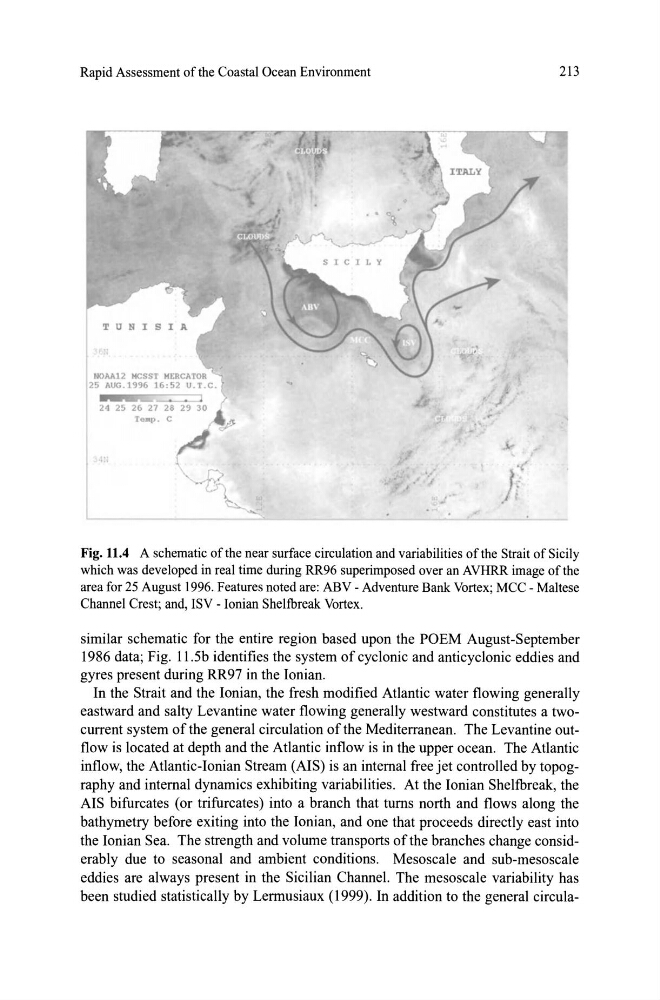
Fig. 11.4 A schematic of the near surf ace circulation and variabilities of the Strait of Sicily
which was developed in real time during RR96 superimposed over an AVHRR image ofthe
area for 25 August 1996. Features noted are: ABV - Adventure Bank Vortex; MCC - Maltese
Channel Crest; and, ISV - Ionian Shelfbreak Vortex.
similar schematic for the entire region based upon the POEM August-September
1986 data; Fig. 11.5b identifies the system of cyclonic and anticyclonic eddies and
gyres present during RR97 in the Ionian.
In the Strait and the Ionian, the fresh modified Atlantic water flowing generally
eastward and salty Levantine water flowing generally westward constitutes a twocurrent system ofthe general circulation ofthe Mediterranean. The Levantine outflow is located at depth and the Atlantic inflow is in the upper ocean. The Atlantic
inflow, the Atlantic-Ionian Stream (AIS) is an internal free jet controlled by topography and internal dynamics exhibiting variabilities. At the Ionian Shelfbreak, the
AIS bifurcates (or trifurcates) into a branch that turns north and flows along the
bathymetry before exiting into the Ionian, and one that proceeds directly east into
the Ionian Sea. The strength and volume transports ofthe branches change considerably due to seasonal and ambient conditions. Mesoscale and sub-mesoscale
eddies are always present in the Sicilian Channel. The mesoscale variability has
been studied statistically by Lermusiaux (1999). In addition to the general circula-
213
.(
).
Fig. 11.4 A schematic of the near surf ace circulation and variabilities of the Strait of Sicily
which was developed in real time during RR96 superimposed over an AVHRR image ofthe
area for 25 August 1996. Features noted are: ABV - Adventure Bank Vortex; MCC - Maltese
Channel Crest; and, ISV - Ionian Shelfbreak Vortex.
similar schematic for the entire region based upon the POEM August-September
1986 data; Fig. 11.5b identifies the system of cyclonic and anticyclonic eddies and
gyres present during RR97 in the Ionian.
In the Strait and the Ionian, the fresh modified Atlantic water flowing generally
eastward and salty Levantine water flowing generally westward constitutes a twocurrent system ofthe general circulation ofthe Mediterranean. The Levantine outflow is located at depth and the Atlantic inflow is in the upper ocean. The Atlantic
inflow, the Atlantic-Ionian Stream (AIS) is an internal free jet controlled by topography and internal dynamics exhibiting variabilities. At the Ionian Shelfbreak, the
AIS bifurcates (or trifurcates) into a branch that turns north and flows along the
bathymetry before exiting into the Ionian, and one that proceeds directly east into
the Ionian Sea. The strength and volume transports ofthe branches change considerably due to seasonal and ambient conditions. Mesoscale and sub-mesoscale
eddies are always present in the Sicilian Channel. The mesoscale variability has
been studied statistically by Lermusiaux (1999). In addition to the general circula-