

Strategy for Regional Seasonal Forecasts
185
leads to a set of equations for all islands that must be solved simultaneously at
internal ocean points.
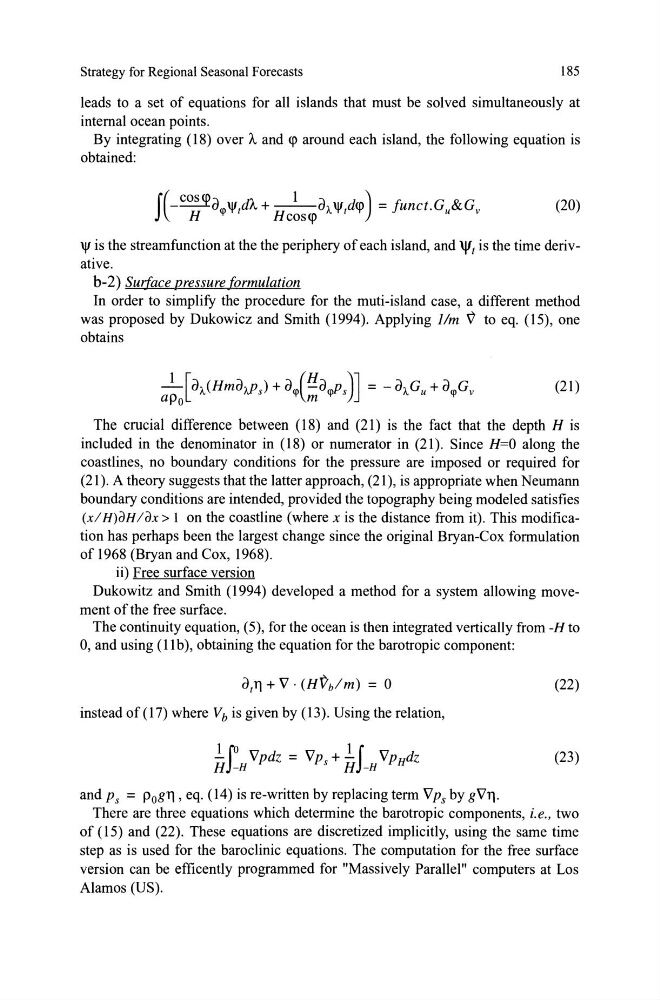
By integrating (18) over A and obtained:
f( -cosPa
Hcos
'V is the streamfunction at the the periphery of each island, and 'l't is the time derivative.
b-2) Suiface pressure formulation
In order to simplify the procedure for the muti-island case, a different method
was proposed by Dukowicz and Smith (1994). Applying l/m V to eq. (15), one
obtains
a~JdA(HmdAPJ + d
The crucial difference between (18) and (21) is the fact that the depth H is
included in the denominator in (18) or numerator in (21). Since H=O along the
coastlines, no boundary conditions for the pressure are imposed or required for
(21). A theory suggests that the latter approach, (21), is appropriate when Neumann
boundary conditions are intended, provided the topography being modeled satisfies
(xl H)dHldX > 1 on the coastline (where x is the distance from it). This modification has perhaps been the largest change since the original Bryan-Cox formulation
of 1968 (Bryan and Cox, 1968).
ii) Free surface version
Dukowitz and Smith (1994) developed a method for a system allowing movement ofthe free surface.
The continuity equation, (5), for the ocean is then integrated vertically from -H to
0, and using (11 b), obtaining the equation for the barotropic component:
dtTj + V . (HVb/m) = O
(22)
instead of (17) where V b is given by (13). Using the relation,
lfO Vpdz = Vp" + lf VPHdZ
H -H
H -H
(23)
and Ps = PogTj, eq. (14) is re-written by replacing term VPs by gVTj.
There are three equations which determine the barotropic components, Le., two
of (15) and (22). These equations are discretized implicitly, using the same time
step as is used for the baroclinic equations. The computation for the free surf ace
version can be efficently programmed for "Massively Parallel" computers at Los
Alamos (US).
185
leads to a set of equations for all islands that must be solved simultaneously at
internal ocean points.
By integrating (18) over A and obtained:
f( -cosPa
Hcos
'V is the streamfunction at the the periphery of each island, and 'l't is the time derivative.
b-2) Suiface pressure formulation
In order to simplify the procedure for the muti-island case, a different method
was proposed by Dukowicz and Smith (1994). Applying l/m V to eq. (15), one
obtains
a~JdA(HmdAPJ + d
The crucial difference between (18) and (21) is the fact that the depth H is
included in the denominator in (18) or numerator in (21). Since H=O along the
coastlines, no boundary conditions for the pressure are imposed or required for
(21). A theory suggests that the latter approach, (21), is appropriate when Neumann
boundary conditions are intended, provided the topography being modeled satisfies
(xl H)dHldX > 1 on the coastline (where x is the distance from it). This modification has perhaps been the largest change since the original Bryan-Cox formulation
of 1968 (Bryan and Cox, 1968).
ii) Free surface version
Dukowitz and Smith (1994) developed a method for a system allowing movement ofthe free surface.
The continuity equation, (5), for the ocean is then integrated vertically from -H to
0, and using (11 b), obtaining the equation for the barotropic component:
dtTj + V . (HVb/m) = O
(22)
instead of (17) where V b is given by (13). Using the relation,
lfO Vpdz = Vp" + lf VPHdZ
H -H
H -H
(23)
and Ps = PogTj, eq. (14) is re-written by replacing term VPs by gVTj.
There are three equations which determine the barotropic components, Le., two
of (15) and (22). These equations are discretized implicitly, using the same time
step as is used for the baroclinic equations. The computation for the free surf ace
version can be efficently programmed for "Massively Parallel" computers at Los
Alamos (US).