

154 Mojib Latif, AxeI Timmennann, Anselm Gr6tzner, Christian Eckert, Reinhard Voss
1990
2~~~~~~~~~~~~~~~~~~~~~2
1960
1970
1980
North Atlantic Ocean
Depth of 125 meters
o~---------4~---1~-+------~r-----~~--T G~~~IO
: '~
- 1
---- --0 -'
OWS "C"
1ST EOF
I
\
,
\
-1
-L~~""~"rT,,-.rr"~""""'T,,-.rr,,~-'r l -2
1960
1970
Year
1980
1990.
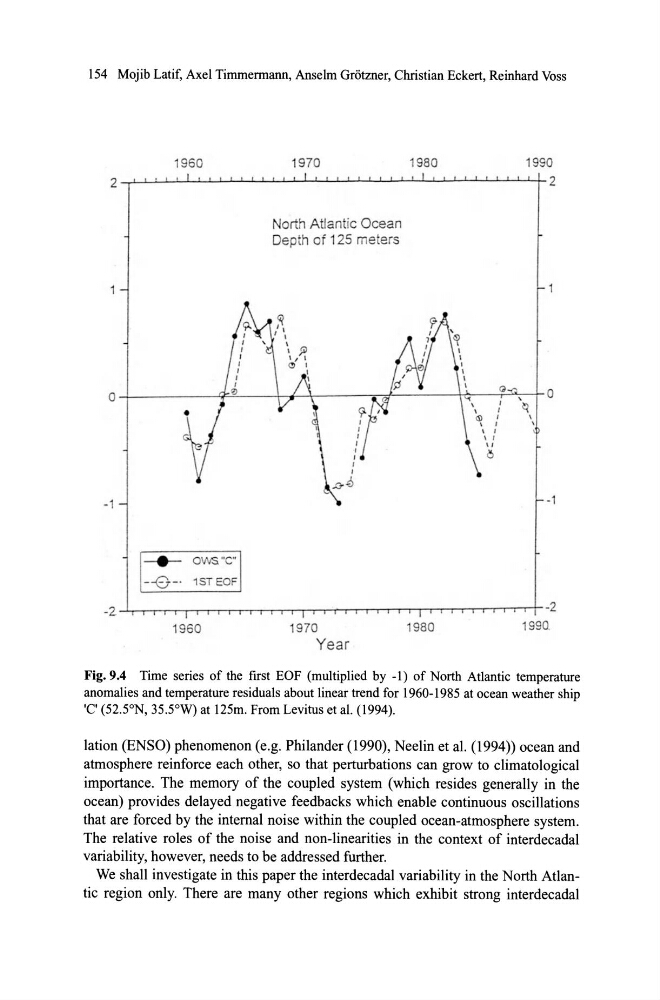
Fig.9.4 Time series of the first EOF (multiplied by -1) of North Atlantic temperature
anomalies and temperature residuals about linear trend for 1960-1985 at ocean weather ship
'C' (52SN, 35.5°W) at 125m. From Levitus et aL (1994).
lation (ENSO) phenomenon (e.g. Philander (1990), Neelin et al. (1994)) ocean and
atmosphere reinforce each other, so that perturbations can grow to climatological
importance. The memory of the coupled system (which resides generally in the
ocean) provides delayed negative feedbacks which enable continuous oscillations
that are forced by the internal noise within the coupled ocean-atmosphere system.
The relative roles of the noise and non-linearities in the context of interdecadal
variability, however, needs to be addressed further.
We shall investigate in this paper the interdecadal variability in the North Atlantic region only. There are many other regions which exhibit strong interdecadal
1990
2~~~~~~~~~~~~~~~~~~~~~2
1960
1970
1980
North Atlantic Ocean
Depth of 125 meters
o~---------4~---1~-+------~r-----~~--T G~~~IO
: '~
- 1
---- --0 -'
OWS "C"
1ST EOF
I
\
,
\
-1
-L~~""~"rT,,-.rr"~""""'T,,-.rr,,~-'r l -2
1960
1970
Year
1980
1990.
Fig.9.4 Time series of the first EOF (multiplied by -1) of North Atlantic temperature
anomalies and temperature residuals about linear trend for 1960-1985 at ocean weather ship
'C' (52SN, 35.5°W) at 125m. From Levitus et aL (1994).
lation (ENSO) phenomenon (e.g. Philander (1990), Neelin et al. (1994)) ocean and
atmosphere reinforce each other, so that perturbations can grow to climatological
importance. The memory of the coupled system (which resides generally in the
ocean) provides delayed negative feedbacks which enable continuous oscillations
that are forced by the internal noise within the coupled ocean-atmosphere system.
The relative roles of the noise and non-linearities in the context of interdecadal
variability, however, needs to be addressed further.
We shall investigate in this paper the interdecadal variability in the North Atlantic region only. There are many other regions which exhibit strong interdecadal