

142 Antonio Navarra
First Member
RAI
Northern Hemlsphere
quator
SoUlhern Hemispher8
Second Member
Northem Hemisphere
quator
Sou1hern Hemisphere
Third Member
Nor1hern Hemisphere
Saulharn Hemisphere
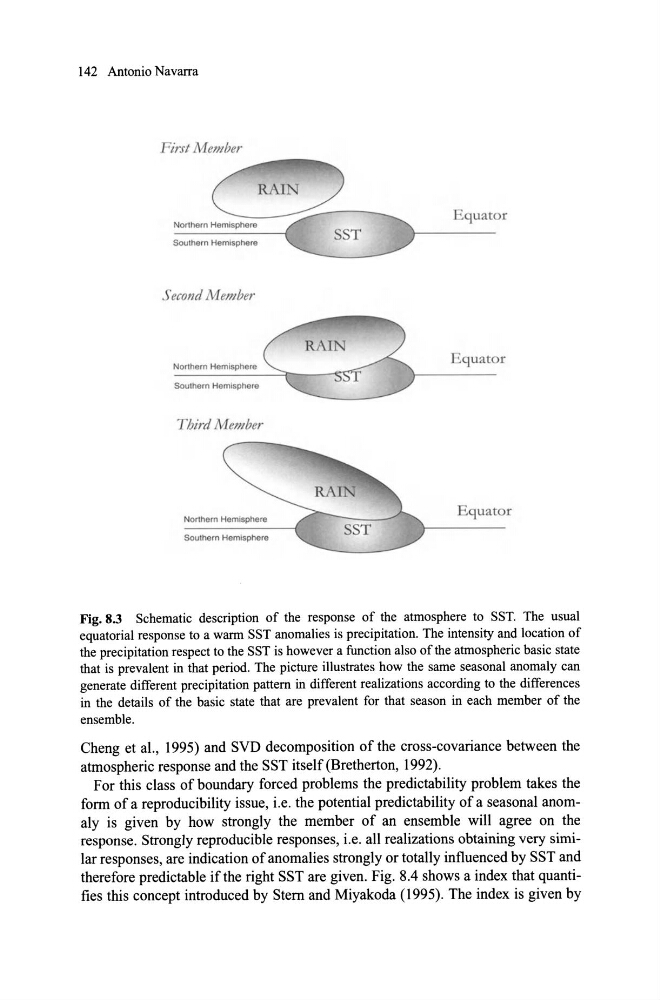
Fig. 8.3 Schematic description of the response of the atmosphere to SST. The usual
equatorial response to a warm SST anomalies is precipitation. The intensity and location of
the precipitation respect to the SST is however a function also ofthe atmospheric basic state
that is prevalent in that period. The picture illustrates how the same seasonal anomaly can
generate different precipitation pattern in different realizations according to the differences
in the details of the basic state that are prevalent for that season in each member of the
ensemble.
Cheng et al., 1995) and SVD decomposition of the cross-covariance between the
atmospheric response and the SST itself (Bretherton, 1992).
For this class ofboundary forced problems the predictability problem takes the
form of a reproducibility issue, i.e. the potential predictability of a seasonal anomaly is given by how strongly the member of an ensemble will agree on the
response. Strongly reproducible responses, i.e. all realizations obtaining very similar responses, are indication of anomalies strongly or totally influenced by SST and
therefore predictable ifthe right SST are given. Fig. 8.4 shows a index that quantifies this concept introduced by Stern and Miyakoda (1995). The index is given by
First Member
RAI
Northern Hemlsphere
quator
SoUlhern Hemispher8
Second Member
Northem Hemisphere
quator
Sou1hern Hemisphere
Third Member
Nor1hern Hemisphere
Saulharn Hemisphere
Fig. 8.3 Schematic description of the response of the atmosphere to SST. The usual
equatorial response to a warm SST anomalies is precipitation. The intensity and location of
the precipitation respect to the SST is however a function also ofthe atmospheric basic state
that is prevalent in that period. The picture illustrates how the same seasonal anomaly can
generate different precipitation pattern in different realizations according to the differences
in the details of the basic state that are prevalent for that season in each member of the
ensemble.
Cheng et al., 1995) and SVD decomposition of the cross-covariance between the
atmospheric response and the SST itself (Bretherton, 1992).
For this class ofboundary forced problems the predictability problem takes the
form of a reproducibility issue, i.e. the potential predictability of a seasonal anomaly is given by how strongly the member of an ensemble will agree on the
response. Strongly reproducible responses, i.e. all realizations obtaining very similar responses, are indication of anomalies strongly or totally influenced by SST and
therefore predictable ifthe right SST are given. Fig. 8.4 shows a index that quantifies this concept introduced by Stern and Miyakoda (1995). The index is given by