

Assimilation of Satellite Altimetry in Ocean Models
129
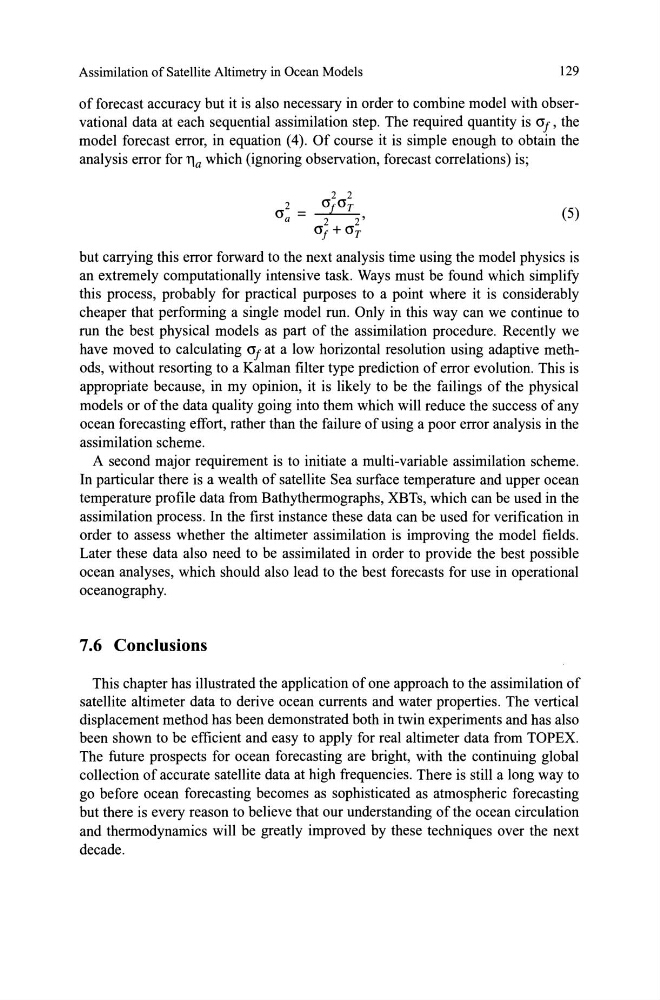
of forecast accuracy but it is also necessary in order to combine model with observational data at each sequential assimilation step. The required quantity is (Jj' the
model forecast error, in equation (4). Of course it is simple enough to obtain the
analysis error for lla which (ignoring observation, forecast correlations) is;
2 2
(J2 = (Jr(JT
a
2
2'
(5)
(JI + (JT
but carrying this error forward to the next analysis time using the model physics is
an extremely computationally intensive task. Ways must be found which simplify
this process, probably for practical purposes to a point where it is considerably
cheaper that performing a single model run. Only in this way can we continue to
run the best physical models as part of the assimilation procedure. Recent1y we
have moved to calculating (Jj at a low horizontal resolution using adaptive methods, without resorting to a Kalman filter type prediction of error evolution. This is
appropriate because, in my opinion, it is likely to be the failings of the physical
models or of the data quality going into them which wiH reduce the success of any
ocean forecasting effort, rather than the failure of using a poor error analysis in the
assimilation scheme.
A second major requirement is to initiate a multi-variable assimilation scheme.
In particular there is a wealth of satellite Sea surf ace temperature and upper ocean
temperature profile data from Bathythermographs, XBTs, which can be used in the
assimilation process. In the first instance these data can be used for verification in
order to assess whether the altimeter assimilation is improving the model fields.
Later these data also need to be assimilated in order to provide the best possible
ocean analyses, which should also lead to the best forecasts for use in operational
oceanography.
7.6 Conclusions
This chapter has illustrated the application of one approach to the assimilation of
satellite altimeter data to derive ocean currents and water properties. The vertical
displacement method has been demonstrated both in twin experiments and has also
been shown to be efficient and easy to apply for real altimeter data from TOPEX.
The future prospects for ocean forecasting are bright, with the continuing global
collection of ac curate satellite data at high frequencies. There is stiH a long way to
go before ocean forecasting becomes as sophisticated as atmospheric forecasting
but there is every reason to believe that our understanding of the ocean circulation
and thermodynamics will be greatly improved by these techniques over the next
decade.
129
of forecast accuracy but it is also necessary in order to combine model with observational data at each sequential assimilation step. The required quantity is (Jj' the
model forecast error, in equation (4). Of course it is simple enough to obtain the
analysis error for lla which (ignoring observation, forecast correlations) is;
2 2
(J2 = (Jr(JT
a
2
2'
(5)
(JI + (JT
but carrying this error forward to the next analysis time using the model physics is
an extremely computationally intensive task. Ways must be found which simplify
this process, probably for practical purposes to a point where it is considerably
cheaper that performing a single model run. Only in this way can we continue to
run the best physical models as part of the assimilation procedure. Recent1y we
have moved to calculating (Jj at a low horizontal resolution using adaptive methods, without resorting to a Kalman filter type prediction of error evolution. This is
appropriate because, in my opinion, it is likely to be the failings of the physical
models or of the data quality going into them which wiH reduce the success of any
ocean forecasting effort, rather than the failure of using a poor error analysis in the
assimilation scheme.
A second major requirement is to initiate a multi-variable assimilation scheme.
In particular there is a wealth of satellite Sea surf ace temperature and upper ocean
temperature profile data from Bathythermographs, XBTs, which can be used in the
assimilation process. In the first instance these data can be used for verification in
order to assess whether the altimeter assimilation is improving the model fields.
Later these data also need to be assimilated in order to provide the best possible
ocean analyses, which should also lead to the best forecasts for use in operational
oceanography.
7.6 Conclusions
This chapter has illustrated the application of one approach to the assimilation of
satellite altimeter data to derive ocean currents and water properties. The vertical
displacement method has been demonstrated both in twin experiments and has also
been shown to be efficient and easy to apply for real altimeter data from TOPEX.
The future prospects for ocean forecasting are bright, with the continuing global
collection of ac curate satellite data at high frequencies. There is stiH a long way to
go before ocean forecasting becomes as sophisticated as atmospheric forecasting
but there is every reason to believe that our understanding of the ocean circulation
and thermodynamics will be greatly improved by these techniques over the next
decade.