

Assimilation of Satellite Altimetry in Ocean Models
121
are also considered. Once the density field has been changed, velocity changes can
be introduced which are in geostrophic balance with the density changes, at least
away from the equator. The bottom constraint that p( -H) does not change now
ensures that the bottom torque, given by
SurfacePs ~
Thermoc1ine
Deep
Water
8h>O
~
Q7'
8h
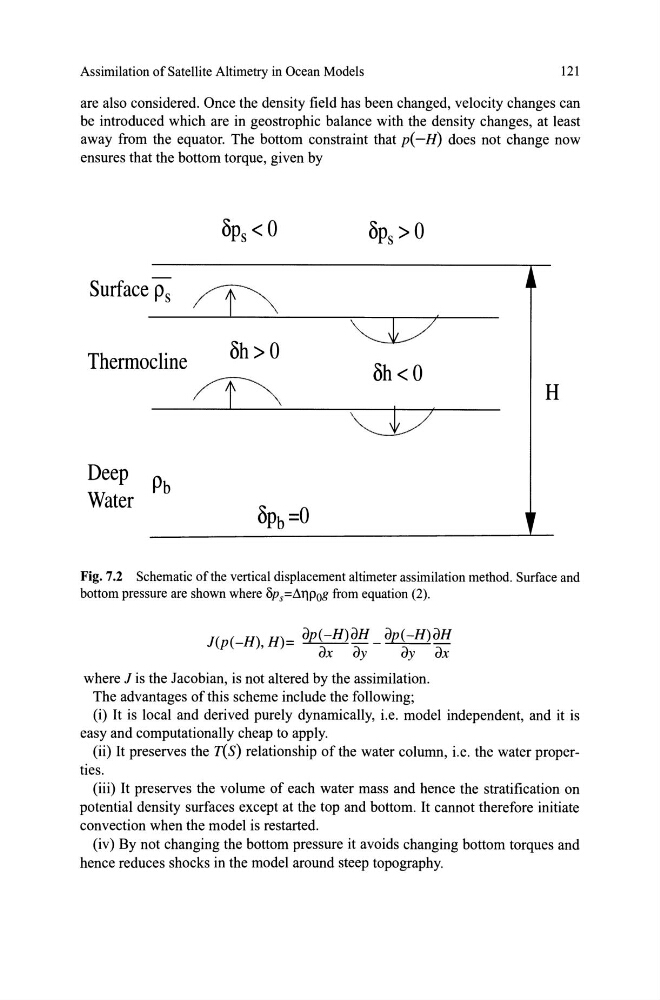
Fig.7.2 Schematic ofthe vertical displacement altimeter assimilation method. Surface and
bottom pressure are shown where ()Ps=~llPog from equation (2).
J(p(-H), H)= op(-H)oH _ op(-H)oH
ax ay ay ax
where J is the Jacobian, is not altered by the assimilation.
The advantages ofthis scheme include the following;
(i) It is local and derived purely dynamically, i.e. model independent, and it is
easy and computationally cheap to apply.
(ii) It preserves the T(S) relationship of the water column, i.e. the water properties.
(iii) It preserves the volume of each water mass and hence the stratification on
potential density surfaces except at the top and bottom. It cannot therefore initiate
convection when the model is restarted.
(iv) By not changing the bottom pressure it avoids changing bottom torques and
hence reduces shocks in the model around steep topography.
121
are also considered. Once the density field has been changed, velocity changes can
be introduced which are in geostrophic balance with the density changes, at least
away from the equator. The bottom constraint that p( -H) does not change now
ensures that the bottom torque, given by
SurfacePs ~
Thermoc1ine
Deep
Water
8h>O
~
Q7'
8h
Fig.7.2 Schematic ofthe vertical displacement altimeter assimilation method. Surface and
bottom pressure are shown where ()Ps=~llPog from equation (2).
J(p(-H), H)= op(-H)oH _ op(-H)oH
ax ay ay ax
where J is the Jacobian, is not altered by the assimilation.
The advantages ofthis scheme include the following;
(i) It is local and derived purely dynamically, i.e. model independent, and it is
easy and computationally cheap to apply.
(ii) It preserves the T(S) relationship of the water column, i.e. the water properties.
(iii) It preserves the volume of each water mass and hence the stratification on
potential density surfaces except at the top and bottom. It cannot therefore initiate
convection when the model is restarted.
(iv) By not changing the bottom pressure it avoids changing bottom torques and
hence reduces shocks in the model around steep topography.