

a
72
Homogeneous Models of the Ocean Circulation
b
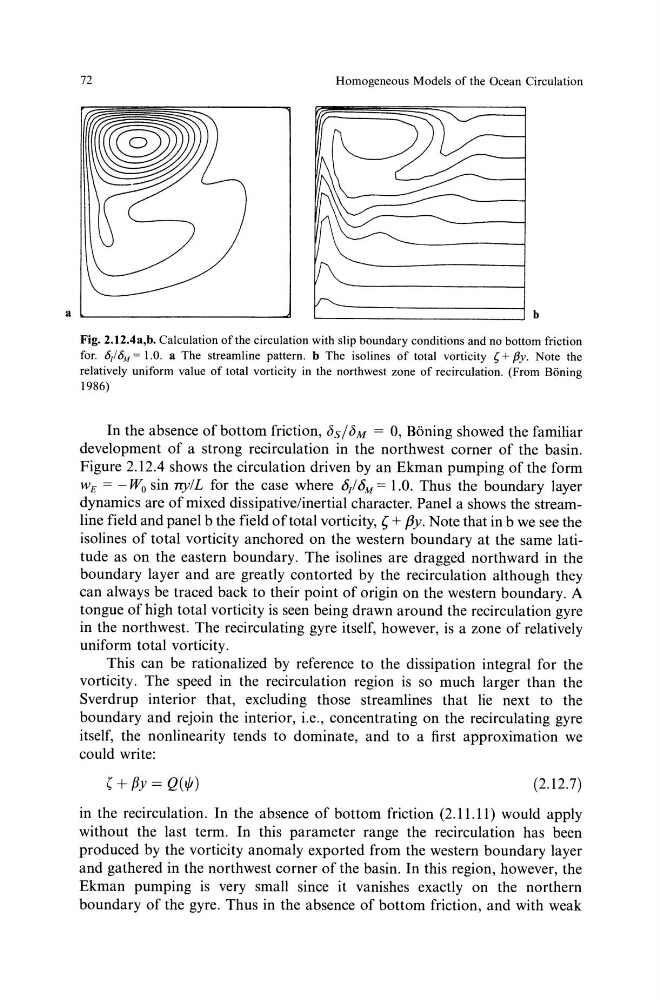
Fig. 2.12.4a,b. Calculation of the circulation with slip boundary conditions and no bottom friction
for. 6/6M = 1.0. a The streamline pattern. b The isolines of total vorticity ~ + {3y. Note the
relatively uniform value of total vorticity in the northwest zone of recirculation. (From Boning
1986)
In the absence of bottom friction, bs/ lJM = 0, Boning showed the familiar
development of a strong recirculation in the northwest corner of the basin.
Figure 2.12.4 shows the circulation driven by an Ekman pumping of the form
wE = - W 0 sin rry/ L for the case where 6/ 6M = 1.0. Thus the boundary layer
dynamics are of mixed dissipative/inertial character. Panel a shows the streamline field and panel b the field of total vorticity, s + f3y. Note that in b we see the
isolines of total vorticity anchored on the western boundary at the same latitude as on the eastern boundary. The isolines are dragged northward in the
boundary layer and are greatly contorted by the recirculation although they
can always be traced back to their point of origin on the western boundary. A
tongue of high total vorticity is seen being drawn around the recirculation gyre
in the northwest. The recirculating gyre itself, however, is a zone of relatively
uniform total vorticity.
This can be rationalized by reference to the dissipation integral for the
vorticity. The speed in the recirculation region is so much larger than the
Sverdrup interior that, excluding those streamlines that lie next to the
boundary and rejoin the interior, i.e., concentrating on the recirculating gyre
itself, the nonlinearity tends to dominate, and to a first approximation we
could write:
(+f3y=Q(Ij;)
(2.12.7)
in the recirculation. In the absence of bottom friction (2.11.11) would apply
without the last term. In this parameter range the recirculation has been
produced by the vorticity anomaly exported from the western boundary layer
and gathered in the northwest corner of the basin. In this region, however, the
Ekman pumping is very small since it vanishes exactly on the northern
boundary of the gyre. Thus in the absence of bottom friction, and with weak
72
Homogeneous Models of the Ocean Circulation
b
Fig. 2.12.4a,b. Calculation of the circulation with slip boundary conditions and no bottom friction
for. 6/6M = 1.0. a The streamline pattern. b The isolines of total vorticity ~ + {3y. Note the
relatively uniform value of total vorticity in the northwest zone of recirculation. (From Boning
1986)
In the absence of bottom friction, bs/ lJM = 0, Boning showed the familiar
development of a strong recirculation in the northwest corner of the basin.
Figure 2.12.4 shows the circulation driven by an Ekman pumping of the form
wE = - W 0 sin rry/ L for the case where 6/ 6M = 1.0. Thus the boundary layer
dynamics are of mixed dissipative/inertial character. Panel a shows the streamline field and panel b the field of total vorticity, s + f3y. Note that in b we see the
isolines of total vorticity anchored on the western boundary at the same latitude as on the eastern boundary. The isolines are dragged northward in the
boundary layer and are greatly contorted by the recirculation although they
can always be traced back to their point of origin on the western boundary. A
tongue of high total vorticity is seen being drawn around the recirculation gyre
in the northwest. The recirculating gyre itself, however, is a zone of relatively
uniform total vorticity.
This can be rationalized by reference to the dissipation integral for the
vorticity. The speed in the recirculation region is so much larger than the
Sverdrup interior that, excluding those streamlines that lie next to the
boundary and rejoin the interior, i.e., concentrating on the recirculating gyre
itself, the nonlinearity tends to dominate, and to a first approximation we
could write:
(+f3y=Q(Ij;)
(2.12.7)
in the recirculation. In the absence of bottom friction (2.11.11) would apply
without the last term. In this parameter range the recirculation has been
produced by the vorticity anomaly exported from the western boundary layer
and gathered in the northwest corner of the basin. In this region, however, the
Ekman pumping is very small since it vanishes exactly on the northern
boundary of the gyre. Thus in the absence of bottom friction, and with weak