

The Linear Problem
39
X
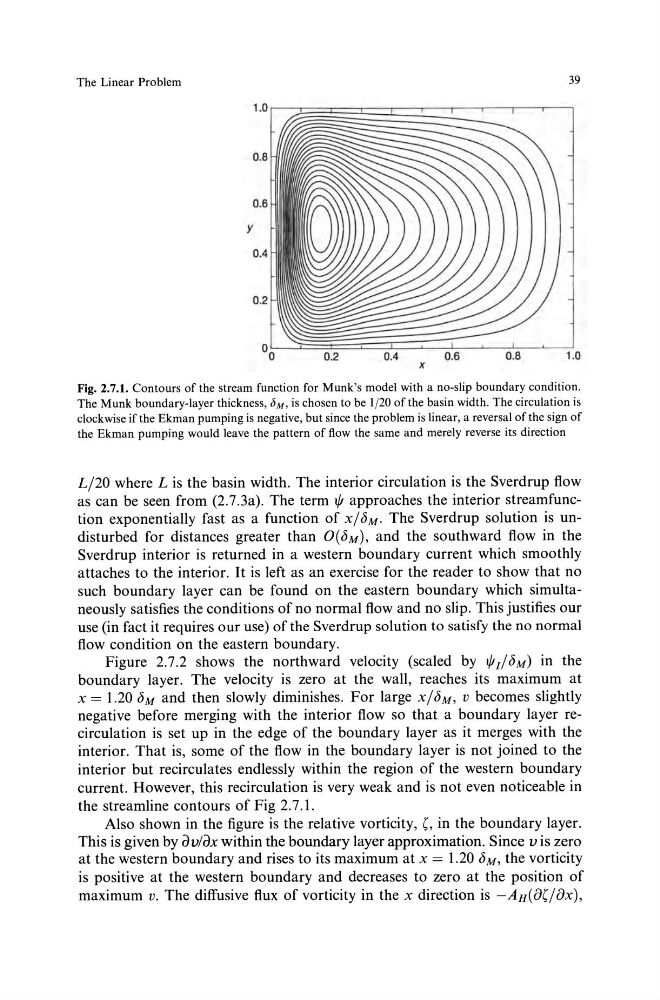
Fig. 2.7.1. Contours of the stream function for Munk's model with a no-slip boundary condition.
The Munk boundary-layer thickness, bM, is chosen to be l /20 of the basin width. The circulation is
clockwise if the Ekman pumping is negative, but since the problem is linear, a reversal of the sign of
the Ekman pumping would leave the pattern of flow the same and merely reverse its direction
L/20 where L is the basin width. The interior circulation is the Sverdrup flow
as can be seen from (2.7.3a). The term t/J approaches the interior streamfunction exponentially fast as a function of xj[JM· The Sverdrup solution is undisturbed for distances greater than O([JM), and the southward flow in the
Sverdrup interior is returned in a western boundary current which smoothly
attaches to the interior. It is left as an exercise for the reader to show that no
such boundary layer can be found on the eastern boundary which simultaneously satisfies the conditions of no normal flow and no slip. This justifies our
use (in fact it requires our use) of the Sverdrup solution to satisfy the no normal
flow condition on the eastern boundary.
Figure 2.7.2 shows the northward velocity (scaled by t/Jd{JM) in the
boundary layer. The velocity is zero at the wall, reaches its maximum at
x = 1.20 [JM and then slowly diminishes. For large xj [JM, v becomes slightly
negative before merging with the interior flow so that a boundary layer recirculation is set up in the edge of the boundary layer as it merges with the
interior. That is, some of the flow in the boundary layer is not joined to the
interior but recirculates endlessly within the region of the western boundary
current. However, this recirculation is very weak and is not even noticeable in
the streamline contours of Fig 2. 7.1.
Also shown in the figure is the relative vorticity, (, in the boundary layer.
This is given by au/ax within the boundary layer approximation. Since u is zero
at the western boundary and rises to its maximum at x = 1.20 [JM, the vorticity
is positive at the western boundary and decreases to zero at the position of
maximum v. The diffusive flux of vorticity in the x direction is -AH(8(/8x) ,
39
X
Fig. 2.7.1. Contours of the stream function for Munk's model with a no-slip boundary condition.
The Munk boundary-layer thickness, bM, is chosen to be l /20 of the basin width. The circulation is
clockwise if the Ekman pumping is negative, but since the problem is linear, a reversal of the sign of
the Ekman pumping would leave the pattern of flow the same and merely reverse its direction
L/20 where L is the basin width. The interior circulation is the Sverdrup flow
as can be seen from (2.7.3a). The term t/J approaches the interior streamfunction exponentially fast as a function of xj[JM· The Sverdrup solution is undisturbed for distances greater than O([JM), and the southward flow in the
Sverdrup interior is returned in a western boundary current which smoothly
attaches to the interior. It is left as an exercise for the reader to show that no
such boundary layer can be found on the eastern boundary which simultaneously satisfies the conditions of no normal flow and no slip. This justifies our
use (in fact it requires our use) of the Sverdrup solution to satisfy the no normal
flow condition on the eastern boundary.
Figure 2.7.2 shows the northward velocity (scaled by t/Jd{JM) in the
boundary layer. The velocity is zero at the wall, reaches its maximum at
x = 1.20 [JM and then slowly diminishes. For large xj [JM, v becomes slightly
negative before merging with the interior flow so that a boundary layer recirculation is set up in the edge of the boundary layer as it merges with the
interior. That is, some of the flow in the boundary layer is not joined to the
interior but recirculates endlessly within the region of the western boundary
current. However, this recirculation is very weak and is not even noticeable in
the streamline contours of Fig 2. 7.1.
Also shown in the figure is the relative vorticity, (, in the boundary layer.
This is given by au/ax within the boundary layer approximation. Since u is zero
at the western boundary and rises to its maximum at x = 1.20 [JM, the vorticity
is positive at the western boundary and decreases to zero at the position of
maximum v. The diffusive flux of vorticity in the x direction is -AH(8(/8x) ,