

The Western Boundary-Layer Equation
37
discrepancy between the boundary conditions at x = xw and the value of the
streamfunction given by the Sverdrup solution there.
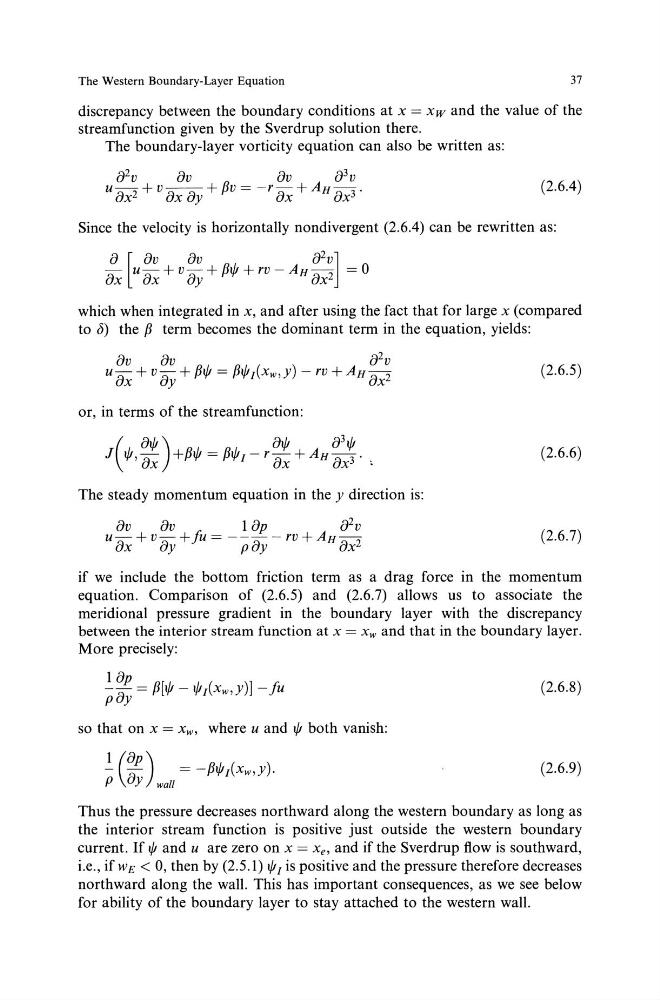
The boundary-layer vorticity equation can also be written as:
EPv
av
av
a 3 v
u ax2 + v ax ay + f3v = -r ax+ An ax3 •
(2.6.4)
Since the velocity is horizontally nondivergent (2.6.4) can be rewritten as:
a [ av
av
&v]
- u-+v-+f3t/J+rv-An- =0
ax ax
ay
ax 2
which when integrated in x, and after using the fact that for large x (compared
to £5) the f3 term becomes the dominant term in the equation, yields:
av
av
&v
u ax+ v ay + /31/1 = f3t/11(xw,Y)- rv +An ax2
(2.6.5)
or, in terms of the streamfunction:
(2.6.6)
The steady momentum equation in the y direction is:
av
av
1 ap
&v
u-+v-+fu= ----rv+Anax
ay
pay
ax 2
(2.6.7)
if we include the bottom friction term as a drag force in the momentum
equation. Comparison of (2.6.5) and (2.6.7) allows us to associate the
meridional pressure gradient in the boundary layer with the discrepancy
between the interior stream function at x = xw and that in the boundary layer.
More precisely:
(2.6.8)
so that on x = xw, where u and t/1 both vanish:
(2.6.9)
Thus the pressure decreases northward along the western boundary as long as
the interior stream function is positive just outside the western boundary
current. If t/1 and u are zero on x = Xe, and if the Sverdrup flow is southward,
i.e., if wE< 0, then by (2.5.1) t/1 1 is positive and the pressure therefore decreases
northward along the wall. This has important consequences, as we see below
for ability of the boundary layer to stay attached to the western wall.
37
discrepancy between the boundary conditions at x = xw and the value of the
streamfunction given by the Sverdrup solution there.
The boundary-layer vorticity equation can also be written as:
EPv
av
av
a 3 v
u ax2 + v ax ay + f3v = -r ax+ An ax3 •
(2.6.4)
Since the velocity is horizontally nondivergent (2.6.4) can be rewritten as:
a [ av
av
&v]
- u-+v-+f3t/J+rv-An- =0
ax ax
ay
ax 2
which when integrated in x, and after using the fact that for large x (compared
to £5) the f3 term becomes the dominant term in the equation, yields:
av
av
&v
u ax+ v ay + /31/1 = f3t/11(xw,Y)- rv +An ax2
(2.6.5)
or, in terms of the streamfunction:
(2.6.6)
The steady momentum equation in the y direction is:
av
av
1 ap
&v
u-+v-+fu= ----rv+Anax
ay
pay
ax 2
(2.6.7)
if we include the bottom friction term as a drag force in the momentum
equation. Comparison of (2.6.5) and (2.6.7) allows us to associate the
meridional pressure gradient in the boundary layer with the discrepancy
between the interior stream function at x = xw and that in the boundary layer.
More precisely:
(2.6.8)
so that on x = xw, where u and t/1 both vanish:
(2.6.9)
Thus the pressure decreases northward along the western boundary as long as
the interior stream function is positive just outside the western boundary
current. If t/1 and u are zero on x = Xe, and if the Sverdrup flow is southward,
i.e., if wE< 0, then by (2.5.1) t/1 1 is positive and the pressure therefore decreases
northward along the wall. This has important consequences, as we see below
for ability of the boundary layer to stay attached to the western wall.