

The Sverdrup Interior
35
(2.4.9)
or on a general boundary that:
(2.4.10)
where J is a unit vector in the y direction. This boundary condition is called
either superslip (when it applies only to the relative vorticity) or hypers/ip when
it is applied to the total vorticity (or its generalization to the potential vorticity
as defined in subsequent chapters).
Which of (2.4.5), (2.4.6), and (2.4.1 0) should we apply? It is very difficult to
say a priori. If the dissipation is small, i.e., if E « 1, does the choice make any
difference for the overall character of the circulation? The answer is, as we see
below, that the choice makes a great difference.
2.5 The Sverdrup Interior
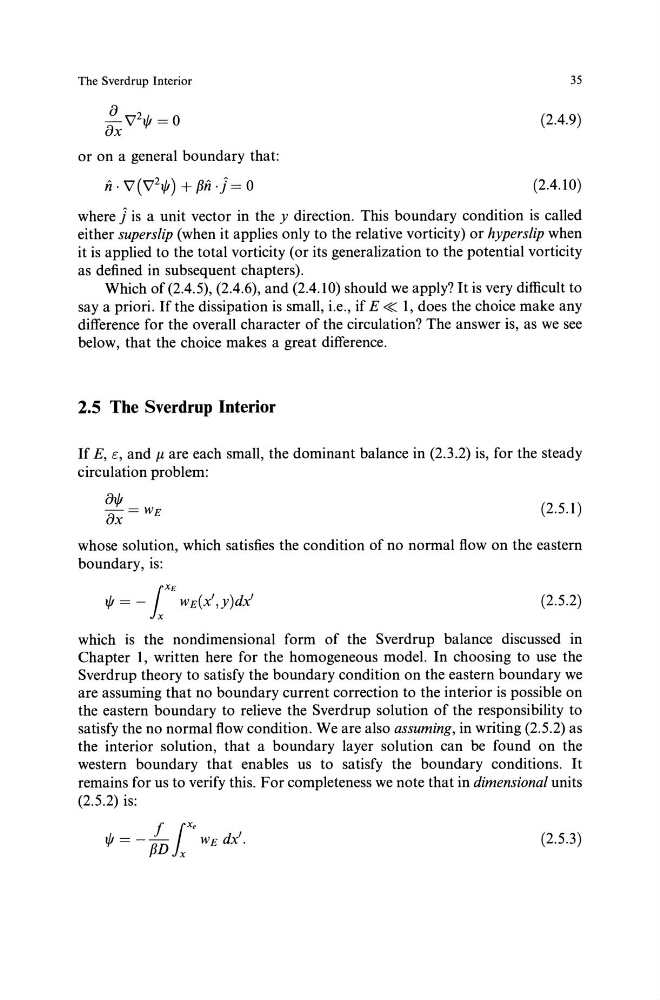
If E, E, and 11 are each small, the dominant balance in (2.3.2) is, for the steady
circulation problem:
at/1
-=WE
OX
(2.5.1)
whose solution, which satisfies the condition of no normal flow on the eastern
boundary, is:
t/1 = -1XE W£(X 1 ,y)dX 1
(2.5.2)
which is the nondimensional form of the Sverdrup balance discussed in
Chapter 1, written here for the homogeneous model. In choosing to use the
Sverdrup theory to satisfy the boundary condition on the eastern boundary we
are assuming that no boundary current correction to the interior is possible on
the eastern boundary to relieve the Sverdrup solution of the responsibility to
satisfy the no normal flow condition. We are also assuming, in writing (2.5.2) as
the interior solution, that a boundary layer solution can be found on the
western boundary that enables us to satisfy the boundary conditions. It
remains for us to verify this. For completeness we note that in dimensional units
(2.5.2) is:
f 1Xe I
t/J=-WEdX.
/3D X
(2.5.3)
35
(2.4.9)
or on a general boundary that:
(2.4.10)
where J is a unit vector in the y direction. This boundary condition is called
either superslip (when it applies only to the relative vorticity) or hypers/ip when
it is applied to the total vorticity (or its generalization to the potential vorticity
as defined in subsequent chapters).
Which of (2.4.5), (2.4.6), and (2.4.1 0) should we apply? It is very difficult to
say a priori. If the dissipation is small, i.e., if E « 1, does the choice make any
difference for the overall character of the circulation? The answer is, as we see
below, that the choice makes a great difference.
2.5 The Sverdrup Interior
If E, E, and 11 are each small, the dominant balance in (2.3.2) is, for the steady
circulation problem:
at/1
-=WE
OX
(2.5.1)
whose solution, which satisfies the condition of no normal flow on the eastern
boundary, is:
t/1 = -1XE W£(X 1 ,y)dX 1
(2.5.2)
which is the nondimensional form of the Sverdrup balance discussed in
Chapter 1, written here for the homogeneous model. In choosing to use the
Sverdrup theory to satisfy the boundary condition on the eastern boundary we
are assuming that no boundary current correction to the interior is possible on
the eastern boundary to relieve the Sverdrup solution of the responsibility to
satisfy the no normal flow condition. We are also assuming, in writing (2.5.2) as
the interior solution, that a boundary layer solution can be found on the
western boundary that enables us to satisfy the boundary conditions. It
remains for us to verify this. For completeness we note that in dimensional units
(2.5.2) is:
f 1Xe I
t/J=-WEdX.
/3D X
(2.5.3)